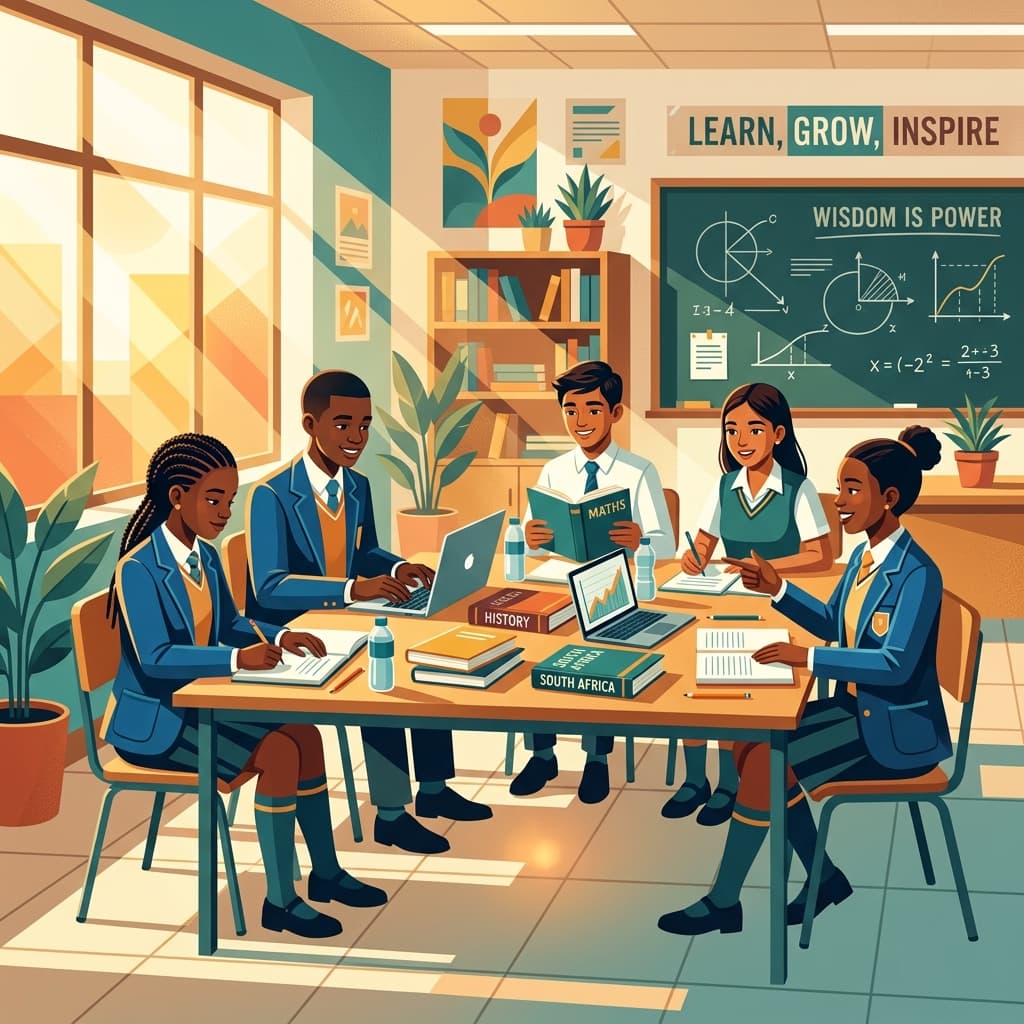
The Digital Revolution is Here: Why AI is Your New Classroom Assistant
For South African teachers, the classroom is a dynamic, often demanding space. From preparing engaging lessons aligned with the CAPS curriculum to managing diverse learning needs and providing meaningful feedback, our plates are consistently full. The idea of adding "learning AI" to that list might seem daunting, or even like another burden. But what if Artificial Intelligence wasn't just another tech trend, but a powerful, supportive tool designed to lighten your load and amplify your impact?
This guide is for you, the dedicated South African educator, whether you've never typed an AI prompt or you're curious about taking your first steps. We'll demystify AI, explore practical applications that resonate with our local context, and equip you to confidently integrate these tools into your teaching practice – all while keeping the CAPS curriculum at the forefront.
Understanding AI: Your Collaborative Partner, Not a Replacement
Let's start simply. When we talk about "AI" in the context of your classroom, we're not talking about robots taking over your job. We're referring to computer programs that can perform tasks that typically require human intelligence, such as understanding language, generating text, solving problems, and learning from data. Think of it as an incredibly efficient, knowledgeable, and tireless assistant who can help you with administrative tasks, brainstorming, and even differentiating instruction.
For us teachers, AI tools are essentially sophisticated pattern recognisers and generators. They don't think or feel in the human sense. Instead, they analyse vast amounts of information (like textbooks, articles, or past exam papers) and use that data to respond to your specific requests. Your expertise, your understanding of your students, and your pedagogical skills remain absolutely central. AI merely augments them.
The Transformative Power of AI in the South African Classroom
Why should a busy South African teacher consider integrating AI? The benefits stretch far beyond just saving time, though that's certainly a significant perk!
- Enhanced Efficiency and Time Savings: Imagine spending less time drafting communication, creating routine worksheets, or brainstorming lesson ideas. AI can handle these tasks quickly, freeing you to focus on the human elements of teaching: connection, mentorship, and deeper pedagogical reflection. For large class sizes often found in SA schools, this can be a game-changer.
- Personalised Learning Experiences: The CAPS curriculum emphasises addressing diverse learning needs. AI can help you generate varied explanations, different levels of complexity for assignments, or alternative learning resources for individual students, ensuring every learner, from the struggling to the gifted, gets the support they need.
- Boosted Student Engagement: AI can assist in creating interactive quizzes, unique scenarios for role-playing, or problem-solving challenges that captivate students' attention, making learning more dynamic and relevant.
- Professional Development and Resource Generation: AI can be a powerful research assistant, helping you find new teaching methodologies, summarise educational research, or even brainstorm ideas for your own professional growth.
- Consistency and Quality: While you remain the expert, AI can help ensure consistency in rubric creation, question formulation, or feedback frameworks, helping you maintain a high standard across all your teaching materials.
Practical AI Tools and Applications for Teachers (with CAPS Examples)
Let's get concrete. Here are practical ways you can start using AI tools in your teaching, with examples directly relevant to the CAPS curriculum.
Lesson Planning & Resource Creation
One of the most immediate benefits of AI for teachers is its ability to accelerate lesson planning and resource development. It's like having a co-planner and a content creator at your fingertips.
- Brainstorming Lesson Ideas:
- Prompt Example: "Brainstorm 5 engaging activities for a Grade 7 Natural Sciences lesson on 'Energy and Change' (CAPS specific content) that includes practical demonstrations and group work."
- AI Output: The AI might suggest building a simple circuit, exploring different energy conversions through household items, or creating a group poster explaining potential and kinetic energy.
- Developing Worksheets and Activities:
- Prompt Example: "Create 10 multiple-choice questions for a Grade 10 History lesson on 'The causes and consequences of the First World War' (CAPS content). Include 4 distractors for each question and ensure they cover different cognitive levels (recall, understanding, application)."
- AI Output: The AI can generate questions ranging from identifying key dates to analysing the impact of specific treaties.
- Crafting Rubrics and Assessment Criteria:
- Prompt Example: "Design a rubric for a Grade 6 English Home Language creative writing task focused on narrative writing, as per CAPS requirements for descriptive language, plot development, and characterisation. Include criteria for 'Excellent', 'Good', 'Developing', and 'Needs Support'."
- AI Output: A detailed rubric with specific indicators for each performance level, saving you hours of meticulous drafting.
- Generating Discussion Prompts:
- Prompt Example: "Generate 5 thought-provoking discussion questions for a Grade 11 Life Orientation class on 'Responsible Decision-Making' in the context of social media use for South African youth."
- AI Output: Questions that encourage critical thinking about online privacy, cyberbullying, and the impact of digital footprints, tailored to the local context.
- Creating 'Do Now' or Exit Ticket Questions:
- Prompt Example: "Provide 3 quick 'Do Now' questions for a Grade 8 Mathematics class revising 'Algebraic Expressions' (CAPS content) to assess prior knowledge."
- AI Output: Simple algebraic expression simplification, substitution, or identification questions.
Differentiated Instruction & Personalisation
Meeting the diverse needs of learners is a cornerstone of effective teaching, and AI can be an invaluable ally in this complex task.
- Adapting Content for Different Reading Levels:
- Prompt Example: "Rewrite this complex paragraph about 'Photosynthesis' (Grade 9 Natural Sciences CAPS) into two simpler versions: one for a student reading at a Grade 6 level and another for a Grade 4 level, retaining core concepts."
- AI Output: The same information presented with simpler vocabulary, shorter sentences, and perhaps analogies suitable for younger learners.
- Generating Remedial or Extension Activities:
- Prompt Example: "For a Grade 5 Social Sciences student struggling with 'Map Skills' (CAPS), suggest 3 hands-on remedial activities they can do at home with a parent. Also, provide 2 extension activities for an advanced student on the same topic."
- AI Output: Remedial ideas like drawing a map of their house, and extension ideas like researching different map projections and their uses.
- Creating Individualised Learning Paths:
- Prompt Example: "Based on a student's difficulty with 'fractions' in Grade 7 Mathematics, outline a step-by-step learning path focusing on conceptual understanding, including online resources (Khan Academy, local textbooks), practice problems, and a mini-assessment."
- AI Output: A structured pathway with recommended activities and resources.
- Providing Alternative Explanations:
- Prompt Example: "Explain the concept of 'Gross Domestic Product (GDP)' for a Grade 10 Economics student (CAPS) using a relatable analogy for a South African context, like a community market or a local business."
- AI Output: An explanation using examples of local vendors, production, and spending within a familiar South African setting.
Assessment & Feedback Support
Lesson Planner
Generate comprehensive, CAPS-aligned lesson plans in seconds.
While AI cannot replace your expert judgment, it can significantly streamline the administrative aspects of assessment and provide frameworks for effective feedback.
- Drafting Quiz Questions:
- Prompt Example: "Generate 5 short-answer questions for a Grade 12 isiXhosa First Additional Language comprehension test based on a provided text about 'South African heritage sites'. Ensure questions require more than simple recall."
- AI Output: Questions that ask students to infer, analyse, and evaluate information from the text.
- Developing Feedback Prompts:
- Prompt Example: "Create a template for constructive feedback on a Grade 9 Technology project focusing on 'Sustainable Energy Solutions' (CAPS). Include prompts for praising strengths, suggesting areas for improvement (e.g., feasibility, design), and encouraging critical thinking."
- AI Output: A structured feedback form that guides your comments and helps students understand where and how to improve.
- Summarising Student Responses (for qualitative assessment):
- Prompt Example: "Summarise the main themes and common misconceptions from these five Grade 11 Physical Sciences student explanations of 'Newton's Laws of Motion' (provide text inputs)."
- AI Output: A concise summary of recurring ideas and errors, helping you pinpoint areas for re-teaching.
Communication & Professional Development
Beyond the direct classroom, AI can support your broader professional responsibilities.
- Drafting Parent Communications:
- Prompt Example: "Write a polite email to parents of my Grade 4 class informing them about an upcoming school excursion to the local botanical gardens, requesting consent forms, and listing items students should bring. Include details about CAPS links to 'Life Skills' and 'Natural Sciences'."
- AI Output: A clear, concise, and professional email, saving you time on routine communication.
- Professional Research and Learning:
- Prompt Example: "Summarise recent educational research on effective strategies for teaching reading comprehension to English Second Language learners in a multicultural classroom context, relevant to South Africa."
- AI Output: Key findings and practical strategies distilled from research papers, helping you stay current with best practices.
- Reflecting on Teaching Practices:
- Prompt Example: "Given the challenge of motivating reluctant learners in Grade 9 Accounting (CAPS), brainstorm 3 innovative teaching strategies that incorporate real-world scenarios or gamification."
- AI Output: Fresh ideas to inject energy into your lessons.
Getting Started: A Step-by-Step Approach for South African Teachers
Feeling inspired but unsure where to begin? Here’s a pragmatic approach.
- Start Small, Start Specific: Don't try to overhaul your entire teaching methodology overnight. Identify one small, recurring task that consumes a lot of your time. Perhaps it's creating quizzes, or drafting parent emails.
- Choose One Accessible Tool: There are many AI tools available. Free options like ChatGPT (various versions), Google Bard, or Microsoft Copilot are excellent starting points. Experiment with one for a few weeks.
- Learn the Art of Prompt Engineering: This sounds complex, but it simply means learning how to ask AI good questions. Be clear, specific, and provide context.
- Bad Prompt: "Give me a lesson plan." (Too vague)
- Good Prompt: "Generate a detailed lesson plan for a 45-minute Grade 7 Creative Arts (Dance) lesson focusing on 'Traditional South African Dance Forms' (CAPS specific content). Include learning outcomes, materials needed, a step-by-step activity guide, and assessment ideas." (Specific, contextualised, detailed).
- Critique and Refine: AI output is a starting point, not a final product. Always review, edit, and adapt what AI generates to fit your students, your teaching style, and the precise requirements of the CAPS curriculum. Your human touch is indispensable.
- Embrace the Iterative Process: If the first output isn't quite right, adjust your prompt and try again. Think of it as a conversation with your assistant.
- Connect with Colleagues: Share your successes and challenges with fellow teachers. Learning from each other is powerful. Create a WhatsApp group or a staffroom discussion specifically for AI tips.
Addressing Challenges and Concerns
It's natural to have reservations. Let's tackle some common ones for the SA context.
- Connectivity and Access:
- Challenge: Many schools and homes in South Africa have limited or inconsistent internet access.
- Solution: Use AI strategically. Generate resources (worksheets, lesson plans, summaries) when you do have connectivity, then download and print them for offline use. AI can significantly reduce the time you spend creating these, even if the end product is physical. Explore "lite" versions of tools that consume less data.
- Time Constraints:
- Challenge: "I barely have time to breathe, let alone learn a new technology!"
- Solution: View AI as a time-saving investment. The initial learning curve is minimal for basic tasks. The minutes you spend learning to prompt effectively will pay back in hours saved on administrative tasks and resource creation.
- Skepticism and Fear of Replacement:
- Challenge: Some teachers worry AI will diminish their role or even replace them.
- Solution: AI is a tool, an assistant, not a replacement. It cannot replicate your empathy, your classroom management skills, your ability to inspire, or your deep understanding of a child's individual needs. It supports, enhances, and streamlines – it doesn't supersede. Our role as educators becomes even more vital as we teach students how to think critically and ethically in an AI-driven world.
Ethical Considerations & Responsible AI Use in Education
Integrating AI responsibly is paramount. As educators, we must model ethical use and teach our students to do the same.
- Plagiarism and Academic Integrity: This is a big one.
- Teacher Use: Always attribute sources if AI generates information you use directly from a specific text. Treat AI output as a draft that requires your verification and human editing.
- Student Use: Openly discuss with students what constitutes acceptable and unacceptable use of AI in assignments. Teach them that AI is a research aid or a brainstorming tool, but the final thought, synthesis, and writing must be their own. Emphasise that simply copying AI-generated text is plagiarism. Schools should develop clear policies on AI use.
- Data Privacy (POPIA Act): Be mindful of sharing sensitive student or personal information with AI tools. While many reputable AI services have strong privacy policies, err on the side of caution. Avoid entering names, grades, or personal details into public AI models.
- Bias in AI: AI models are trained on vast datasets, and if those datasets contain biases (e.g., gender, racial, cultural), the AI's output can reflect those biases.
- Teacher Role: Always critically evaluate AI-generated content. Does it reflect our diverse South African context accurately? Does it perpetuate stereotypes? Use your judgment to correct or refine biased outputs. Teach students to critically assess AI-generated information.
- Critical Thinking vs. Over-Reliance: The goal is to empower students, not to make them dependent on AI. Encourage them to question AI's answers, verify information, and use AI to deepen their understanding, not to bypass thinking. Frame AI as a powerful calculator for ideas, where the student is still the mathematician.
- Digital Citizenship: Integrating AI into the curriculum is an excellent opportunity to teach digital citizenship – responsible, ethical, and safe use of technology. This is directly aligned with the 'Life Skills' and 'Life Orientation' components of CAPS.
Future-Proofing Your Teaching and Your Students
By embracing AI, you're not just making your life easier; you're preparing yourself and your students for a future where AI fluency will be as crucial as digital literacy is today. You are modelling adaptation, critical thinking, and responsible innovation – skills that are absolutely invaluable for the next generation of South African leaders, thinkers, and innovators.
Your AI Journey Starts Now
The journey into using AI in education doesn't require a computer science degree or advanced technical skills. It requires curiosity, a willingness to experiment, and your innate pedagogical wisdom. Think of AI as an exciting new chapter in your teaching story, a chapter where efficiency, personalization, and innovation become more accessible than ever before.
Take that first step. Try generating a lesson idea for tomorrow's class, or rephrasing a complex concept for a struggling learner. You might just find that your new AI assistant becomes an indispensable part of your teaching toolkit, helping you to inspire, educate, and empower the young minds of South Africa with renewed energy and focus.
Siyanda. M
Dedicated to empowering South African teachers through modern AI strategies, research-backed pedagogy, and policy insights.