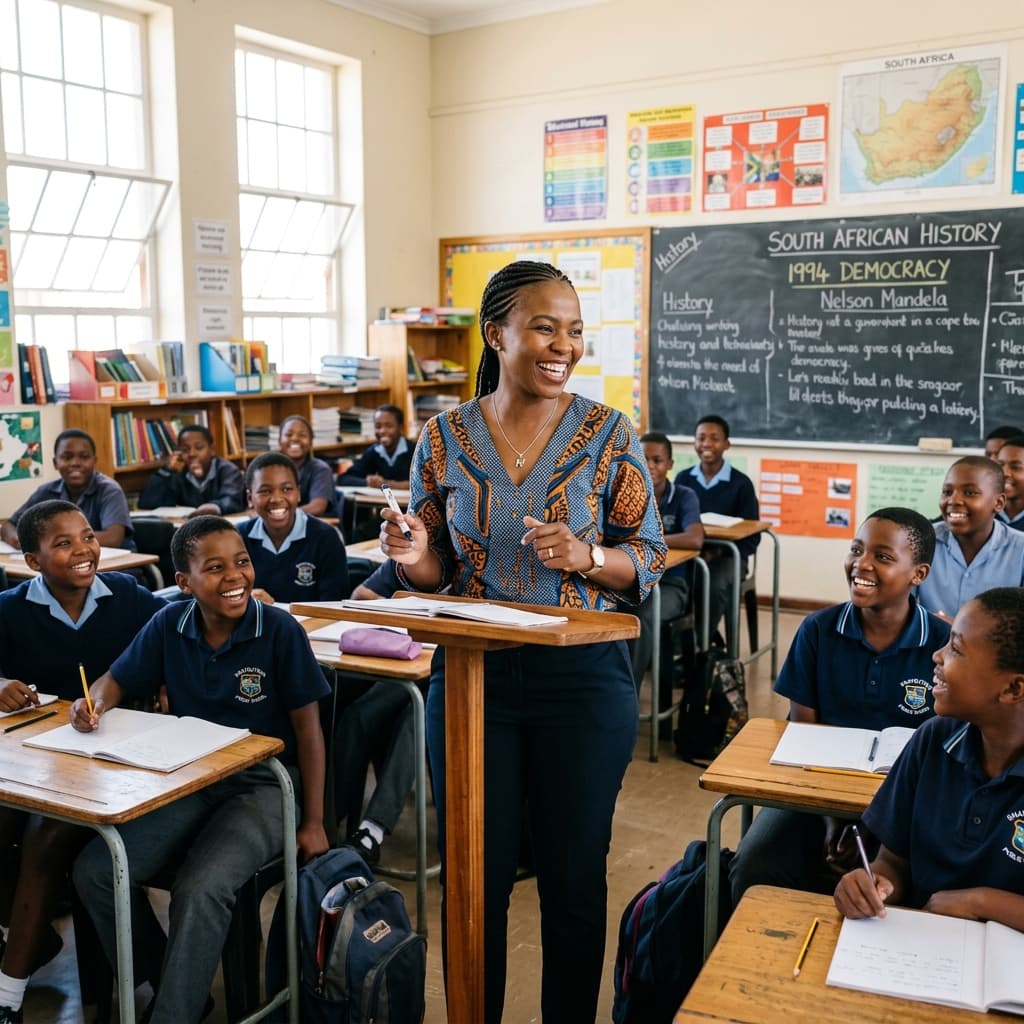
The Daily Reality of a Teacher in South Africa: Classroom Joys, Challenges, and Survival Strategies
I remember my first day standing at the front of a Grade 9 class. Forty-two learners. Three broken desks pushed against the wall. A chalkboard with half its paint peeled off. And a CAPS document in my hand that told me exactly what I needed to cover by the end of the week. Standing there, chalk-dusty and slightly terrified, I thought to myself: nobody told me about this part in varsity.
That was eleven years ago. Today I still feel that same mix of exhilaration and exhaustion. Being a teacher in South Africa is unlike any other teaching experience in the world. We operate within one of the most complex education systems on the planet — a country with eleven official languages, extreme socioeconomic inequality, crumbling infrastructure in some areas and world-class facilities in others, and a curriculum that changes just enough to keep us permanently on our toes. Yet every single school morning, we lock up our cars, walk through the school gate, and choose to show up.
This is the real story of what it means to be a teacher in South Africa.
The Morning Bell: Starting the Day in South African Schools
The alarm goes off at 05:30. Not because school starts at 07:30, but because I need that quiet hour before the chaos to read through my lesson plans, check my SBA deadlines against the ATP (Annual Teaching Plan), and perhaps respond to the parent WhatsApp group message I missed at 11 PM the night before.
Depending on where you teach in South Africa, mornings look very different. In leafy suburban Johannesburg, teachers arrive to smart boards, controlled temperatures, and classes of twenty-five well-rested learners. In Limpopo or the Eastern Cape, a colleague might drive forty kilometres on a dirt road to reach a school with no running water, where learners arrive hungry and barefoot, having walked from home since six in the morning.
Both teachers carry the same CAPS document. Both are expected to achieve the same outcomes. This is one of the defining tensions of being a teacher in South Africa: the system assumes equal starting points when the reality is anything but.
Before the first bell, there is the staffroom — the sacred sanctuary of South African educators. Tea, coffee, hurried conversations about which classes had assessments returned, who needs to moderate by Friday, and whether the deputy principal's new behaviour management system is going to last more than two weeks. The staffroom is where professional friendships are forged, crisis counselling happens informally, and where the collective resilience of the South African teaching profession is most visible.
The Administrator Burden: Beyond the Chalkboard
Nobody warned me about the paperwork. I thought teaching was about standing in front of learners and helping them understand the world. And it is — but it is also about filling in forms, updating spreadsheets, tracking SBA marks, completing moderation files, maintaining learner portfolios, writing intervention letters for struggling learners, and compiling HOD report-back summaries.
The CAPS curriculum is thorough, structured, and well-designed — but it comes with significant administrative demands. Every subject has an ATP that must be followed. Every assessment task must align with the School Assessment Policy. Every test must be pre-moderated by the Head of Department (HOD) before administration, and post-moderated after marking. Learner mark sheets must be maintained. SBA records must be kept for a minimum of three years.
For a single subject teacher handling five classes of forty-plus learners each, this means tracking upward of 200 individual learner records. It means maintaining a marking memorandum for every test and assignment, keeping a moderation checklist, and ensuring that cognitive levels (a balance of routine knowledge, application, and problem-solving) are correctly distributed.
The DBE (Department of Basic Education) introduced the Annual Teaching Plan to help teachers stay on track with content delivery. In theory, this is excellent — it removes the guesswork about pacing. In practice, disruptions are constant. Sports days, public holidays, civil action days, unexpected teacher absences, and community events mean that ATPs must be flexibly managed. Most experienced teachers in South Africa develop a kind of "ATP arithmetic" — figuring out which content can be compressed, which can be grouped with related topics, and when it is safe to push an assessment out by a week.
What this means practically is that the administrative life of a South African teacher extends well beyond the school day. Evenings, weekends, and school holidays all get absorbed by planning, marking, and record-keeping. The workload is not theoretical — it is real, it is heavy, and it is one of the primary reasons the country faces a growing teacher retention crisis.
The Reality of the Classroom: 45 Learners, One Teacher, Infinite Possibilities
Let us talk about the classroom itself, because this is where the real work happens.
A class of 45 learners in a township school in Soweto presents a set of challenges that cannot be managed using the pedagogical models designed for European or American classrooms. The noise level alone requires a different kind of energy management. Physical space is limited — desks touch each other, bags are piled in corners, and moving around the room requires a kind of choreographed navigation.
Within that same classroom, you will find learners operating across a broad spectrum of academic ability. Some are reading at a Grade 12 level. Others are functionally illiterate in English but deeply proficient in their home language. Some have learning support needs that have never been formally diagnosed because the school has no educational psychologist and the district assessment team is stretched across hundreds of schools.
The language question is one of the most complex realities facing any teacher in South Africa. Our constitution guarantees the right to learn in one's home language where reasonably possible. CAPS allows for mother-tongue instruction in the Foundation Phase (Grades R to 3). But from Grade 4 onwards, the vast majority of South African learners transition to English or Afrikaans as their Language of Learning and Teaching (LoLT) — even when that is not their first language.
This means that a mathematics teacher in Mpumalanga might be explaining algebra in English to thirty-five learners whose home language is Siswati or Zulu. A Physical Sciences teacher in KwaZulu-Natal explains Newton's Laws to learners who are simultaneously translating concepts in their heads. We code-switch constantly — dropping into isiZulu or Setswana to explain a difficult concept, then returning to English because the exam will be in English. This is not a failure of the system. It is a survival adaptation that South African teachers have developed because we understand our learners.
Surviving Load Shedding and Infrastructure Challenges
No article about being a teacher in South Africa in the 2020s would be complete without discussing load shedding. For several years, rolling power outages — sometimes lasting 8 to 10 hours a day — fundamentally disrupted classroom learning. Preparing digital lessons on the assumption that projectors and laptops would be available became a gamble every teacher had to take seriously.
I developed what I privately call my "Stage 4 Lesson Plan" — a version of every lesson that requires zero technology and zero electricity. Printed worksheets prepared in advance. Chalkboard diagrams drawn ahead of time. Group work activities that require only a piece of paper and learner discussion. When Stage 4 load shedding was announced the night before school, I did not have to panic. My Stage 4 Lesson Plan was ready.
Many South African teachers developed similar adaptations. We learned to download YouTube videos and save them offline using offline players. We learned to print resources in batches when electricity was available. We learned to move assessments from Monday mornings (often the worst time for power outages in residential areas) to mid-week where possible.
But load shedding was never just about the lights going off. It disrupted learner study time at home. It meant hot food could not be prepared for school nutrition programmes. It left vulnerable learners in dark homes with no means of completing evening homework. As teachers, we adjusted our homework expectations during high load shedding schedules and focused more on in-class consolidation.
The infrastructure challenges extend beyond electricity. Many South African schools lack reliable running water, have crumbling sanitation facilities, and operate from temporary or prefabricated structures. Internet connectivity in rural schools is often non-existent or unreliable. Yet teachers in these schools deliver curriculum with extraordinary creativity, using rivers as nature study classrooms, creating their own manipulatives from cardboard and recycled materials, and hosting informal study groups in community centres.
The Marking Marathon: SBA, Term Reports, and HOD Moderation
There are certain times in the school year that every South African teacher recognises with a mixture of dread and determination: assessment moderation weeks.
Under CAPS, School-Based Assessment (SBA) counts for a significant percentage of the final mark in most subjects. This means that the quality of our classroom assessments matters enormously for learner outcomes. Each task — whether a formal test, an assignment, a practical investigation, or a project — must be carefully designed, pre-moderated by the HOD, administered under controlled conditions, and post-moderated after marking.
For a teacher handling five classes, this means creating a test, writing the marking memorandum, submitting both to the HOD at least a week before administration, incorporating any HOD corrections, administering the test, marking up to 220 scripts, recording marks in the class mark sheet, completing a class analysis (showing the distribution of marks and identifying areas where learners generally struggled), submitting the marked scripts and analysis to the HOD for post-moderation, and filing everything in the SBA portfolio.
I am exhausted just typing that. And that is one task, for one subject, for one term.
The physical reality of marking is something that non-teachers genuinely cannot understand until they have sat at a kitchen table at 11 PM with a red pen, working through a stack of scripts while desperately trying to remain objective and consistent. Good marking is a skill — it requires you to understand the learner's reasoning even when their expression is imperfect, to reward partial understanding, and to remain fair across 200+ scripts despite fatigue.
Experienced South African teachers develop marking strategies. We use highlighters for common errors. We mark by question across all scripts rather than marking one script at a time — it is more consistent and faster. We create shorthand notation for the most common mistakes. We share the marking of large projects with a trusted colleague. These are not shortcuts — they are professional adaptations that preserve marking quality without destroying teacher wellness.
Practical Survival Strategies for South African Educators
After eleven years in the classroom, I have accumulated a set of survival strategies that I share with every new teacher who joins our staff. Some are logistical. Some are emotional. All of them are essential.
Plan at the right time. I plan my week on Sunday mornings, not Sunday evenings. Sunday evenings need to be protected as recovery time, not admin time. Sunday mornings, with coffee and a quiet house, are far more productive planning sessions.
Batch similar tasks. Respond to all parent messages at one scheduled time. Mark all scripts from one class before moving to the next. Create all your assessments for the term in one sitting during the holidays. Batching reduces the mental overhead of context-switching.
Build your toolkit. SA Teachers AI has genuinely transformed how I create lesson plans, worksheets, and examination papers. What used to take me four to five hours on a Sunday afternoon now takes me twenty minutes. I still personalise everything — I know my learners, I know what examples resonate in my community, and I know what language level to pitch my explanations at. But having a structured, CAPS-aligned starting point saves enormous time.
Protect the staffroom. Your colleagues are your primary support system. A school culture where teachers support each other — sharing resources, covering classes in emergencies, providing honest and non-judgmental feedback — is worth more than any professional development programme. Invest in these relationships.
Set boundaries with technology. Decide when you will and will not respond to school communications. Tell parents and learners these boundaries clearly and consistently. A teacher who is available 24/7 is not more dedicated — they are burning out faster.
Find your professional development path. SACE requires continuing professional development through the CPTD system. Rather than viewing this as a compliance burden, use it as an opportunity to grow in areas that genuinely interest you. A Geography teacher who becomes an expert in GIS technology adds value. A Life Sciences teacher who builds expertise in environmental assessment becomes indispensable.
Protect your mental health. Teaching in South Africa is emotionally demanding in ways that go beyond most professions. We are not merely subject matter experts — we are often called upon to be counsellors, social workers, parents, and mentors. Learning to hold space for learners' challenges without absorbing their trauma is a professional skill that takes deliberate cultivation.
Why We Stay
I want to end this article where it deserves to end: not with the paperwork or the broken desks or the load shedding, but with the reason that thousands of dedicated people choose to be a teacher in South Africa every single day.
I stayed because of Thabo, a Grade 10 learner who came to me in Maths tears at the beginning of Term 1 convinced he was too stupid for algebra. By the end of the year he was tutoring his classmates. I stayed because of the afternoon a Grade 12 class spontaneously started humming softly as they wrote their final SBA test — a kind of collective courage that moved me to tears in the passage outside. I stayed because when the lights went out one Tuesday afternoon during a Grade 8 Life Sciences lesson, we took the class outside and spent the next forty minutes discovering insect life in the school garden, and six learners told me afterwards it was the best lesson of their lives.
A teacher in South Africa carries extraordinary weight. We carry it through electricity outages and moderation crises and impossible administrative demands. We carry it through heartbreaking stories that follow us home and keep us awake. But we also carry the extraordinary privilege of being present at the moment a young person understands something that will change the course of their thinking — sometimes the course of their life.
That is why we stay. That is why, when the alarm goes off at 05:30, we get up, make the tea, check the ATP, and choose the classroom again.
Sipho Khumalo is a senior educator with eleven years of experience teaching in South African public schools. He advocates for educator wellness, CAPS curriculum navigation, and the responsible use of AI tools in education.
Sipho Khumalo
Dedicated to empowering South African teachers through modern AI strategies, research-backed pedagogy, and policy insights.