The Role of Information Technology in South African Education: A Digital Transformation
The dawn of the Fourth Industrial Revolution (4IR) has brought about significant shifts in paradigms globally, and South Africa is no exception. In the context of our unique educational landscape, Information Technology (IT) is no longer a luxury but a fundamental necessity. As we navigate the complexities of a post-pandemic world, the integration of digital tools in our classrooms is redefining how we teach, how learners acquire knowledge, and how we bridge the historical divides that have long plagued our system.
The Catalyst: Online Learning After COVID-19
The COVID-19 pandemic served as an unprecedented stress test for the South African education system. While it exposed deep-seated inequalities, it also acted as a rapid catalyst for digital adoption. Schools that had never considered virtual classrooms were suddenly forced to implement Zoom, Microsoft Teams, and WhatsApp for education.
This transition was far from seamless. However, the legacy of that period is a permanent shift in perspective. We now understand that learning can—and sometimes must—happen outside the four walls of a physical classroom. Hybrid learning models, combining face-to-face instruction with digital resources, are becoming the standard in proactive schools across Gauteng, the Western Cape, and beyond. This "blended" approach allows for greater flexibility, catering to different learning paces and styles that traditional methods often overlooked.
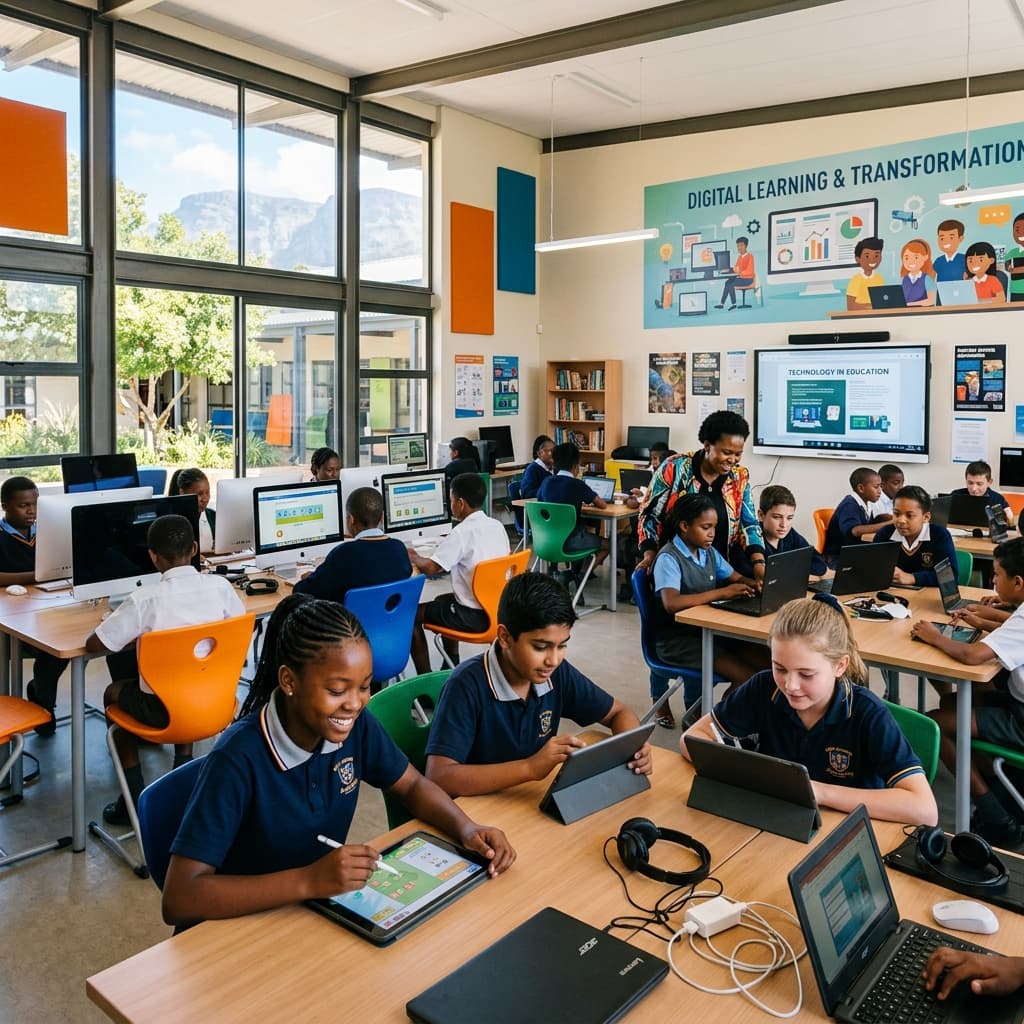
The Modern Digital Classroom
What does a digital classroom look like in 2026? It goes beyond just replacing paper with screens. A truly integrated digital environment utilizes technology to enhance engagement, collaboration, and critical thinking.
1. Interactive Whiteboards and Smart Boards
Gone are the days of dusty chalkboards. Modern South African classrooms are increasingly equipped with interactive whiteboards. These devices allow teachers to pull in real-time data, educational videos, and interactive simulations. For a Geography teacher, this might mean a 3D flyover of the Drakensberg mountains. For a Science teacher, it means virtual chemistry experiments that would otherwise be too dangerous or expensive to conduct in a school lab.
2. Tablets and E-Books
The weight of physical textbooks is being replaced by the vast capacity of tablets. Devices like iPads and Android tablets provide learners with access to thousands of resources at their fingertips. More importantly, e-books in South Africa are now being designed with interactive elements—quizzes that provide instant feedback and embedded videos that explain complex concepts in the learner's home language.
3. Learning Management Systems (LMS)
Platforms like Moodle, Google Classroom, and our own SA Teachers tools are streamlining administrative tasks. Teachers can distribute assignments, grade work, and track learner progress in a centralized location. This data-driven approach allows for early intervention when a learner is struggling, ensuring that no child falls through the cracks.
Empowering Rural Schools: Bridging the Divide
Perhaps the most significant impact of IT is its potential to bring high-quality education to rural and marginalized areas. In many parts of South Africa, rural schools struggle with a lack of physical resources and a shortage of specialist teachers. Technology offers a solution to these systemic challenges.
Lesson Planner
Generate comprehensive, CAPS-aligned lesson plans in seconds.
Remote Access to Specialist Educators
Through video conferencing and recorded lessons, a learner in a remote village in Limpopo can receive instruction from a top-tier Mathematics teacher based in Johannesburg. This democratization of expertise is crucial for improving Matric results in areas where specialized knowledge is scarce.
Mobile Learning and Offline Capabilities
Recognizing that constant internet access is still a challenge, many educational platforms are developing "offline-first" capabilities. Learners can download content when they have access to a Wi-Fi hotspot (at a library or a community center) and then study on their devices at home without needing data. This approach is vital for ensuring that the digital revolution includes everyone, not just those with high-speed fiber at home.
The Teacher's Evolving Role
There is a common misconception that IT will replace teachers. On the contrary, technology makes the teacher's role more important than ever. In a world where information is abundant, the teacher evolves from a "transmitter of facts" to a "facilitator of learning."
Teachers are now mentors, guiding learners on how to verify information, how to think critically about data, and how to use digital tools ethically. Our tools at SA Teachers are designed specifically to support this evolution—automating the repetitive tasks of lesson planning and exam generation so that educators can focus on what they do best: inspiring and mentoring their students.
Challenges to Implementation
Despite the clear benefits, we must remain realistic about the hurdles. Load shedding continues to be a significant barrier to consistent digital learning. Schools require robust backup power solutions, such as solar panels and inverters, to maintain their digital infrastructure.
Furthermore, teacher training is paramount. Providing a tablet to every learner is useless if the teacher hasn't been trained on how to integrate that device into their pedagogy. Continuous professional development (CPD) focusing on ICT integration is non-negotiable for the success of South Africa's digital transformation.
Looking Ahead: The Future is Bright
As we look toward the future, the integration of Information Technology in South African education holds immense promise. We are moving toward a system that is more inclusive, more engaging, and more aligned with the needs of the global economy.
By investing in infrastructure, prioritizing teacher training, and supporting innovative local platforms, we can ensure that every South African learner is equipped with the skills they need to thrive in the digital age. The journey is long and the challenges are many, but the potential for positive change is limitless.
Trust Molai is the Founder of SA Teachers and a leading voice in South African educational technology. He is committed to creating tools that empower educators and bridge the digital divide.
Trust Molai
Founder of SA Teachers. Passionate about educational technology, programming, and empowering the next generation of South African learners.