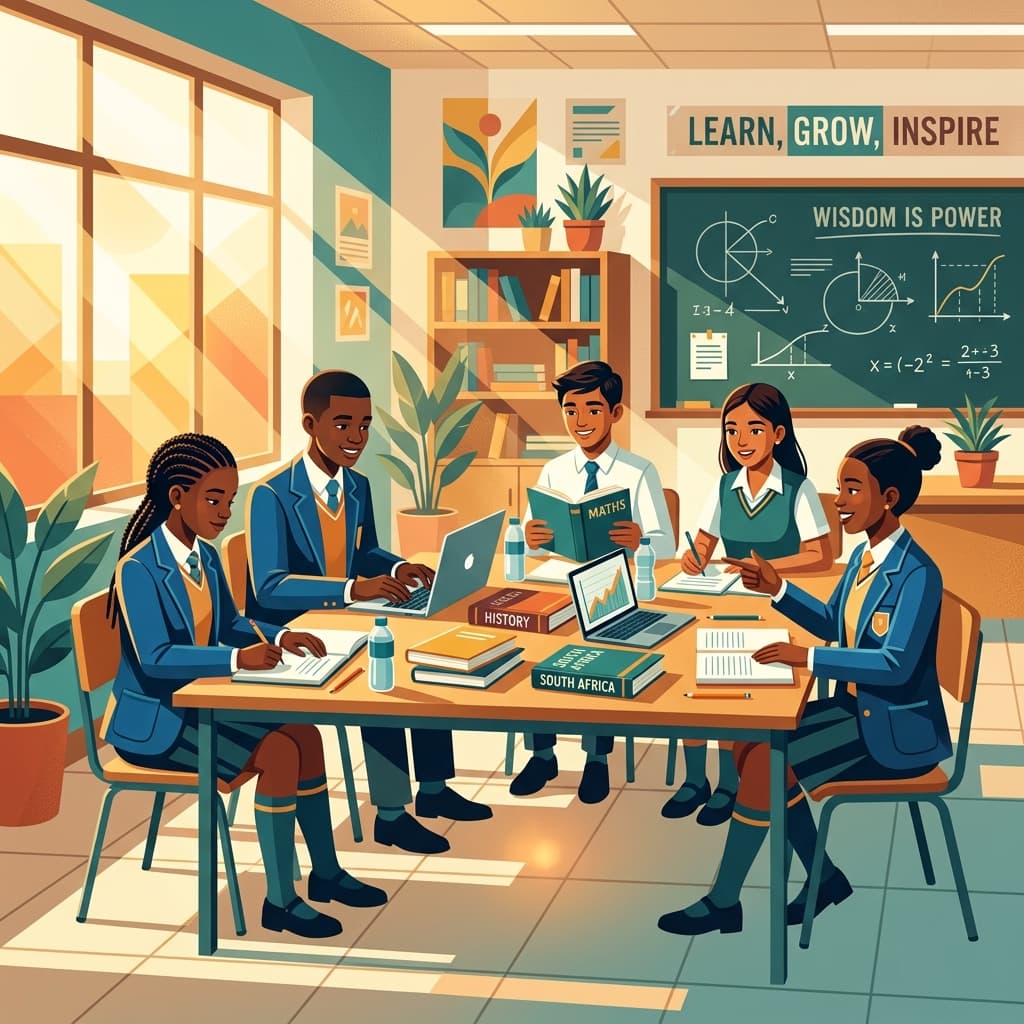
The Strategic Imperative for Visual Learning
In the South African educational landscape, our School Management Teams (SMTs) face a unique set of challenges. We navigate the complexities of multi-grade classrooms, significant language barriers where English is often a First Additional Language (FAL) for the majority, and the ever-present pressure of delivering the Curriculum and Assessment Policy Statement (CAPS) under tight timelines.
In this context, visual learning is not merely an "add-on" or a way to make classrooms look "pretty." It is a vital cognitive bridge. From a leadership perspective, promoting visual learning is a strategic move to improve literacy, enhance retention, and democratize access to complex information. When we talk about visual learning today, we are talking about Visual Literacy—a core competency required by the Department of Basic Education (DBE) across various subjects, from the analysis of cartoons in English Paper 1 to interpreting topographical maps in Geography.
As leaders, our role is to move visual learning from a peripheral teaching tip to a central pillar of our school’s pedagogical identity.
Understanding the South African Context: The Language Bridge
One of the most profound arguments for visual learning in South Africa is its ability to mitigate the "Language of Learning and Teaching" (LoLT) gap. Many of our learners transition from their mother tongue to English in Grade 4—a transition that often sees a dip in academic performance.
Visuals—be they infographics, flowcharts, or icons—serve as a universal language. They provide a "scaffold" that allows a learner to grasp a concept (the what) before they have fully mastered the technical English terminology (the how). For an HOD or Principal, ensuring that teachers use visual anchors means we are actively supporting inclusivity and reducing the cognitive load on our learners.
Strategic Pillar 1: Implementing School-Wide Graphic Organisers
From a management standpoint, consistency is key. If a learner encounters a "Mind Map" in Life Sciences, a "Fishbone Diagram" in History, and a "Venn Diagram" in English, their brain starts to recognize these patterns as tools for processing information.
Standardising the Visual Toolkit
I recommend that SMTs adopt a "School-Wide Visual Toolkit." Instead of every teacher using different styles, agree on 4-5 core graphic organisers that will be used across all grades:
- The Frayer Model: For vocabulary building (essential for CAPS technical terms).
- Flow Charts: For processes in Natural Sciences and chronological events in History.
- Concept Maps: For showing relationships between complex ideas.
- T-Charts: For comparative analysis in Business Studies or Economics.
By standardising these, we reduce the "instructional friction." The learner no longer has to learn how to use the tool; they can focus immediately on the content.
Strategic Pillar 2: The "Third Teacher" Concept
In educational philosophy, the environment is often called the "third teacher." In many of our quintile 1-3 schools, resources are scarce. However, the walls of a classroom are free real estate.
Moving Beyond "Wallpaper"
As leaders, we must audit our classrooms. Are the posters on the walls relevant to the current CAPS term? Or is it "educational wallpaper"—posters that have been there since 2018, faded and ignored?
Strategic visual learning requires Active Walls. This means:
- Word Walls: High-frequency CAPS terms updated per module.
- Anchor Charts: Hand-drawn charts created with students during a lesson, rather than pre-bought posters. This creates a sense of ownership.
- Success Criteria Visuals: Visual rubrics that show a learner what a "Level 7" essay looks like versus a "Level 3" essay.
Strategic Pillar 3: Visual Literacy and the Digital Divide
We cannot discuss visual learning without addressing the digital divide. While some independent schools in Gauteng or the Western Cape have smartboards and 1:1 iPad ratios, many of our schools struggle with basic electricity and data costs.
Low-Tech, High-Impact Solutions
School leaders should encourage "Low-Tech Visuals" that do not rely on the grid:
- The Power of the Manilla Folder: Encourage teachers to create "lapbooks" or foldable organisers.
- Data-Free Visuals: Use WhatsApp groups (often zero-rated or low-cost) to send infographics or short summary images to parents and learners.
- Picture Studies: Using local newspapers or magazines to find visual stimuli for Creative Writing or Social Sciences.
For schools with some tech, the focus should be on Data-Light visuals. Instead of 40-slide PowerPoints (which are often just "text on a screen"), train staff on using tools like Canva to create single-page high-impact infographics that can be printed or shared via a school's management system.
Strategic Pillar 4: Modeling Visual Thinking in Management
If we want teachers to use visual learning, the SMT must lead by example. Our staff meetings and briefings are often "death by memo."
Lesson Planner
Generate comprehensive, CAPS-aligned lesson plans in seconds.
Visual Leadership Strategies
- Visual Data Walls: In the staffroom, maintain a visual representation of the school’s academic progress. Use colour-coded graphs to show attendance or pass rates. When teachers see the SMT using visuals to simplify complex school data, they are more likely to adopt the practice in their classrooms.
- Sketchnoting in PD: During Professional Development (CPTD) sessions, encourage teachers to "sketchnote" their learnings. This involves using doodles, arrows, and frames to take notes. It’s a powerful way to increase the retention of new pedagogical theories.
Addressing the Challenges: Time and "The Syllabus"
The most common pushback from teachers regarding visual learning is: "I don't have time; I have to finish the syllabus."
As leaders, we must reframe this. Visual learning is not a detour; it is a shortcut. A well-constructed diagram of the water cycle can save three periods of rote-reading from a textbook.
Practical Time-Savers for Staff
- Shared Resource Drive: Create a central digital or physical repository where teachers can share their best visual aids.
- Collaborative Planning: Encourage the English and Social Sciences HODs to plan together. If the English department is teaching "Visual Literacy" (cartoons/ads), can they use historical South African advertisements? This creates a visual "cross-pollination" that saves time and reinforces learning.
Cognitive Load and the CAPS Reality
We must be mindful of "Visual Overload." Research suggests that too many visuals can actually hinder learning. For our learners, especially those with neurodivergent needs (ADHD or Autism), a cluttered classroom can be a barrier.
Our strategy should be "Purposeful Visuals." Every visual must serve one of three purposes:
- Organizational: Helping the learner see the structure of the lesson.
- Interpretive: Helping the learner understand a difficult concept.
- Transformative: Helping the learner create something new (e.g., drawing their own diagram).
Case Study: Visual Learning in the Foundation Phase vs. FET
The application of this strategy changes as we move through the phases:
- Foundation Phase: Visuals are often concrete. Using "Manipulatives" in Mathematics (DBE workbooks are excellent at this) ensures that the abstract concept of "number" is grounded in visual reality.
- FET Phase (Grade 10-12): Visuals become more abstract and analytical. In Accounting, it’s the "T-Account." In Physics, it’s the "Vector Diagram." As leaders, we need to ensure our Grade 12 teachers are using visual scaffolding to tackle the "High Order" (Level 3 and 4) questions in the NSC examinations.
Monitoring and Evaluation: The HOD’s Role
How do we know if our visual learning strategy is working? It shouldn't be measured by how many posters are on the wall, but by the quality of the learners' notebooks.
The Notebook Audit
During work moderation, HODs should look for:
- Are there student-generated drawings or diagrams?
- Are graphic organisers used to summarise chapters?
- Is colour used strategically to highlight key concepts?
If a learner’s book is just a wall of copied text, we have failed to implement a visual learning strategy. We are merely training scribes, not thinkers.
Budgeting for Visuals: A Management Perspective
In the SGB (School Governing Body) budget meetings, visual learning needs its own line item. This isn't just about "stationery." It’s about:
- Laminating pouches: To make visual aids durable for years of use.
- Coloured markers and chart paper: Essential for anchor charts.
- Projector maintenance: Ensuring that the schools that have tech can actually use it (bulb replacements, etc.).
- Professional Development: Bringing in experts to train staff on visual literacy.
Conclusion: A Vision for the Future
In South Africa, our education system is often criticized for being too focused on rote memorization. By championing visual learning, School Management Teams can lead a shift toward deep conceptual understanding.
Visual learning levels the playing field. It speaks to the child in rural Limpopo just as effectively as the child in a suburban school in Cape Town. It transcends language, simplifies the complex CAPS curriculum, and prepares our learners for a 21st-century world that is increasingly visual.
As school leaders, let us move beyond the chalkboard. Let us create "Visible Classrooms" where every learner can see their way to success.
Action Steps for the Next 30 Days:
- Week 1: Conduct a "Visual Audit" of three classrooms. Note what is on the walls and how it relates to the current week's CAPS ATP (Annual Teaching Plan).
- Week 2: Introduce one standard graphic organiser (e.g., The Frayer Model) in a staff meeting and demonstrate its use.
- Week 3: Allocate a small portion of the LTSM (Learner Teacher Support Material) budget specifically for "Visual Classroom Tools."
- Week 4: Share a "Success Story" in the staff briefing of a teacher who used a visual aid to help learners master a difficult concept.
Siyanda M.
Dedicated to empowering South African teachers through modern AI strategies, research-backed pedagogy, and policy insights.