The Paperwork Pandemic: A Crisis in South African Classrooms
In the current landscape of South African education, a silent crisis is unfolding behind the stacks of marking and the endless columns of the South African School Administration and Management System (SA-SAMS). While the Curriculum and Assessment Policy Statement (CAPS) was designed to provide structure and uniformity across our diverse provinces, it has inadvertently birthed an administrative behemoth that threatens to consume our most valuable resource: teacher time.
As School Management Teams (SMTs), we often hear the refrain: "I didn’t become a teacher to be a data capturer." This is more than a grievance; it is a systemic warning. When a quintile 5 teacher in Johannesburg or a quintile 1 educator in a rural village in the Eastern Cape spends 40% of their week on compliance-related paperwork, the quality of instruction inevitably suffers.
To improve learner outcomes, we must first address the "paperwork pandemic." This requires a shift from a culture of compliance to a culture of professional trust and strategic efficiency. Reducing paperwork is not about lowering standards; it is about eliminating the "performative admin" that adds no value to the learner's journey.
Reimagining Lesson Planning: Moving Beyond the File
One of the heaviest administrative burdens in South Africa is the traditional lesson plan file. Many HODs (Heads of Department) still insist on handwritten, exhaustive daily plans that often mirror the Annual Teaching Plans (ATPs) provided by the Department of Basic Education (DBE).
Transitioning to Digital Repositories
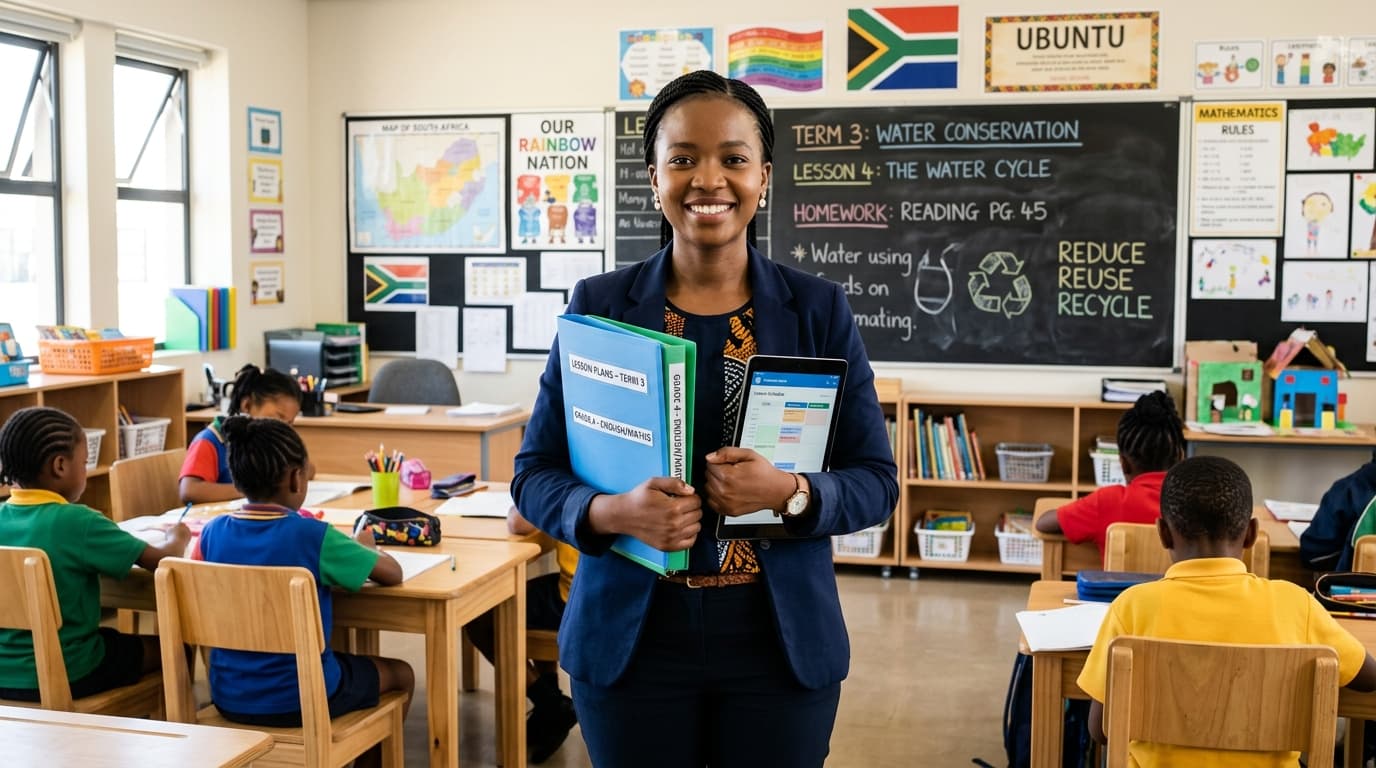
The first strategic move for any South African school leader is to digitize the planning process. Instead of physical files, schools should utilize platforms like Google Workspace for Education or Microsoft Teams.
By creating a centralized school-wide digital repository, teachers can collaborate on lesson plans. Why should four different Grade 9 Mathematics teachers draft four separate lesson plans for "Algebraic Expressions"? By allowing a team-based approach where educators share a living document, we reduce the individual workload by 75%. From a management perspective, HODs can monitor progress in real-time through shared folders, eliminating the need for the "weekly file submission" ritual.
Prioritizing the 'What' Over the 'How Much'
SMTs must empower teachers to focus on "backwards design" rather than narrative descriptions of their teaching. If the DBE’s ATP already outlines the content, the teacher's planning should focus on the differentiation strategy and the assessment for learning. We should move away from requiring teachers to rewrite CAPS outcomes by hand—a redundant task that serves no pedagogical purpose.
Streamlining School-Based Assessment (SBA)
Assessment is the heartbeat of the South African curriculum, but the marking and recording cycle is where most educators burn out. The pressure of formal assessments, combined with the necessity of "informal" evidence, creates a mountain of paper.
Strategic Rubric Design
To reduce marking time, schools should invest time in "The Big Rubric" strategy. Instead of creating a unique rubric for every task, departments should develop standardized, high-quality rubrics for specific genres of work (e.g., a standard essay rubric, a standard scientific report rubric). These can be printed in bulk or used digitally. This consistency not only helps the teacher mark faster but also helps the learner understand expectations across the year.
The Power of Comparative Judgment and Peer Feedback
Not every piece of work needs a teacher’s red pen. SMTs should encourage the use of peer-assessment and self-assessment for informal tasks. This is not "lazy teaching"; it is a critical meta-cognitive skill. By reducing the volume of informal marking, teachers have more cognitive energy for the high-stakes formal assessments that determine a learner’s progression.
Automated Marking for the Digital Age
For schools with access to basic ICT, using tools like Google Forms (with the 'Quiz' feature) or platforms like Socrative can handle the marking of multiple-choice and short-answer questions instantaneously. This data can then be exported directly into a spreadsheet, ready for SA-SAMS, bypassing the manual entry phase entirely.
Optimizing SA-SAMS and Data Management
SA-SAMS is a non-negotiable reality in the South African context. However, the way many schools interact with it is inefficient. Often, data is recorded on paper, then transferred to a personal spreadsheet, and finally typed into SA-SAMS by an admin clerk or the teacher themselves.
The "Single Entry" Principle
Leadership must enforce a "single entry" policy. Data should be captured once, and once only. If a teacher uses a digital markbook, it should be designed to export directly into a format that SA-SAMS can import. Schools should move away from the "mark sheet to mark sheet" relay race.
Lesson Planner
Generate comprehensive, CAPS-aligned lesson plans in seconds.
Investing in Dedicated Data Support
Where the budget allows, SMTs should look at appointing or designating a "Data Champion." This individual isn't just an admin clerk; they are a bridge between the pedagogical data and the departmental requirements. By streamlining the flow of information from the classroom to the district office, we prevent the "emergency admin" sessions that often derail end-of-term marking periods.
Reforming the Culture of Meetings and Minutes
In many South African schools, the staff meeting is a source of significant paperwork: agendas, minutes, attendance registers, and follow-up memos.
The "Stand-Up" Briefing vs. The Plenary
Shift daily administrative updates to a digital bulletin or a brief 10-minute "stand-up" meeting. Use formal staff meetings only for Professional Learning Communities (PLCs) and strategic development.
Moving Minutes to the Cloud
Instead of printing and filing minutes of every departmental meeting, use a shared digital log. This ensures that action items are transparent and accessible to the SMT without the need for physical "monitoring and oversight" signatures at every turn. In the context of IQMS (Integrated Quality Management System), digital evidence of collaboration is just as valid—and far more functional—than a dusty lever-arch file.
Navigating Local Challenges: Load Shedding and the Digital Divide
A uniquely South African strategy for reducing paperwork must account for our infrastructure challenges. We cannot suggest a 100% digital solution when load shedding can disconnect a school for hours, or when rural schools lack consistent internet.
The "Hybrid" Efficiency Model
In resource-constrained environments, reduction is about simplification.
- Consolidated Registers: Instead of five different registers for various activities, create a single "Master Tracking Sheet" for each learner.
- Template Standardization: The SMT should provide pre-printed, streamlined templates for common tasks like incident reports or parent-teacher interventions. This prevents teachers from having to "reinvent the wheel" or write long-form narratives for routine events.
- Offline-First Digital Tools: Encourage the use of apps that work offline and sync when data is available. This ensures that the administrative workflow isn't halted by the national grid.
Leadership’s Role: The "Admin Audit"
The most effective way a South African Principal or Deputy Principal can reduce paperwork is to conduct an Administrative Audit. Ask the following three questions of every document required in the school:
- Who is this for? (Is it for the learner, the teacher, or the District?)
- What happens if we don’t do it? (Is it a legal requirement under the South African Schools Act, or just "the way we’ve always done it"?)
- Can this be automated or combined?
Often, schools continue to produce paperwork that the District no longer requires, simply because of "policy inertia." As leaders, it is our job to filter the demands coming from the Department and protect our staff from redundant requests. We must be the "Buffer" that allows teachers to teach.
Professional Trust: The Ultimate Time-Saver
Perhaps the most radical way to reduce paperwork in South Africa is to restore professional trust. The current system is built on "monitoring"—the idea that if it isn't on paper, it didn't happen.
As school leaders, we must move toward "output-based management." If a teacher’s learners are engaged, their assessments are fair, and their results are consistent, do we really need to check their lesson plan every Friday? By granting autonomy to high-performing, experienced educators, we reduce their admin burden and free up SMT time to support those who are actually struggling.
Conclusion: A Call to Action for SMTs
The South African education system is under pressure, and the temptation for management is often to tighten control through more paperwork. However, the evidence suggests that this only leads to burnout and a "box-ticking" mentality that hollows out the profession.
By digitizing where possible, streamlining assessments, optimizing our use of SA-SAMS, and fostering a culture of professional trust, we can strip away the layers of bureaucracy that stifle our schools. Our goal should be a South Africa where the most significant thing a teacher carries home is not a crate of files, but the satisfaction of a day spent truly connecting with their learners.
Reducing paperwork is not a luxury; it is a strategic imperative for the survival and success of our education system. Let us choose to lead with efficiency and empathy, ensuring that our teachers have the "time to teach" that our children so desperately deserve.
Siyanda M.
Dedicated to empowering South African teachers through modern AI strategies, research-backed pedagogy, and policy insights.