The Myth of the High-Budget Classroom
In the staffrooms of South Africa, from the windswept hills of the Eastern Cape to the bustling suburbs of Gauteng, a common narrative persists: "If only we had the budget, we could deliver quality education." There is an understandable envy directed toward "Quintile 5" schools with their interactive whiteboards, high-speed fiber, and 3D printing labs. However, as School Management Teams (SMTs), we must challenge the dangerous assumption that expensive resources are the primary driver of learner success.
The reality of the South African context—marked by the Curriculum and Assessment Policy Statement (CAPS) and a stark digital divide—demands a different kind of leadership. Confidence in the classroom does not stem from the presence of a smartboard; it stems from pedagogical mastery, cultural relevance, and the strategic use of what is already at hand. As leaders, our task is to transition our staff from a "scarcity mindset" to a "resourceful mindset."
Redefining 'Resources' in the South African Context
To teach confidently without high-end equipment, we must first redefine what a "resource" actually is. In a professional management strategy, we categorize resources into three tiers:
- Human Capital: The lived experience, subject knowledge, and passion of the educator.
- Environmental Capital: The local community, the school grounds, and the "living laboratory" of the South African landscape.
- Low-Cost Tangibles: Recycled materials, open-source printed materials, and the ingenious repurposing of everyday objects.
When a teacher realizes that their greatest tool is their own ability to facilitate a connection between the learner and the CAPS content, the lack of a tablet becomes a secondary concern.
The SMT Strategy: Cultivating Pedagogical Mastery
Confidence is the byproduct of competence. If a teacher is struggling to understand the cognitive levels required by a CAPS Life Sciences or Mathematics assessment, no amount of expensive software will help them.
Prioritizing Pedagogical Content Knowledge (PCK)
School leaders must invest time in Professional Learning Communities (PLCs). Instead of using staff meetings for administrative announcements, use them for "Pedagogy Swaps." In these sessions, teachers demonstrate how they teach a difficult concept using only a chalkboard and a piece of string. When an HOD (Head of Department) praises a teacher for a creative, low-cost solution, they are signaling that "resourcefulness" is a valued institutional trait.
Scaffolding the CAPS Framework
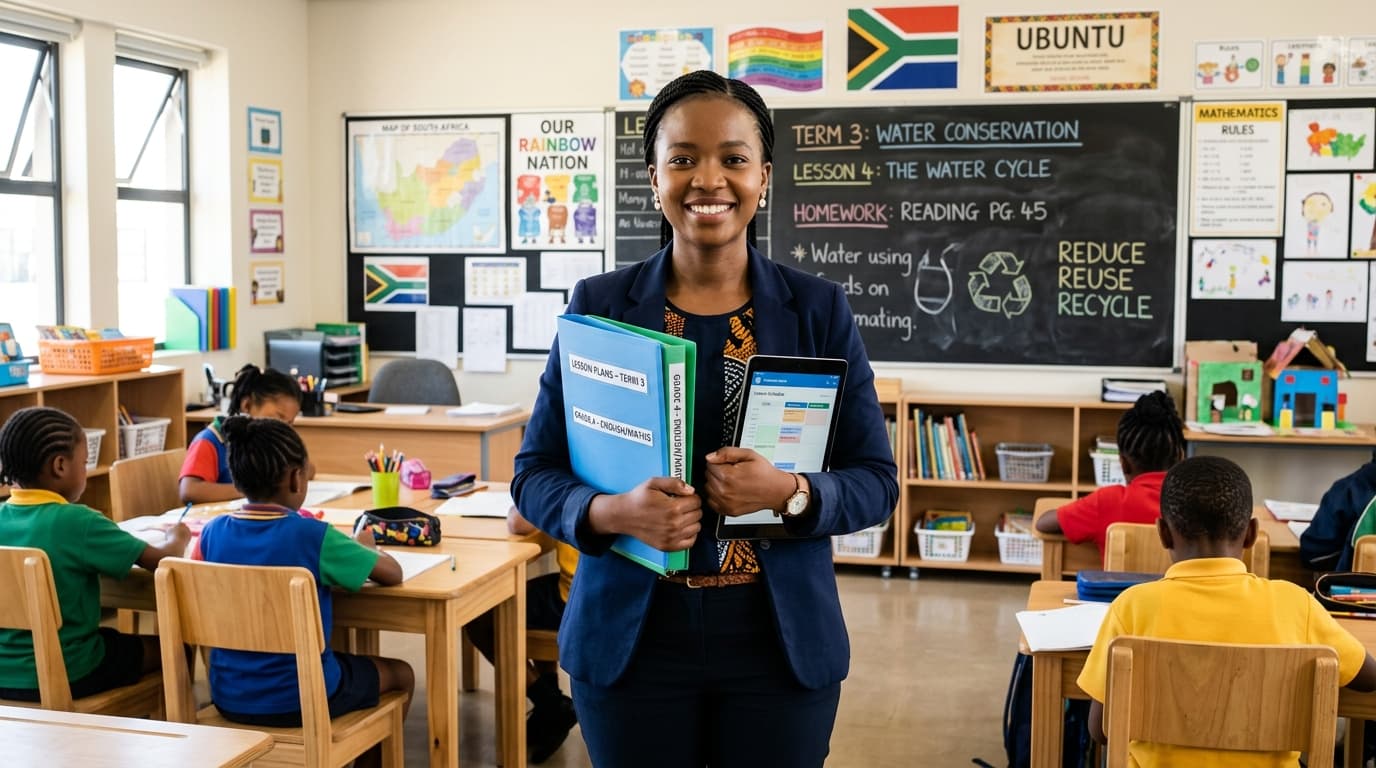
The CAPS document is often viewed as a rigid burden. However, confident leaders teach their staff to use it as a skeletal structure upon which they can build creatively. Teaching the "Water Cycle" doesn't require a digital simulation. It requires a plastic bag, a rubber band, and a sunny window in the classroom. By mastery of the intent of the curriculum, teachers can strip away the need for expensive "props" and focus on the core cognitive tasks.
The Power of the 'Living Laboratory'
In South Africa, we are surrounded by rich educational stimuli that cost nothing. A leadership strategy for confident teaching should encourage "Outdoor Classroom" days.
Geography and Environmental Studies
Why look at a grainy photo of soil erosion in a textbook when there is a donga fifty meters from the school gate? Teaching learners to observe, measure, and analyze their immediate environment fosters a level of engagement that no YouTube video can replicate. This is "Place-Based Education," and it is free.
Mathematics in the Real World
Geometry is present in the architecture of the local mall or the patterns in traditional beadwork. Ratios and percentages can be taught by analyzing the prices at a local "spaza" shop. When leaders encourage teachers to bring the real world into the classroom—or take the classroom into the world—they remove the financial barrier to high-level conceptual thinking.
Overcoming the 'Digital Divide' with Analogue Innovation
While we advocate for ICT integration in South African schools, we cannot allow the absence of it to paralyze our teaching. Confident teaching in a low-resource setting involves "Analogue Innovation."
Lesson Planner
Generate comprehensive, CAPS-aligned lesson plans in seconds.
The "Trash to Treasure" Inventory
Every school should have a centralized "Resource Bank" of recycled materials. Egg cartons become counters for Foundation Phase numeracy. Old newspapers become the basis for language analysis (identifying adjectives, nouns, or bias in reporting). Plastic bottles become the apparatus for Physics experiments.
As a management strategy, formalize this. Create a "Innovation Hub" where these items are organized. When a teacher sees a neatly curated collection of "junk," they stop seeing it as trash and start seeing it as a toolkit.
Peer-to-Peer Learning as a Resource
One of our most underutilized resources is the learners themselves. Peer-mediated instruction costs nothing. By training "Subject Ambassadors" within a classroom, teachers can manage large class sizes (a common SA challenge) and ensure that no learner is left behind. This builds the teacher’s confidence by delegating the cognitive load and fostering a collaborative environment.
Leadership and the Psychology of Confidence
Teachers in under-resourced schools often suffer from "Professional Shame"—the feeling that their work is inferior because their school "looks" poor. An effective SMT must actively dismantle this psychology.
Affirming Professional Identity
Leadership must reinforce the idea that the teacher, not the tool, is the expert. During appraisals (IQMS or its successors), focus on the engagement levels and the depth of questioning rather than the presence of tech. When a teacher uses a storytelling technique to explain a historical event in Grade 9 Social Sciences, and the learners are captivated, the leader must highlight that this is "gold-standard" teaching.
Creating a Safety Net for Failure
Confidence requires the freedom to take risks. If a teacher tries to build a model of a DNA strand using wire and recycled beads and it fails, the SMT should view this as a research and development phase, not a failure. A culture that celebrates "creative attempts" will eventually produce "creative experts."
The Role of Ubuntu: Engaging the Community
In the South African context, the community is an extension of the school. A school leader’s strategy should include a "Community Skills Audit."
- Does a parent work as a carpenter? Invite them to the Technology class.
- Is there a grandmother who remembers the local history? Invite her to the History class.
- Is there a local nurse? She is a living resource for Life Orientation.
By integrating the community into the curriculum, the school expands its resource base exponentially without spending a single Rand. This also strengthens the "social contract" between the school and the parents, leading to better learner discipline and support.
Actionable Strategy Checklist for School Leaders
To implement this "Pedagogy of Possibility," SMTs can adopt the following 5-step plan:
- Conduct a "Zero-Budget" Audit: Ask every department to list three complex CAPS topics they find hard to teach and brainstorm three ways to teach them using only found objects or local environment.
- Repurpose the SGB Budget: Instead of buying one expensive projector that only one teacher uses, invest in high-quality, reusable printed posters, "big books," and basic science kits that can be shared across grades.
- Establish 'Resourcefulness Awards': Monthly recognition for the teacher who demonstrated the most creative use of low-cost materials.
- Master the Chalkboard: Provide professional development on "Chalkboard Artistry." A well-organized, visual, and colorful chalkboard is still one of the most effective teaching tools in the world.
- Focus on Feedback: Evidence shows that high-quality teacher feedback to learners has a much higher impact on achievement than technology. Train your teachers to be "Feedback Experts."
Conclusion: The Teacher is the Technology
As South African educators, we occupy a unique space. We are tasked with bridging the gap between a challenging past and a prosperous future. We cannot wait for "perfect conditions" or massive budget injections to provide our children with the quality of education they deserve.
Confident teaching is not about what we have; it is about how we see. When school leaders empower their staff to see the curriculum as a playground, the environment as a laboratory, and the community as a library, we break the shackles of resource-dependency.
In the end, the most sophisticated piece of "technology" in any South African classroom is the mind of a prepared, passionate, and confident teacher. Everything else is just an accessory. Let us lead our schools with the conviction that excellence is a choice, not a purchase order. Through the principles of Ubuntu, the rigor of CAPS, and the spirit of South African "make-do" (Boer-maak-’n-plan), we can achieve world-class results in any classroom, anywhere.
Siyanda M.
Dedicated to empowering South African teachers through modern AI strategies, research-backed pedagogy, and policy insights.