The New Frontier of South African Pedagogy
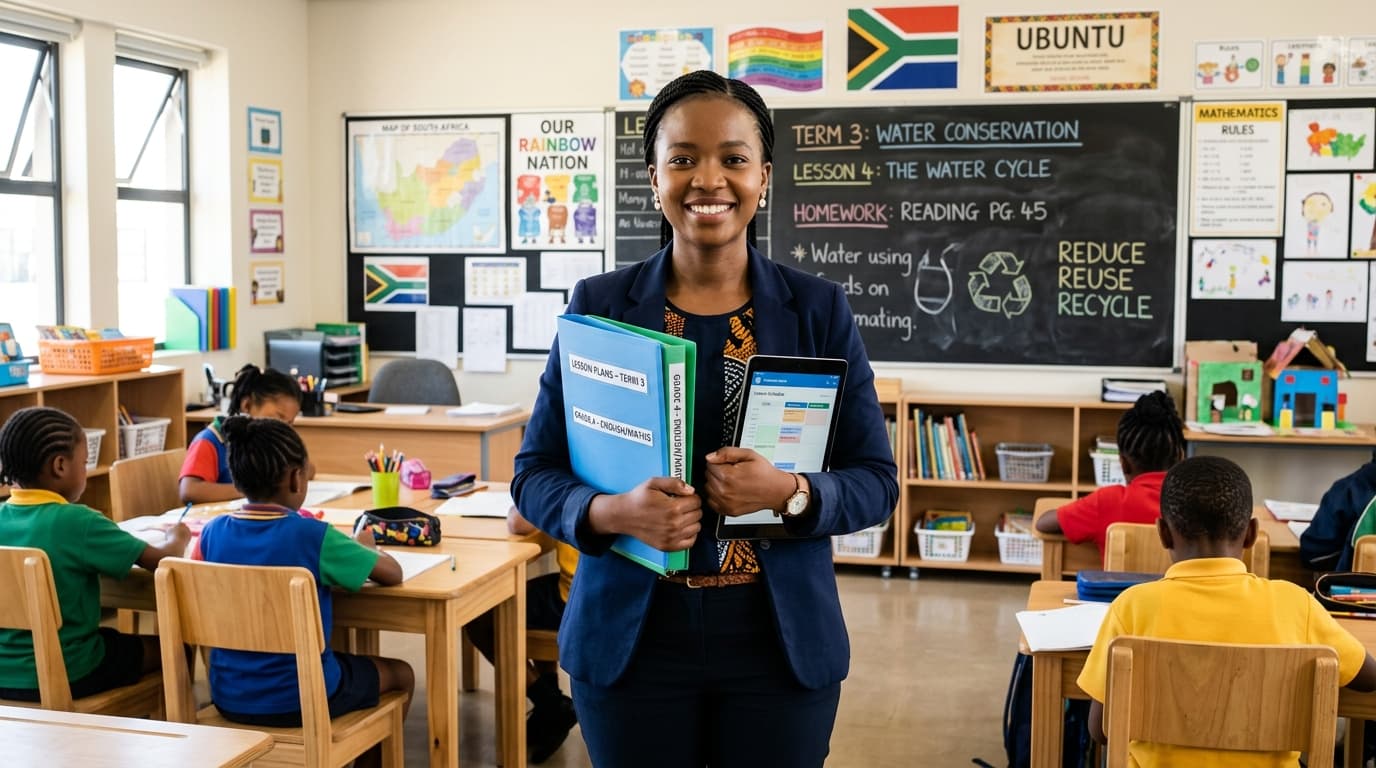
In the staffrooms of Polokwane, the corridors of Soweto, and the administrative offices of Cape Town, the conversation is shifting. For years, our educators have been stretched to their breaking points. Between the rigorous demands of the Curriculum and Assessment Policy Statement (CAPS), the administrative weight of SA-SAMS, and the pastoral needs of learners in a complex socio-economic landscape, the South African teacher is often more of a clerk than a mentor.
As we navigate 2026, Artificial Intelligence (AI) has moved from being a futuristic "buzzword" to a functional necessity. For School Management Teams (SMTs) and Principals, the question is no longer if we should use AI, but how we can strategically deploy it to simplify teaching tasks, protect our staff's mental health, and improve learner outcomes. This isn't about replacing the teacher—it’s about using technology to return the teacher to the heart of the classroom.
Redefining Lesson Planning and CAPS Alignment
One of the most significant "time-thieves" in the South African education system is the preparation of detailed lesson plans that must strictly adhere to the Annual Teaching Plans (ATPs). Often, teachers spend hours formatting documents that mirror CAPS requirements rather than thinking about creative delivery.
Automated Lesson Scaffolding
AI-powered platforms can now take a single CAPS topic—for example, "The causes of the South African War" in Grade 12 History or "Functions and Relationships" in Grade 9 Mathematics—and generate a comprehensive lesson scaffold in seconds. By inputting specific constraints, such as the duration of the period and the available resources (e.g., "no data projectors available"), AI can suggest interactive activities that meet the specific Assessment Standards.
Differentiating for the "Missing Middle"
South African classrooms are notoriously diverse in terms of ability. An SMT strategy should encourage teachers to use AI to create three versions of the same worksheet: one for learners who need remediation, one for the average learner, and one for those requiring extension. Previously, this took hours of manual labor; now, an AI can rephrase a text or adjust the complexity of math problems while keeping the core CAPS objectives intact.
Streamlining Assessment and Feedback Cycles
Assessment is the heartbeat of the South African school calendar, but the marking load during Term 1 and Term 3 often leads to teacher exhaustion and delayed feedback for learners.
AI-Driven Rubric Generation
Creating a rubric for a Grade 11 English Home Language creative writing task or a Life Orientation project is a meticulous task. AI can generate detailed, criteria-based rubrics aligned with the Bloom’s Taxonomy levels required by the Department of Basic Education (DBE). When teachers use standardized, AI-assisted rubrics, it ensures transparency and consistency across a grade, which is vital for internal moderation processes.
Personalised Feedback at Scale
The most effective way to improve learner performance is through frequent, high-quality feedback. However, in a class of 40 or 50 learners, providing a paragraph of constructive advice to every child is impossible. Modern AI tools allow teachers to input a learner’s marks and a few bullet points about their performance; the AI then generates a professional, encouraging, and actionable feedback report for the parent and learner. This turns a week-long marking ordeal into a manageable afternoon task.
Navigating the Multilingual Classroom
South Africa’s linguistic diversity is our greatest asset, but it presents a massive challenge for curriculum delivery, especially when English or Afrikaans is the Language of Learning and Teaching (LoLT) for Second Language speakers.
Real-Time Translation and Bridging
AI tools now excel at translating complex academic concepts into isiZulu, isiXhosa, Sesotho, or any of our official languages without losing the technical nuance. For a Grade 4 learner transitioning from mother-tongue instruction to English, AI can generate "bridge glossaries"—lists of key terms in both the LoLT and the learner's home language.
Supporting FAL and SAL Literacy
For First Additional Language (FAL) teachers, AI can generate reading passages that are culturally relevant to the South African context. Instead of using generic international examples, a teacher can prompt the AI to: "Write a 300-word story about a soccer match in a rural village using Grade 6 FAL vocabulary." This increases engagement and simplifies the task of content creation.
Administrative Efficiency: Beyond the Chalkboard
Lesson Planner
Generate comprehensive, CAPS-aligned lesson plans in seconds.
A school's success is often determined by the efficiency of its administrative engine. SMTs can use AI to reclaim hours of their week currently lost to "paper-pushing."
Parent Communication and Newsletters
Maintaining a positive school-home relationship requires constant communication. AI can draft weekly newsletters, permission slips for excursions, and sensitive emails to parents regarding disciplinary issues. By providing the AI with the core facts, the SMT can ensure the tone is professional, empathetic, and grammatically perfect, saving the Principal hours of drafting time.
Meeting Summaries and Action Items
In a busy South African school, staff meetings can often become lengthy. By using AI transcription tools (with proper consent and privacy protocols), the SMT can instantly generate a summary of the meeting, including a clear list of "Action Items" and "Deadlines." This ensures accountability without someone having to spend their afternoon typing up minutes.
The Leadership Strategy: Implementing AI Ethically
As school leaders, we must be the architects of a responsible AI rollout. We cannot simply tell teachers to "use AI" without a framework. The South African context requires a specific focus on ethics and the digital divide.
1. Prioritizing POPIA Compliance
The Protection of Personal Information Act (POPIA) is non-negotiable. Leadership must ensure that any AI tool used does not store sensitive learner data in a way that violates South African law. We must train our staff never to input a learner’s full name or ID number into a public AI model.
2. Bridging the Digital Divide
We must be careful that AI doesn't become a tool that only benefits Quintile 4 and 5 schools. Leadership in lower-quintile schools should focus on "Offline-First" AI tools or mobile-friendly platforms that can be used on a teacher’s smartphone with minimal data. SGBs (School Governing Bodies) should be encouraged to prioritize data-light infrastructure as part of their three-year strategic plans.
3. Professional Development, Not Just "Training"
One-off workshops are rarely effective. SMTs should establish "AI Professional Learning Communities" (PLCs) where teachers share one prompt or one tool that worked for them that week. This peer-to-peer learning builds confidence and reduces the fear that technology will replace human jobs.
Addressing the Challenges: Load Shedding and Connectivity
We cannot talk about technology in South African schools without addressing the elephant in the room: infrastructure. Unstable electricity and expensive data remain barriers.
However, the beauty of AI in 2026 is its asynchronous nature. A teacher can generate a week's worth of lesson plans and worksheets at home or in a library when the power is on, and then use those printed materials in a classroom that has no electricity. AI should be viewed as a "preparation partner" that works behind the scenes, rather than a tool that must be "live" in the classroom during every lesson.
The Human-Centric Conclusion
The ultimate goal of simplifying teaching tasks is not to make teachers lazy; it is to make them more present. When we use AI to handle the mundane—the rubric formatting, the initial drafting of reports, the alignment of lesson plans to CAPS—we clear the space for what really matters.
In a South African context, "what matters" is the mentorship of a young person. It is the ability of a teacher to notice that a learner is hungry, or that a student is struggling with a concept because of a barrier at home. By automating the "machine work," we empower our educators to do the "heart work."
As leaders, let us embrace this technology with a critical but optimistic eye. Let us build schools where the administration is invisible, and the inspiration is palpable. The future of South African education isn't just digital; it is a blend of high-tech efficiency and high-touch humanity.
Call to Action: Does your school have an AI Ethics Policy? Start the conversation in your next SMT meeting by identifying one administrative task that could be automated this term.
Siyanda M.
Dedicated to empowering South African teachers through modern AI strategies, research-backed pedagogy, and policy insights.