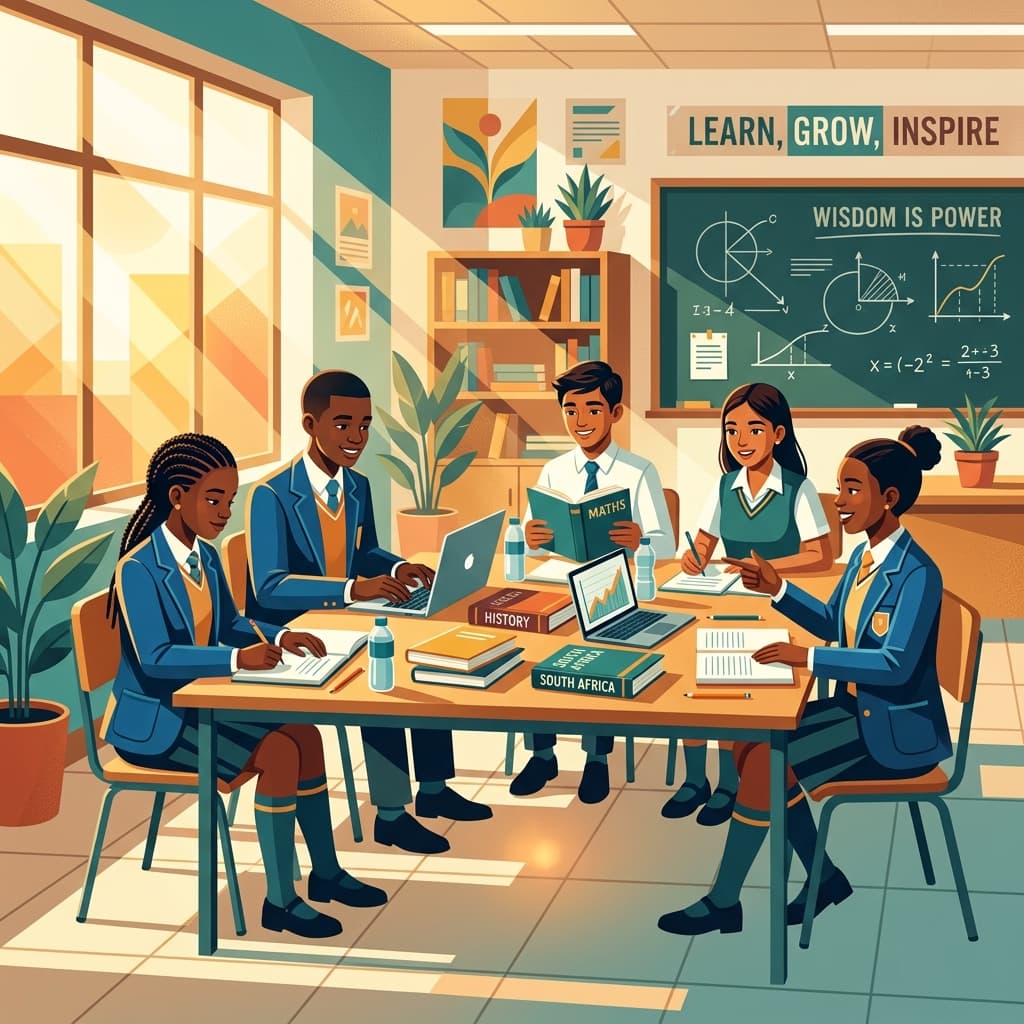
The Engagement Imperative in the South African Context
In the bustling corridors of South African schools—from the state-of-the-art facilities in Sandton to the resource-constrained classrooms in rural Limpopo—a universal challenge persists: how do we transform passive recipients of information into active participants in their own education?
For School Management Teams (SMTs), the pursuit of "learner engagement" is often viewed through the lens of academic results. We look at the National Senior Certificate (NSC) pass rates and the Annual Teaching Plans (ATPs) as our primary metrics of success. However, as leaders, we must recognize that engagement is the engine of achievement. A learner who is merely "present" is a learner at risk.
In our unique South African landscape, we navigate a rigid Curriculum and Assessment Policy Statement (CAPS) framework, large class sizes, and the persistent "digital divide." Making lessons interactive is not just a pedagogical preference; it is a management strategy to improve discipline, reduce failure rates, and produce the critical thinkers our economy desperately requires.
Moving Beyond the "Chalk and Talk" Tradition
The traditional "sage on the stage" model—where the teacher speaks and the learner scribbles—is a legacy of an industrial-era education system that no longer serves the Mzansi of 2026. To move forward, school leadership must champion a shift toward "active learning."
Active learning doesn't require expensive technology or a total overhaul of the curriculum. It requires a cultural shift within the staffroom. As leaders, we must empower our educators to see themselves as facilitators of discovery rather than just deliverers of content. When a learner engages with a concept—debates it, applies it, or teaches it to a peer—the retention rate skyrockets compared to passive listening.
1. Collaborative Learning: Harnessing the Power of the Peer
In many South African classrooms, we face the challenge of high learner-to-teacher ratios. While this is often seen as a deficit, it can be turned into a strategic advantage through structured collaborative learning.
Structured Group Work (The Jigsaw Method)
Instead of a teacher lecturing on the causes of the Great Depression or the properties of acids and bases, the class is divided into "home groups." Each member of the group is assigned a specific sub-topic to master and then teach back to their group.
From a management perspective, this reduces the burden on the teacher to be the sole source of information and encourages "peer-to-peer" accountability. It directly addresses the "Life Skills" and "Social Responsibility" components of the CAPS curriculum by fostering teamwork and communication.
Think-Pair-Share: The 2-Minute Engagement Hack
This is perhaps the simplest yet most effective tool for any South African classroom. When a teacher asks a question, instead of calling on the one learner whose hand is always up, they instruct: "Think for 30 seconds, pair with your neighbor, and share your answer."
As leaders, we should encourage teachers to use this during our "learning walks." It ensures that 100% of the class is thinking, rather than just the 5% who are naturally vocal.
2. Contextualizing CAPS: Bringing the World into the Classroom
One of the biggest hurdles to engagement is the perceived "irrelevance" of the curriculum. If a learner in a township school doesn't see how a Mathematical Literacy concept applies to their reality, they check out.
Real-World Problem Solving
SMTs should encourage departments to "localize" their examples. When teaching percentages in Grade 9 Math, why use abstract examples when you can use the current SASSA grant increases or the interest rates on a local furniture store’s hire-purchase agreement?
Engagement spikes when learners realize that what they are learning in the classroom provides them with the tools to navigate the challenges of South African life. This "Place-Based Education" makes the ATPs feel less like a checklist and more like a toolkit.
3. Low-Tech Gamification: Motivation Without the Price Tag
While "gamification" often conjures images of expensive tablets and high-speed internet, in the South African context, we must be more creative. We can gamify learning through competition and recognition without spending a cent on data.
Classroom "Leagues" and Points Systems
Teachers can create "Knowledge Leagues" where rows or groups compete for points based on homework completion, participation, and quiz scores. The prize needn't be monetary; "Privilege Rewards" such as being the first group to leave for break or a "Homework Pass" for one evening are highly effective motivators.
The "Whiteboard" Revolution (Mini-Boards)
If your school cannot afford individual tablets, the "mini-whiteboard" is the next best thing. Using laminated pieces of white cardstock and markers, every learner can write down their answer to a question and hold it up simultaneously. This provides the teacher with instant formative assessment and keeps every learner on their toes.
Lesson Planner
Generate comprehensive, CAPS-aligned lesson plans in seconds.
4. Leveraging Mobile Technology (The "BYOD" Approach)
We must acknowledge that while many learners lack laptops, the majority of South African households have access to a smartphone. As leaders, we need to move from a "ban the phone" mentality to a "harness the tool" strategy.
QR Codes and WhatsApp Groups
Teachers can use QR codes posted around the school for "Scavenger Hunts" related to History or Geography. Furthermore, controlled WhatsApp or Telegram groups can be used to share voice notes of summaries or links to Khan Academy videos that are zero-rated by certain service providers.
Management plays a crucial role here in establishing "Acceptable Use Policies" that protect both teachers and learners while opening the door to 21st-century engagement.
5. The Physical Environment: Breaking the Rows
The way a classroom is laid out dictates the type of learning that happens within it. Traditional rows signal "listen and obey."
Even in crowded classrooms, SMTs should support teachers in experimenting with different layouts.
- The U-Shape: Perfect for debates and whole-class discussions.
- Cluster Seating: Ideal for project-based learning.
- The "Station" Model: Rotating groups through different activities (one reading, one practicing, one receiving teacher-led instruction).
If we want interactive lessons, we must allow our teachers the freedom to move the furniture—literally and metaphorically.
6. The Role of School Leadership: Creating the Safety to Fail
Perhaps the most important factor in making lessons more interactive is the support of the School Management Team. Many teachers stick to "chalk and talk" because it is safe. It maintains a semblance of order, and it ensures the syllabus is "covered."
To change this, leadership must:
Redefine "Good Teaching" in Observations
When HODs conduct classroom observations, the criteria should shift. Instead of asking "Did the teacher finish the lesson plan?", we should ask "What percentage of the learners were actively doing something other than listening?" We need to reward the teacher who tries a new interactive method, even if it gets a bit noisy or doesn't go perfectly the first time.
Facilitate "Micro-PD" (Professional Development)
Long, dry afternoon workshops are the enemy of innovation. Instead, use 15 minutes of your weekly staff meeting for a "Teach-Meet" style session. Ask one teacher to demonstrate a single 5-minute engagement strategy that worked in their classroom that week. This builds a culture of "by South African teachers, for South African teachers."
Managing the "Coverage" Anxiety
The pressure of the DBE’s Annual Teaching Plans is real. Leaders must help teachers understand that quality of understanding often leads to speed of coverage later. If a learner truly grasps a foundational concept through an interactive lesson in Term 1, the teacher will spend far less time on remediation in Term 3.
7. Addressing the Discipline-Engagement Link
In our schools, we often struggle with behavioral issues. It is a well-documented fact that "off-task" behavior is frequently a symptom of boredom or lack of comprehension.
When a lesson is interactive, the "disruptive" learner often finds a channel for their energy. If they are the "leader" of their group in a competition, or if they are moving around the room during a "Gallery Walk," they are less likely to seek attention through negative means. Interaction is, in many ways, our best proactive classroom management tool.
Conclusion: A Call to Action for SMTs
The South African classroom is a place of immense potential and significant challenge. As leaders, we cannot wait for a massive influx of Departmental funding or for the digital divide to close on its own. We must work with what we have.
Making lessons more interactive is not about "entertainment." It is about cognitive activation. It is about ensuring that when a learner walks out of our school gates, they aren't just carrying a certificate, but a set of skills—collaboration, critical thinking, and communication—that will allow them to thrive in the modern world.
Let us challenge our departments to try one new interactive strategy this month. Let us celebrate the "noise" of a productive, debating classroom. Let us move from managing schools of silence to leading centers of active, vibrant, and uniquely South African learning.
The future of Mzansi is sitting in our classrooms right now. Let's make sure they aren't just sitting—let's make sure they are engaged.
Siyanda M.
Dedicated to empowering South African teachers through modern AI strategies, research-backed pedagogy, and policy insights.