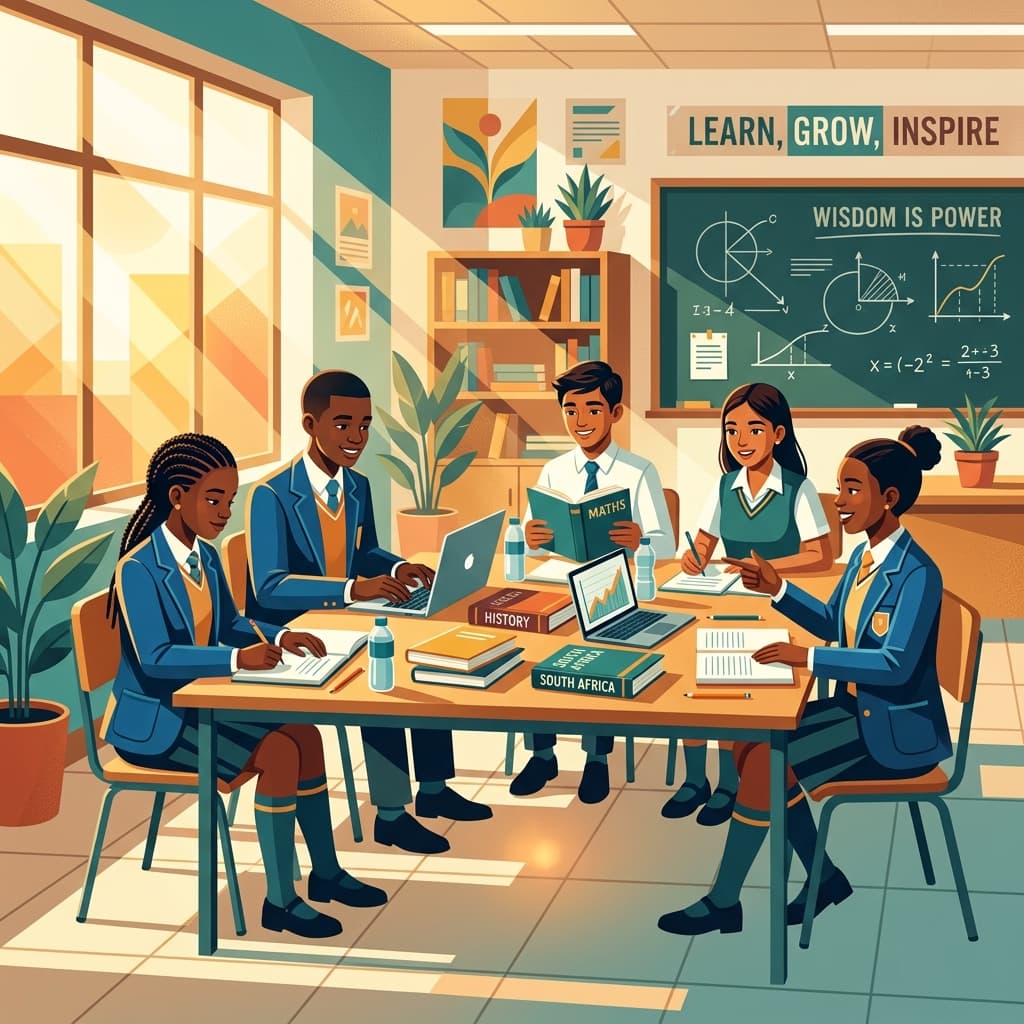
The Power of the Visible: Why South African Teachers Must Embrace Visual Learning
Walk into any South African classroom—from the bustling, high-density schools of Soweto to the rural reaches of the Eastern Cape—and you will immediately recognize our unique educational landscape. We navigate a complex tapestry of eleven official languages, varying levels of resource access, and the ever-present pressure of the Curriculum and Assessment Policy Statement (CAPS).
In this context, visual learning is not a "nice-to-have" or an optional extra for the creative arts. It is a fundamental pedagogical bridge. Visual learning refers to the use of images, diagrams, graphic organizers, and spatial arrangements to help learners process and retain information.
According to Allan Paivio’s Dual Coding Theory, our brains process visual and verbal information through two distinct channels. When we provide a learner with a spoken explanation (verbal) alongside a diagram (visual), we create two different pathways for memory retrieval. In a country where many of our learners are navigating English as an Additional Language (EAL), visuals serve as a "universal language," reducing the cognitive load and allowing the core concepts to shine through the language barrier.
This guide provides practical, evidence-based strategies tailored specifically for the South African educator looking to enhance their classroom impact through visual learning.
Aligning Visuals with the CAPS Framework
Before we dive into the "how," we must understand the "where" within our curriculum. The CAPS document across almost all phases—Foundation, Intermediate, Senior, and FET—emphasizes "Visual Literacy."
In languages, we teach our learners to interpret advertisements, cartoons, and photographs. In Social Sciences, we ask them to read maps and timelines. In Life Skills, we use posters to communicate health and safety. However, visual learning should go beyond being a subject of study; it should be the medium of instruction.
By integrating visuals into your daily delivery, you aren't deviating from CAPS; you are facilitating the "High Knowledge and High Skills" principles that the Department of Basic Education (DBE) promotes.
1. Mastering the Architecture of the Chalkboard (or Whiteboard)
In an era of smartboards and tablets, the humble chalkboard remains the backbone of the South African classroom, especially when load shedding hits or technology fails. However, we often use it as a dumping ground for text.
The "Chalkboard Architecture" Strategy
Don't just write; design. Divide your board into specific zones:
- The Anchor Zone (Left): Key vocabulary and the day’s "Big Question" or CAPS lesson objective.
- The Working Zone (Center): This is where you draw your flowcharts or mind maps during the lesson.
- The Summary Zone (Right): Homework instructions, important dates, and a 3-point visual summary of the lesson.
Pro-Tip for SA Teachers: Use colored chalk or markers strategically. Use one color for "Definitions" and another for "Examples." This color-coding helps learners with neurodivergence (like ADHD or Dyslexia) categorize information more effectively.
2. Graphic Organizers: Scaffolding Complex Thoughts
South African learners often struggle with the transition from the Foundation Phase to the Intermediate Phase, where the volume of reading increases significantly. Graphic organizers are the ultimate tool for this transition.
Venn Diagrams for Comparison
Whether you are comparing the climate of the Western Cape to KwaZulu-Natal in Geography, or comparing two characters in an Afrikaans FAL short story, the Venn diagram is a visual powerhouse. It forces learners to move beyond rote memorization into higher-order thinking (Analysis and Synthesis).
Frayer Models for Vocabulary
In our multilingual classrooms, vocabulary is the biggest hurdle. The Frayer Model is a four-square graphic organizer:
- Definition (in the learner's own words).
- Characteristics (how do we recognize it?).
- Examples.
- Non-examples (what is it NOT?).
By having a visual "anchor" for a word like "Photosynthesis" or "Democracy," learners are less likely to forget the meaning when they encounter it in an exam.
3. Anchor Charts: Making Learning Permanent
One of the biggest challenges in South African schools is the sheer size of the classes. When you have 40 to 60 learners, individual attention is difficult. Anchor charts act as "silent co-teachers."
An anchor chart is a poster created with the learners that captures the most important part of a lesson.
- Don't buy them; make them. A piece of flipchart paper or the back of an old calendar works perfectly.
- Visual Cues: If you are teaching the "Order of Operations" in Maths (BODMAS), include a small drawing next to each letter (e.g., a pair of glasses for Brackets).
- Placement: Hang these at eye level. For Foundation Phase learners, this is lower than you think!
Lesson Planner
Generate comprehensive, CAPS-aligned lesson plans in seconds.
4. Visualizing Data: Making Maths and Science Tangible
The 2023 PIRLS and TIMSS reports highlighted the challenges South African learners face in literacy and numeracy. Visualizing data is a key intervention strategy.
Human Graphs
Before moving to paper, use the learners themselves. If you are teaching bar graphs, ask learners to line up based on their favorite fruit or their home province. Taking a photo of this "human graph" and then drawing it on the board connects a physical experience to an abstract concept.
Sketch-noting
Encourage your FET learners to practice "sketch-noting" during lectures. Instead of taking linear, word-for-word notes (which often leads to passive learning), encourage them to draw small icons next to key concepts. A small crown for "Imperialism" or a water droplet for "Hydrological Cycle" creates a visual hook that aids long-term retention.
5. Navigating Resource Constraints and Load Shedding
We cannot talk about visual learning in South Africa without addressing the "Eskom in the room." Reliance on digital projectors can be risky.
The "Offline" Visual Kit
Every South African teacher should have a "Low-Tech Visual Kit":
- Flashcards: Large enough to be seen from the back of the room.
- Real objects (Realia): If you are teaching about soil types in Natural Sciences, bring three jars of actual sand, loam, and clay. No projector can beat the visual and tactile impact of the real thing.
- Picture Files: Start a physical folder of cut-outs from magazines like Drum, Huisgenoot, or old newspapers. These are invaluable for creative writing prompts or Social Science discussions.
6. Using Technology Wisely (When the Lights are On)
When you do have power and access to technology, use it to enhance, not replace, your teaching.
- Interactive Simulations: Use tools like PhET Simulations (many are downloadable for offline use) to show learners how circuits work or how fractions are divided.
- Video Snippets: A 2-minute YouTube clip of a historical event (like the 1994 elections) provides more context than a 20-minute reading. Always use subtitles—it reinforces the link between the spoken word and the visual text, aiding EAL learners.
Overcoming Challenges: The "Too Many Learners" Problem
A common critique is: "Siyanda, I have 65 learners in a small room. I don't have space for posters or time for drawing."
This is a valid concern. Here is how to adapt:
- The "Pass-the-Visual" Method: Instead of one big poster, create 5-6 small visual cards. Have learners sit in groups (even if the groups are large) and rotate the cards every few minutes.
- Visual Peer Teaching: Ask the artistic learners in your class to help create the visuals. This gives them a sense of ownership and saves you time.
- Phone-Friendly Visuals: In many high schools, learners have access to WhatsApp. Send a photo of your chalkboard mind map to the class group. This ensures every learner has a clear, personal copy of the visual, even if they were sitting at the very back of a crowded room.
The Evidence Base: Why This Works for the SA Context
Research into the "Picture Superiority Effect" shows that humans are significantly more likely to remember information presented as images than as words. In the South African context, this is amplified. When a learner who speaks isiXhosa at home sits in a Life Sciences class being taught in English, their brain is working overtime to translate terms. A visual diagram of a cell allows them to bypass the translation hurdle and engage directly with the biological concept.
Furthermore, visual learning supports Universal Design for Learning (UDL). By providing multiple means of representation, you are catering to the learner with a hearing impairment, the learner with dyslexia, and the high-achiever who needs to see the "big picture" to stay engaged.
A 5-Day Action Plan for Teachers
If you want to start using visual learning tomorrow, follow this simple rollout:
- Monday: Audit your chalkboard. Plan to use at least two different colors and create a designated "Vocabulary Corner."
- Tuesday: Introduce one graphic organizer. Use a Venn diagram for any comparison task in your lesson.
- Wednesday: Bring in one "real" object. Whatever you are teaching, find a physical, visual representation of it.
- Thursday: Create an Anchor Chart. Summarize the most difficult concept of the week on a single sheet of paper with at least three drawings.
- Friday: Reflect. Ask your learners: "Did the drawing help you understand this better?" Their feedback is your best guide.
Conclusion: Creating a Vision for Success
Visual learning is not about being a great artist; it’s about being a clear communicator. In South Africa, our classrooms are vibrant, noisy, and full of potential, but they can also be overwhelming. Visuals provide the "calm in the storm"—a clear point of reference that helps every learner, regardless of their home language or socio-economic background, to grasp the curriculum.
By transforming your classroom into a visual-rich environment, you are doing more than just teaching CAPS; you are empowering a generation to see their own potential. Start small, be consistent, and watch as the "lightbulb moments" become more frequent in your classroom.
Education is the most powerful weapon which you can use to change the world—and that weapon is much more effective when it’s clearly visible.
Siyanda M.
Dedicated to empowering South African teachers through modern AI strategies, research-backed pedagogy, and policy insights.