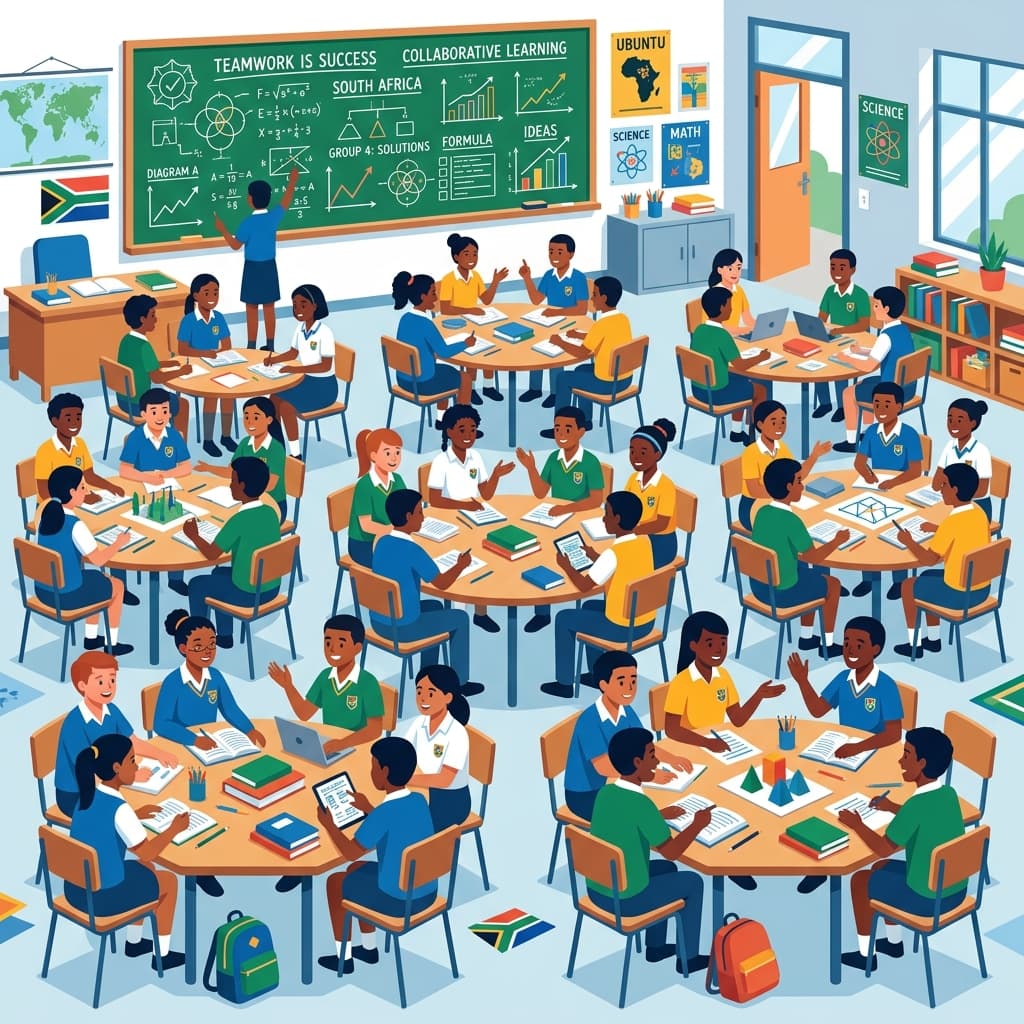
The Reality of the South African Classroom: Why Group Work is Non-Negotiable
If you walk into a typical public school in South Africa today—whether it’s in the heart of Soweto, a rural village in Limpopo, or a bustling suburb in Cape Town—you are likely to be met with a similar sight: rows of desks packed tightly together, forty to sixty learners eager to learn, and a teacher balancing the heavy demands of the Curriculum and Assessment Policy Statement (CAPS).
In our context, the "large class" isn't a pedagogical anomaly; it is the daily reality. For many South African educators, the mere mention of "group work" triggers a sense of dread. We envision noise levels that draw the principal from the office, "free riders" who let others do the work, and the logistical nightmare of moving heavy wooden desks in a cramped space.
However, group work is not just a "nice-to-have" teaching strategy; it is a critical cross-field outcome of the South African curriculum. CAPS explicitly requires that learners work effectively with others as members of a team, group, organisation, and community. Beyond the policy, group work taps into the African philosophy of Ubuntu—"I am because we are." By leveraging the social nature of our learners, we can turn a crowded classroom from a liability into a vibrant community of inquiry.
This guide provides practical, evidence-based strategies to implement effective group work in large, resource-constrained South African classrooms.
The Foundation: Strategic Group Formation
The most common mistake in large classes is allowing learners to "choose their own groups." In a class of 55, this leads to friendship cliques, the exclusion of marginalized learners, and inevitable disciplinary issues.
Heterogeneous Grouping: The Power of Diversity
In the South African context, our classrooms are beautifully diverse—not just in terms of culture and language, but in academic readiness. Effective group work relies on heterogeneous grouping. Aim for groups of 4 to 6. Each group should ideally contain:
- One "High Achiever" (to act as a peer tutor).
- Two "Middle Achievers."
- One "Lower Achiever" (who needs support but can contribute).
Using your latest School-Based Assessment (SBA) results is the most objective way to facilitate this. Explain to the learners that these groups are "Professional Teams" designed to ensure everyone succeeds.
The 'Home Group' vs. 'Expert Group' (The Jigsaw Method)
For complex topics—like the causes of the French Revolution in Grade 9 Social Sciences or the properties of matter in Natural Sciences—the Jigsaw Method is a lifesaver.
- Assign each member of the "Home Group" a specific sub-topic.
- Learners with the same sub-topic meet in "Expert Groups" to master the material.
- They then return to their "Home Groups" to teach their peers. This ensures individual accountability; the group cannot succeed unless every member performs their role as an "expert."
Tackling the Logistics: Managing Space and Noise
South African classrooms are often small, with furniture that hasn't changed since the 1980s. Moving desks is noisy and time-consuming.
The 'Turn-and-Talk' Pivot
You don't always need to move furniture. For shorter collaborative tasks, use the "Pivot" method. Learners in the front row simply turn their bodies to face the learners in the row behind them. This creates groups of four instantly without a single desk being moved.
The Noise Meter and the Non-Verbal Signal
Noise is the biggest barrier to group work success. Instead of shouting to be heard over 60 voices, implement a "Zero-Voice Signal." Raising your hand or using a traditional African shaker can signal that all talking must stop within five seconds. Introduce a "Whisper Zone" rule. Explain that in a professional environment, a team should only be heard by their immediate teammates, not the group across the room.
Defining Roles: Every Learner a Stakeholder
In a large class, it is easy for quiet learners to hide. Assigning specific, culturally relevant roles ensures that every learner has a stake in the outcome.
Essential Classroom Roles
- The Facilitator (The Chairperson): Ensures everyone gets a turn to speak and keeps the group on task.
- The Scribe (The Secretary): Records the group’s ideas. This is excellent for learners who are diligent with their notebooks.
- The Timekeeper: Keeps track of the 10 or 15 minutes allocated for the task.
- The Language Bridge: In our multilingual classrooms, this learner helps translate complex concepts between English (the LoLT) and the learners' home languages (e.g., isiZulu, Setswana, or Afrikaans).
- The Reporter: Presents the group’s findings to the whole class.
By rotating these roles weekly, you build a variety of soft skills across the entire learner cohort.
Leveraging Language as a Resource (Translanguaging)
One of the unique challenges in South African education is that many learners are studying in their second or third language. In a large class, the teacher cannot be everywhere at once to explain difficult concepts.
Lesson Planner
Generate comprehensive, CAPS-aligned lesson plans in seconds.
Strategic Code-Switching
Encourage "Translanguaging" during the small-group discussion phase. Allow learners to discuss the concepts in their home languages to deepen their understanding. However, the final "output" (the poster, the presentation, or the written report) must be in the Language of Learning and Teaching (LoLT), as per CAPS requirements. This approach respects the learners' linguistic identity while scaffolding their academic English or Afrikaans.
Designing the Task: Beyond 'Discussion'
Group work fails when the task is too simple (one person can do it alone) or too vague ("Discuss Chapter 4"). For a large class, the task must be highly structured and "group-worthy."
The Inquiry-Based Approach
Instead of asking them to read a text, give them a problem to solve.
- Example (Mathematics): "Here is a common error made in last week's test on fractions. In your groups, identify why this mistake was made and create a 'Help Guide' to prevent it."
- Example (Life Orientation): "Design a community intervention for a local environmental issue using only the resources available in our township."
Resource Management in Low-Resource Settings
We often lack enough textbooks or tablets. Group work allows you to stretch your resources. If you only have ten textbooks for sixty learners, one textbook per group of six becomes a functional necessity rather than a crisis. Use "Station Teaching" where groups rotate between different stations—one station uses the textbooks, another uses a newspaper clipping, and a third works directly with the teacher.
Assessment and Accountability: The 'Free Rider' Problem
How do you grade group work in a class of 60 without losing your mind?
The 80/20 Assessment Rule
Avoid giving a single group grade for every task. This frustrates high-achieving learners who feel they are "carrying" the group. Instead, use a split grading system:
- 80% Individual Accountability: Each learner must submit their own written reflection or answer a short quiz based on the group work.
- 20% Group Process: A small portion of the mark is based on how well the group collaborated, evidenced by a peer-assessment rubric.
Peer Feedback (The 'Two Stars and a Wish' Method)
In a large class, the teacher cannot give detailed feedback to every individual during a lesson. Teach learners to give peer feedback using the "Two Stars and a Wish" technique:
- Star: One thing the group did well.
- Star: Another strength of their work.
- Wish: One specific area where they can improve for next time.
This builds a culture of constructive criticism and lightens the teacher's marking load.
Dealing with Conflict and Resistance
In any South African classroom, you will encounter resistance. Some learners are shy; others are dominant.
The 'Talking Tokens' Strategy
To prevent one learner from dominating the conversation, give each member three "tokens" (these can be bottle caps, stones, or scraps of paper). Every time a learner speaks, they must place a token in the center of the desk. Once their tokens are gone, they cannot speak again until everyone else has used at least one token. This physically visualizes the flow of conversation and encourages the "quiet" learners to contribute.
The Teacher as a 'Facilitator,' Not a 'Sage'
In large classes, our instinct is to stand at the front and lecture (the "Chalk-and-talk" method) because it feels like we have more control. To make group work work, you must move. Circulate through the room. Don't answer questions directly; instead, ask, "What does your group think about that?" or "Did you ask your Facilitator for the answer first?"
Conclusion: Building a Future-Ready South Africa
Implementing effective group work in a large South African classroom is, undeniably, an act of courage and high-level management. It requires more preparation than a traditional lecture, but the dividends are immeasurable.
When we facilitate successful group work, we are doing more than just teaching the CAPS curriculum. We are teaching our youth how to negotiate, how to lead, how to listen to perspectives different from their own, and how to solve problems collectively. These are the very skills required to build a prosperous, democratic South Africa.
Start small. Try one "Turn-and-Talk" this week. Move to a "Jigsaw" next month. With patience and consistency, your overcrowded classroom will transform from a place of passive listening into a hive of active, collaborative, and quintessentially South African excellence.
Reflection for the Week: Look at your seating plan tomorrow. How can you strategically place one 'peer-tutor' in each section of the room to assist you in managing the next group activity?
Siyanda M.
Dedicated to empowering South African teachers through modern AI strategies, research-backed pedagogy, and policy insights.