The Reality of the South African Chalkboard
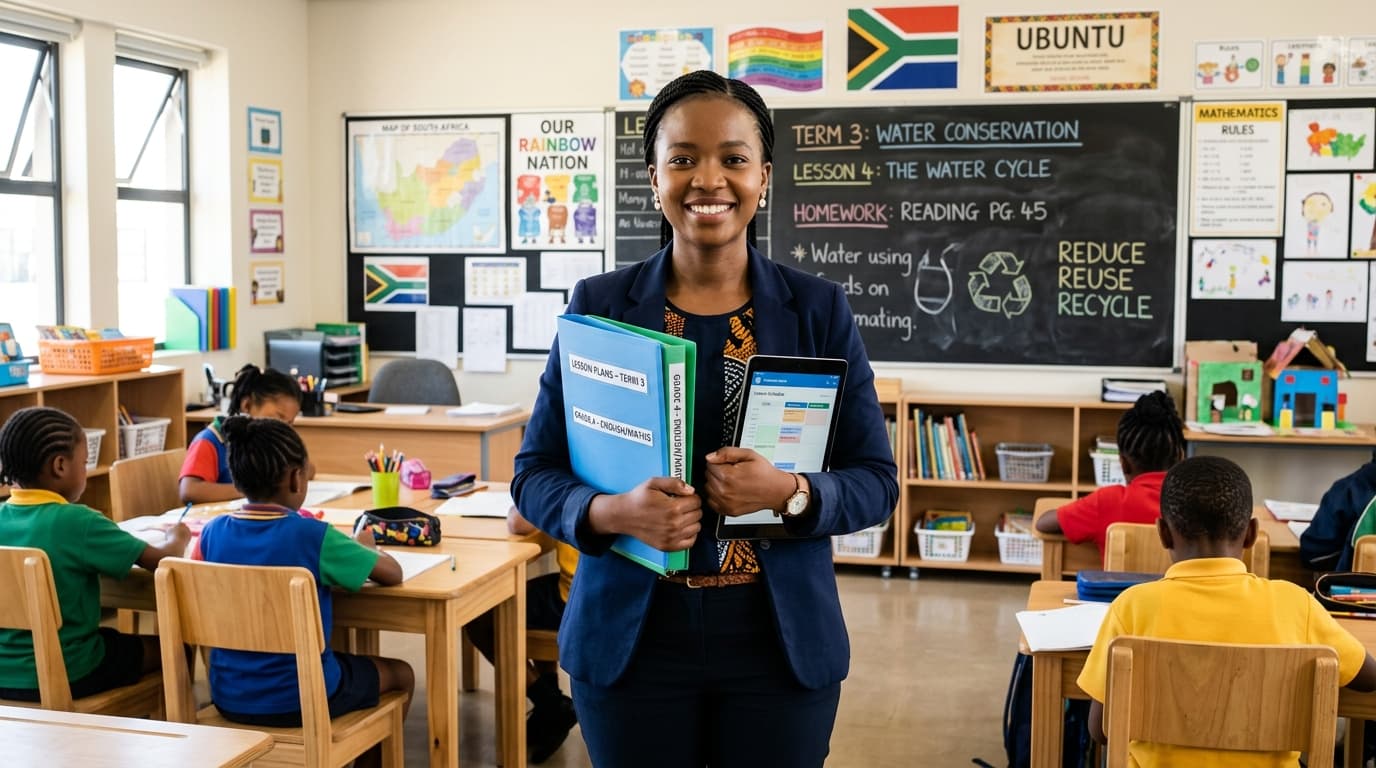
In a perfect world, every South African classroom would be equipped with high-speed fiber, interactive whiteboards, and a 1-to-1 tablet ratio for learners. But as educators from Polokwane to Port Elizabeth know, the reality of the South African school system—marked by the quintile system and varying levels of infrastructure—is often much leaner. We face overcrowded classrooms, limited textbooks, and the perennial challenge of "making do."
However, there is a dangerous myth circulating in our staffrooms: the idea that the quality of education is directly proportional to the price tag of the resources used.
As an educator in the South African context, your greatest asset is not a R50,000 smart screen; it is your pedagogical mastery, your understanding of the CAPS (Curriculum and Assessment Policy Statement) requirements, and your ability to connect with the lived experience of your learners. Confidence in the classroom doesn't come from what you have in your cupboard; it comes from how you use what is in your head.
Reclaiming the Pedagogy: Expertise as Your Primary Resource
Confidence is born from competence. To teach confidently without expensive resources, you must first master the "what" and the "how" of the South African curriculum.
Mastering the CAPS ATPs
The Annual Teaching Plan (ATP) is your roadmap. Often, teachers feel overwhelmed because they see the ATP as a list of boxes to tick. To teach confidently, you must look at the ATP as a conceptual framework. When you deeply understand the "Big Ideas" behind a topic—whether it’s the cause-and-effect of the French Revolution in Grade 12 History or the properties of matter in Grade 4 Natural Science—you no longer need a glossy textbook to explain it.
Study the examination guidelines and the pace-setters. When you know exactly what the DBE (Department of Basic Education) requires for assessment, you can strip away the fluff. This clarity allows you to walk into a room with nothing but a piece of chalk and deliver a lesson that hits every cognitive level required by Bloom’s Taxonomy.
The Power of Direct Instruction and Storytelling
In many high-resource environments, there is a push toward purely inquiry-based learning. However, evidence-based research (such as the work of John Hattie and Rosenshine’s Principles of Instruction) suggests that for many learners, particularly those in under-resourced contexts, explicit, direct instruction is incredibly effective.
Storytelling costs nothing. In South Africa, we have a rich heritage of oral tradition. Whether you are explaining the circulatory system as a "logistics network" like a local taxi rank or describing the complexities of the Bill of Rights through local community scenarios, you are using the most powerful tool in the history of education: the human narrative.
The "Zero-Rand" Resource Kit: Innovation in Every Aisle
If you look at your environment through the lens of a "MacGyver Teacher," the world becomes a warehouse of free resources.
The Cardboard Revolution
Never throw away a cereal box or a delivery carton. Cardboard is the "Gold Standard" of low-cost teaching.
- Flashcards: Cut them into uniform sizes for vocabulary drills or maths facts.
- 3D Modeling: In Geography or Life Sciences, cardboard is perfect for creating topographical maps or models of DNA strands.
- Manipulatives: In the Foundation Phase, cardboard "coins" or "counters" are essential for tactile learners who need to move objects to understand the concept of number.
Bottle Caps and Stones
In Mathematics, the "Concrete-Representational-Abstract" (CRA) sequence is vital. You don't need expensive "Unifix" cubes.
- Plastic Bottle Caps: Collect them in different colors. Use them for grouping, counting, and even basic algebraic balancing.
- Stones and Seeds: For schools in more rural settings, the earth provides. Sorting stones by size or texture can be a rich sensory lesson for Grade R and 1 learners.
The "Living Textbook": Newspapers and Magazines
Local newspapers (even the free community ones) are goldmines for English First Additional Language (FAL) and Life Orientation. Use them for:
- Identifying parts of speech.
- Analyzing persuasive language in advertisements.
- Discussing current affairs and social justice issues within the South African context.
Leveraging Community and "Ubuntu" in Education
South Africa's strength has always been its people. When the budget is zero, the community is your greatest stakeholder.
Lesson Planner
Generate comprehensive, CAPS-aligned lesson plans in seconds.
Tapping into Local Expertise
Do you have a parent who is a mechanic? Invite them to explain the mechanics of simple machines for Grade 7 Technology. Is there a grandmother who remembers the local history of your township? She is a primary source for Social Sciences.
Inviting "Guest Teachers" from the community costs nothing but a formal letter of invitation (and perhaps a cup of tea). It validates the community's knowledge and shows learners that education is not something that only exists between the covers of a book.
Peer Teaching and Collaborative Learning
One of the most underutilized resources in a South African classroom is the learners themselves. Peer-to-peer teaching is a high-impact, low-cost strategy. When a learner explains a concept in their mother tongue—even in an English-medium classroom—it can bridge the gap in "Code-Switching" that often hinders conceptual understanding.
Encourage "Group Experts." Assign different sections of a CAPS topic to different groups, and have them teach the rest of the class. This builds confidence in the learners and allows you to move from "Sage on the Stage" to "Guide on the Side."
Technology on a Shoestring: The Mobile Revolution
We must be realistic: the digital divide is real. However, South Africa has one of the highest mobile penetration rates in the world.
WhatsApp as a Learning Management System
If you cannot afford a fancy LMS like Canvas or Blackboard, use WhatsApp. Create a "Broadcast List" (rather than a group, to protect privacy) where you send voice notes summarizing the day's lesson, photos of the chalkboard, or PDF versions of DBE workbooks. This ensures that learners who were absent or who need to revise can access the material on their parents' phones.
Zero-Rated Sites and Siyavula
Educate yourself and your learners on zero-rated educational websites. Many service providers in South Africa allow free access to sites like Siyavula (for Maths and Science) or the DBE’s Cloud Portal. You don't need a computer lab if you can guide learners to these resources using the devices they already have in their homes.
Maintaining Confidence in the Face of Adversity
It is easy to feel defeated when you see schools with AstroTurf and iPad labs while you are struggling with a shortage of desks. But confidence is a choice based on your professional identity.
The "Expert Teacher" Persona
Your presence in the room sets the tone. If you walk in looking defeated by the lack of resources, your learners will feel that their education is "second-rate." If you walk in with a clear plan, a firm voice, and a passion for your subject, you create a culture of excellence.
Remember, the most influential factor in learner achievement—according to educational researcher John Hattie—is Teacher Collective Efficacy. This is the belief that you, as a teacher, can make a difference regardless of the external circumstances.
Focus on Feedback, Not Fancy Paper
Assessment doesn't need to be on high-quality printed paper. Use mini-whiteboards (or even laminated pieces of white cardboard) for "Check for Understanding" moments. The "Exit Ticket" strategy—where learners write one thing they learned on a scrap piece of paper before leaving—provides you with immediate data on your lesson's effectiveness. This data allows you to pivot your teaching, which is the hallmark of a confident, professional educator.
Conclusion: The Architecture of Impact
In the South African context, we are often called to be more than just teachers; we are social workers, counselors, and innovators. While we should continue to advocate for better resources and government support, we cannot let the absence of those things paralyze our practice.
Confidence in teaching comes from the realization that you are the resource. Your ability to break down a complex chemical equation, your passion for the poetry of Mongane Wally Serote, and your belief in the potential of the child sitting in a broken desk are things money cannot buy.
By leveraging the CAPS framework, repurposing everyday materials, and tapping into the power of our communities, we can provide an education that is not just "good enough for now," but world-class. You are not a "disadvantaged" teacher; you are a resourceful architect of the South African future. Stand tall, teach with what you have, and watch the impact ripple through generations.
About the Author: Siyanda M. is a veteran South African educator with 15 years of experience in both rural and urban school settings. He specializes in teacher development and curriculum implementation in resource-constrained environments.
Siyanda M.
Dedicated to empowering South African teachers through modern AI strategies, research-backed pedagogy, and policy insights.