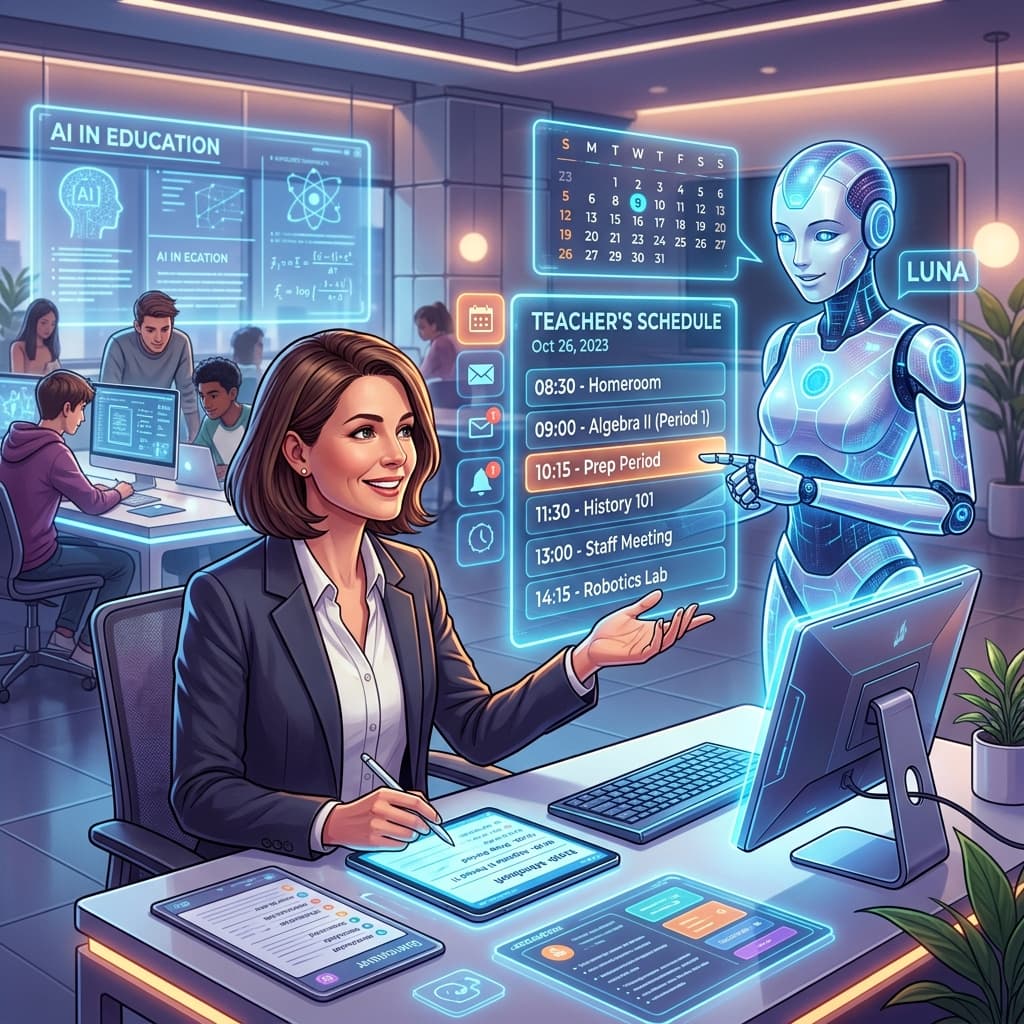
Unleashing the Power of AI in South African Classrooms: Case Study 22 - Implementing CAPS with Artificial Intelligence
The South African education landscape is dynamic, ever-evolving, and deeply rooted in the foundational principles of the Curriculum and Assessment Policy Statement (CAPS). For our dedicated teachers across Grades R-12, the challenge isn't just to cover the syllabus, but to ignite learning, foster critical thinking, and prepare our learners for a future that is increasingly shaped by technological advancements. This is where Artificial Intelligence (AI) enters the picture, not as a replacement for the invaluable human touch of a teacher, but as a powerful ally.
In Case Study 22, we delve into a real-world implementation of AI within the South African CAPS framework, showcasing how teachers are strategically integrating these tools to enhance their pedagogical practices. This isn't about futuristic pipe dreams; it's about practical application that addresses the unique realities and opportunities within our diverse school system.
The CAPS Curriculum: A Foundation for AI Integration
The CAPS curriculum, with its emphasis on outcomes-based education, clear learning objectives, and standardized assessments, provides a robust framework that is surprisingly well-suited for AI integration. Think of CAPS as the blueprint, and AI as the advanced tools that can help us build more effectively.
For instance, CAPS requires teachers to differentiate instruction to cater to diverse learning needs. AI can be a game-changer here. Adaptive learning platforms, powered by AI, can assess individual learner progress in real-time. They can identify areas where a learner is excelling and where they might be struggling, then automatically provide tailored resources, practice exercises, or even explanations at varying levels of complexity. This frees up the teacher to focus on higher-order tasks like facilitating discussions, providing individualised support, and nurturing socio-emotional development, which are crucial components of effective CAPS implementation.
Beyond the Textbook: Enhancing Content Delivery with AI
One of the most immediate benefits of AI for CAPS implementation is its ability to enrich and diversify content delivery. South African classrooms often face resource constraints, and AI can bridge some of these gaps.
For Foundation Phase (Grades R-3): Imagine an AI-powered storytelling tool that can generate dynamic narratives based on CAPS-aligned themes. Instead of a static storybook, learners can interact with a story, make choices that influence the plot, and encounter new vocabulary in context. AI can also generate personalised worksheets for foundational literacy and numeracy, adapting the difficulty based on each child's performance. This is particularly valuable in large classes where individualised attention can be challenging.
For Intermediate and Senior Phases (Grades 4-9): AI can assist in creating engaging multimedia resources to explain complex concepts within subjects like Natural Sciences or Social Sciences. Think of AI generating interactive diagrams, simulations, or even short animated explanations of historical events or scientific processes, all aligned with specific CAPS content descriptors. For language subjects, AI can provide instant feedback on grammar, spelling, and even offer suggestions for improving sentence structure, allowing learners to practice independently and receive immediate remediation.
For Further Education and Training (FET) Phase (Grades 10-12): The demands of the FET phase, especially for subjects with high theoretical components like Mathematics, Physical Sciences, or Accounting, can be significant. AI can provide AI-powered tutors that can answer specific learner questions, explain complex formulas, or walk learners through problem-solving steps. This is not about bypassing the teacher but about providing supplementary support that learners can access outside of class hours, reinforcing concepts taught by the teacher. AI can also help generate a vast array of practice questions, with detailed explanations for correct answers, aiding learners in their exam preparation, a critical aspect of the CAPS assessment framework.
Streamlining Assessment and Feedback: A Teacher's Best Friend
Assessment is a cornerstone of the CAPS curriculum. Teachers spend a significant amount of time designing, administering, and marking assessments. AI offers a powerful avenue for streamlining these processes.
Automated Marking: For subjects with objective questions (e.g., multiple-choice, fill-in-the-blanks in Mathematics or Natural Sciences), AI can automate the marking process. This significantly reduces the teacher's workload, allowing them to dedicate more time to analysing learner performance and planning targeted interventions.
Personalised Feedback: AI can go beyond simple marking by providing personalised feedback. For instance, in written assignments for English or Afrikaans, AI tools can identify common errors in grammar, punctuation, and essay structure. While human feedback remains paramount for nuanced understanding and critical analysis, AI can handle the more mechanical aspects, providing learners with actionable insights for improvement. This aligns with the CAPS emphasis on developing learners' writing skills holistically.
Data-Driven Insights: AI-powered learning platforms can collect and analyse data on learner performance across various CAPS topics. This data can reveal trends, identify areas where the majority of the class is struggling, or highlight individual learners who require additional support. These insights empower teachers to make informed decisions about their teaching strategies and to tailor their lessons more effectively, ensuring that all learners are progressing towards the stipulated CAPS outcomes.
Practical Implementation Strategies for South African Educators
Integrating AI into the CAPS curriculum requires a thoughtful and strategic approach. Here are some practical steps for South African teachers:
Start Small and Specific: Don't try to overhaul your entire teaching practice overnight. Identify one or two specific CAPS learning objectives or assessment tasks where AI could provide a tangible benefit. For example, use an AI tool to generate varied comprehension questions for a specific CAPS Literature topic.
Focus on Augmentation, Not Replacement: Remember that AI is a tool to enhance your teaching, not replace it. The human connection, the ability to inspire, to understand a learner's emotional state, and to foster critical thinking – these are irreplaceable. AI should free you up to do more of these vital tasks.
Prioritise Data Privacy and Security: Be mindful of the data you are inputting and the platforms you are using. Ensure that any AI tool complies with South African data protection regulations and that learner information is kept secure.
Embrace Professional Development: The landscape of AI is rapidly evolving. Actively seek out professional development opportunities, workshops, and online resources that focus on AI in education. Engage with your colleagues to share experiences and best practices.
Leverage Free and Accessible Tools: Many AI tools offer free versions or educational discounts. Explore platforms that can assist with lesson planning, generating quiz questions, or providing writing feedback. Websites like ChatGPT, Bard, or even specialised educational AI platforms can be starting points.
Integrate with Existing CAPS Resources: Think about how AI can complement your existing CAPS-aligned textbooks and teaching materials. Can AI generate additional practice problems for a specific CAPS chapter? Can it create interactive quizzes based on the content you've already covered?
Foster Learner Digital Literacy: As you introduce AI tools, also focus on teaching learners about responsible AI use, digital citizenship, and how to critically evaluate AI-generated content. This is an essential skill for their future.
Case Study 22 in Action: A Hypothetical Scenario
Consider a Grade 7 Mathematics teacher in a township school grappling with learners' varying levels of understanding of fractions, a key component of the CAPS curriculum.
Challenge: Learners struggle with visualising fraction operations, and the teacher has limited time for individualised support.
AI Solution: The teacher uses an AI tool to generate interactive visual aids and personalised practice problems for fractions.
Implementation:
- Content Generation: The teacher inputs the CAPS learning objectives for fractions into an AI tool. The AI generates a series of colourful, interactive diagrams illustrating addition, subtraction, multiplication, and division of fractions.
- Personalised Practice: The AI then creates adaptive worksheets. Learners who grasp concepts quickly receive more challenging problems, while those who struggle get simpler exercises and step-by-step guidance.
- Feedback Loop: The AI platform provides instant feedback on learner responses. It flags common errors, such as not finding a common denominator, and offers brief, targeted explanations.
- Teacher's Role: The teacher uses the AI-generated data to identify specific learners who require more direct intervention. During class, they can now focus on those learners, using the AI-generated visuals and explanations as a basis for their one-on-one support. The teacher also uses the AI to generate varied assessment questions to gauge overall class understanding against CAPS benchmarks.
Outcome: Learners are more engaged with the topic of fractions due to the interactive nature of the AI tools. The teacher has a clearer understanding of individual learner needs, allowing for more effective and targeted instruction. The overall attainment of CAPS objectives for fractions improves.
The Future of CAPS and AI in South Africa
The integration of AI into the CAPS curriculum is not a trend; it's a fundamental shift in how we can approach teaching and learning in South Africa. As AI technologies become more sophisticated and accessible, their potential to transform our classrooms will only grow.
By embracing AI strategically, with a focus on enhancing pedagogical practices and addressing the unique challenges and opportunities within our educational system, we can empower our teachers, engage our learners, and ultimately contribute to a brighter future for South African education, one that is deeply aligned with the principles of CAPS and forward-looking in its embrace of innovation. Let Case Study 22 be the beginning of your journey into this exciting new era.
Siyanda M.
Dedicated to empowering South African teachers through modern AI strategies, research-backed pedagogy, and policy insights.