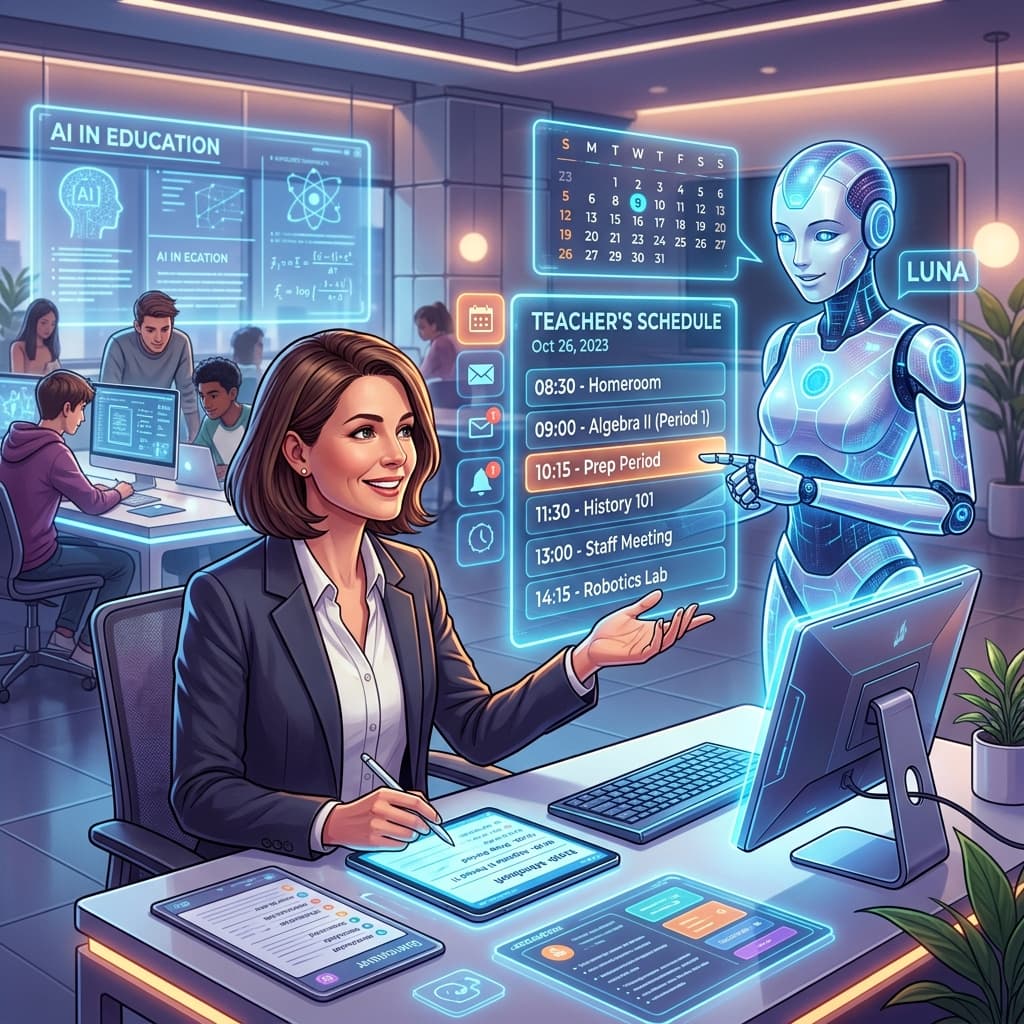
Unlocking CAPS Potential: Case Study 32 - AI as a South African Teacher's Ally
The landscape of South African education is dynamic, and at its heart lies the Curriculum and Assessment Policy Statement (CAPS). For Grades R-12 educators across our diverse nation, mastering CAPS implementation is a continuous journey. This journey, however, can be significantly enhanced by the strategic integration of Artificial Intelligence (AI). In this, our 32nd case study, we delve into the practical realities and successes of South African teachers leveraging AI to not just meet, but excel within the CAPS framework. This isn't about replacing the irreplaceable human touch of a teacher; it's about empowering them with tools that amplify their impact, address unique classroom challenges, and foster deeper student engagement.
The CAPS curriculum, with its specific learning outcomes, content requirements, and assessment strategies, demands meticulous planning and execution. Teachers often grapple with differentiated instruction for diverse learners, the creation of engaging learning materials, and the need for timely, constructive feedback. These are precisely the areas where AI, when applied thoughtfully and contextually, can become an invaluable partner.
Understanding the South African Context: Beyond Generic AI Solutions
Before diving into AI applications, it’s crucial to acknowledge the distinct realities of South African classrooms. We understand the resource constraints, the varying levels of technological access, and the cultural nuances that shape our learning environments. Generic AI solutions designed for affluent Western markets often fall short. Therefore, our focus here is on AI tools and strategies that are adaptable, affordable, and directly address the specific needs of CAPS implementation in South Africa.
Case Study 32: The AI-Powered CAPS Navigator
Meet Mrs. Themba, a Grade 7 Mathematics teacher in a township school in Gauteng. Like many of her peers, she faces large class sizes, varying levels of prior knowledge among her students, and the constant pressure to cover the CAPS syllabus effectively. Mrs. Themba, however, is a pioneer. She has embraced AI as her "CAPS Navigator," a suite of tools designed to streamline her workload and enhance her teaching.
AI for CAPS Content and Planning:
One of the most immediate benefits of AI for South African teachers is its capacity to assist with content generation and lesson planning, directly aligning with CAPS requirements.
Differentiated Learning Materials: Mrs. Themba previously spent hours adapting worksheets for learners who struggled with foundational concepts or required extension activities. Using an AI content generator, she can now input a CAPS-aligned topic (e.g., "Fractions – Grade 7 CAPS Term 2") and prompt the AI to create:
- Simplified explanations: For learners who need a more concrete introduction to abstract concepts.
- Challenging problem sets: For those who have mastered the basics and require deeper engagement.
- Visual aids prompts: While AI cannot directly generate images without explicit instructions, it can generate detailed prompts for teachers to use with image-creation tools or to guide their own visual representation, aligning with CAPS emphasis on diverse learning modalities. For instance, "Generate a detailed description for a visual aid explaining how to find a common denominator for fractions, using everyday South African examples like slices of bread or oranges."
- Real-world South African applications: By prompting the AI with "Connect this CAPS topic to local contexts," Mrs. Themba has generated word problems involving stokvel contributions, local market prices, or distances between familiar landmarks, making learning more relevant.
CAPS Alignment Check: AI-powered tools can help teachers cross-reference their lesson plans against specific CAPS requirements. A teacher can input their lesson outline and ask an AI assistant, "Does this lesson plan adequately address the Grade 5 Natural Sciences CAPS outcomes for Term 1, specifically regarding the scientific process?" The AI can then flag any perceived gaps or suggest areas for deeper exploration, ensuring compliance and a comprehensive approach.
AI for Assessment and Feedback (CAPS-Driven):
The assessment component of CAPS is rigorous. AI offers significant advantages in managing this aspect of teaching.
Automated Quiz Generation: For formative assessments, a cornerstone of CAPS, Mrs. Themba uses AI to generate multiple-choice questions, fill-in-the-blanks, or short-answer prompts based on specific CAPS content points. She can specify the difficulty level and the cognitive level (e.g., Bloom's Taxonomy verbs specified in CAPS). This frees up her time for more in-depth analysis of student work.
Personalized Feedback Generation: While AI cannot replicate the nuanced, empathetic feedback a teacher provides, it can offer initial drafts of constructive criticism. For example, after Mrs. Themba marks a student's essay, she can feed anonymized snippets of common errors into an AI tool and ask it to generate generic feedback on improving sentence structure, identifying grammatical errors, or suggesting ways to elaborate on arguments. She then personalizes this feedback, adding her specific observations and encouragement. This is particularly useful for large classes where individualised written feedback is a significant time sink.
- Rubric Development: Developing effective rubrics aligned with CAPS assessment criteria can be time-consuming. AI can assist by generating draft rubrics based on specified CAPS assessment standards and learning objectives, which the teacher can then refine and customise.
AI for Enhancing Classroom Engagement (CAPS Focused):
CAPS emphasizes active learning and critical thinking. AI can be a catalyst for these approaches.
Interactive Learning Scenarios: Mrs. Themba uses AI to generate prompts for class debates or role-playing exercises that align with CAPS topics. For a History lesson on apartheid, she might prompt an AI to "Create a scenario for a Grade 9 class role-play simulating a discussion between different stakeholders during the apartheid era, focusing on the socio-economic impacts as outlined in the CAPS curriculum."
Personalised Learning Pathways: For students with specific learning challenges, AI can help suggest alternative activities or resources. If a student is struggling with algebraic equations as per CAPS, an AI can suggest visual representations, simpler step-by-step guides, or interactive online games that reinforce the same concepts, tailored to that student's progress.
Concept Clarification Tools: Students can use AI chatbots (under teacher supervision) to ask clarifying questions about CAPS content outside of class. This empowers self-directed learning, a key outcome in the CAPS framework, by providing instant, accessible support. The key here is to guide students on how to formulate effective questions and to critically evaluate the AI's responses, fostering digital literacy.
Practical Implementation Strategies for South African Teachers:
Start Small and Focus: Don't try to implement everything at once. Identify one or two areas where you feel AI could make the biggest difference in your CAPS implementation (e.g., differentiated worksheets or quiz generation).
Leverage Free and Affordable Tools: Many powerful AI tools offer free tiers or are relatively affordable. Explore tools like ChatGPT, Google Bard, or various AI-powered educational platforms. For resource-limited schools, focusing on text-based AI assistants that require minimal bandwidth is often more feasible.
Prioritise Teacher Training and Professional Development: As educational institutions and the Department of Basic Education, it is vital to invest in training for teachers. Understanding the capabilities and limitations of AI, and how to integrate it ethically and effectively into CAPS teaching, is paramount. Workshops and online courses tailored to the South African context are crucial.
Maintain Human Oversight and Ethical Considerations: AI is a tool, not a replacement for the teacher. Always review and adapt AI-generated content. Be mindful of data privacy, algorithmic bias, and ensure that AI tools are used to enhance, not diminish, the human connection in the classroom. Discuss AI usage openly with students, fostering critical thinking about technology.
Focus on Augmentation, Not Automation: The goal is to augment your teaching practice, freeing up your time for what matters most: connecting with students, fostering critical thinking, and providing personalised support – all core tenets of the CAPS curriculum.
The Future is Collaborative: Teacher and AI
Case Study 32 demonstrates that AI is not a distant future concept for South African education; it is a present reality with tangible benefits. By strategically integrating AI into their teaching practices, educators can navigate the complexities of the CAPS curriculum more effectively, create more engaging and relevant learning experiences, and ultimately, better serve the diverse needs of their students. As AI technology continues to evolve, its potential to transform education in South Africa, while respecting and enhancing the unique strengths of our teaching force, is immense. The journey of implementing CAPS with AI is one of collaboration, innovation, and a shared commitment to unlocking the full potential of every South African learner.
Siyanda M.
Dedicated to empowering South African teachers through modern AI strategies, research-backed pedagogy, and policy insights.