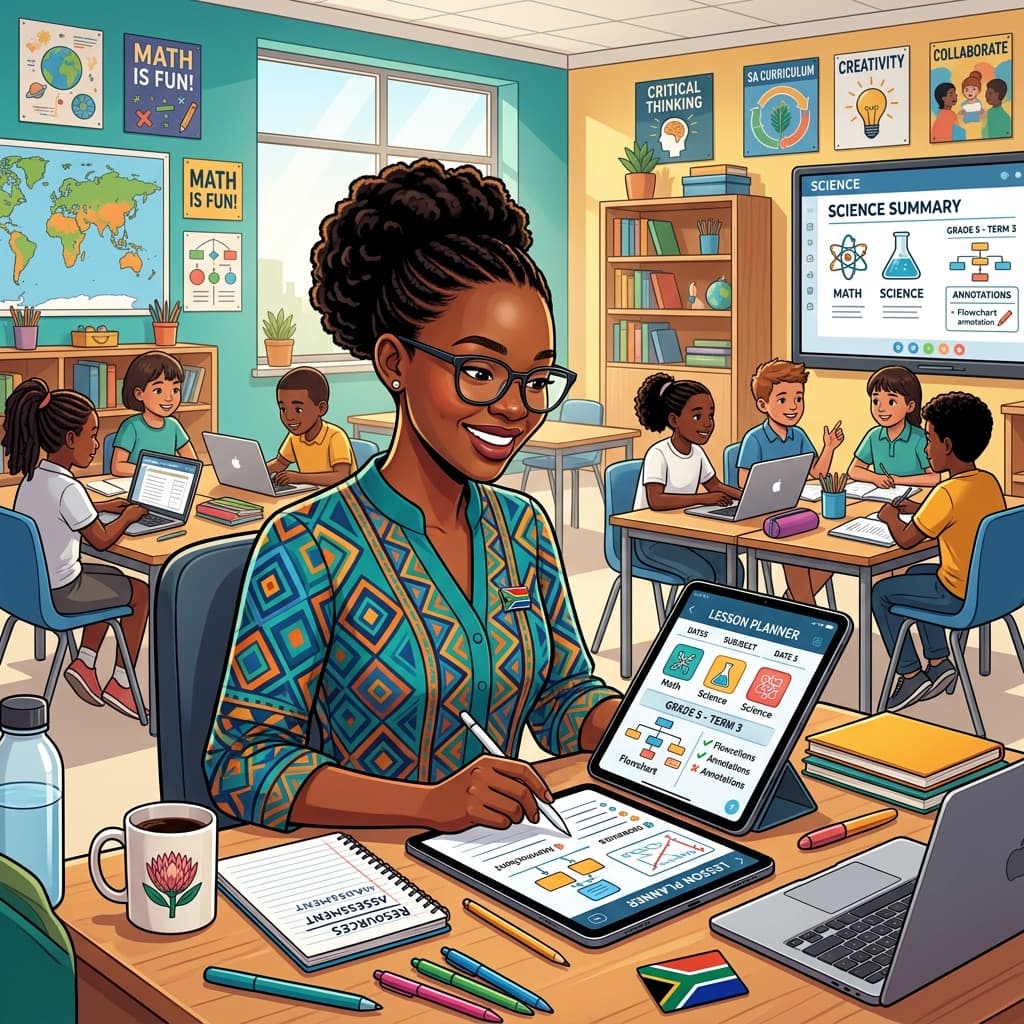
The New Frontier of South African Education
The South African educational landscape is at a crossroads. For decades, our educators have been the backbone of the nation, navigating shifting curricula, overcrowded classrooms, and the relentless pressure of the Department of Basic Education’s (DBE) Annual Teaching Plans (ATPs). However, the "chalk and talk" era is rapidly evolving. We are no longer just preparing learners for exams; we are preparing them for a world dominated by the Fourth Industrial Revolution (4IR).
For a teacher in 2026, digital literacy is no longer an optional "extra-mural" skill—it is a fundamental requirement for survival and success. The introduction of Artificial Intelligence (AI) in education has created a paradigm shift. While some view AI with skepticism, fearing it might replace the human element of teaching, the reality is quite the opposite. AI is the most powerful assistant a South African teacher could ask for, provided they have the training to use it effectively.
At SA Teachers, we understand that your time is your most precious resource. This post explores why AI training is the key to unlocking a more sustainable, impactful teaching career and how our platform serves as the bridge between traditional pedagogy and future-ready instruction.
1. Addressing the Administrative Burden and Burnout
Ask any educator from Polokwane to Port Elizabeth what their biggest challenge is, and the answer is almost always the same: administrative overload. The "paperwork mountain"—comprising lesson plans, assessment records, learner profiles, and termly reports—often leaves teachers with little energy for actual teaching.
The Psychology of Teacher Burnout
Burnout in the South African context is often linked to the "hidden workload." This is the work that happens after 14:30—the hours spent hunched over a laptop or marking pile. When teachers lack digital skills, they perform these tasks manually, which is inefficient and mentally draining.
AI training allows teachers to automate the mundane. Imagine a scenario where the hours spent agonising over report comments are reduced to minutes.
This is where digital skills meet practical application. Instead of typing "John has worked hard this term" fifty times, our Report Comments Generator allows teachers to input specific learner traits and achievements. The AI then generates professional, personalised, and grammatically correct comments that adhere to South African school standards. This doesn't just save time; it ensures that every learner receives meaningful feedback that reflects their unique progress, which is a core requirement of the CAPS assessment framework.

2. Navigating the Pressure of ATPs and CAPS Alignment
The Curriculum and Assessment Policy Statement (CAPS) is comprehensive, but the pace required by the ATPs can be punishing. Educators often feel they are "racing to finish the syllabus" rather than ensuring deep conceptual understanding.
Why AI Training Matters for Curriculum Delivery
Digital skills enable a teacher to map out an entire term's content in a fraction of the time. AI training teaches an educator how to "prompt" a system to align content with specific CAPS requirements. Without these skills, a teacher might spend a whole weekend trying to find resources that fit the specific themes required for Grade 9 Social Sciences or Grade 4 Mathematics.
Solution: CAPS-Aligned Lesson Planner
Our CAPS-Aligned Lesson Planner is designed specifically for the South African context. By using this tool, teachers can generate detailed lesson plans that include:
- Specific aims and objectives.
- Introduction, teaching phase, and conclusion.
- LTSM (Learning and Teaching Support Materials) lists.
- Differentiation strategies for diverse classrooms.
By mastering this tool, a teacher ensures they are always "on track" with their ATPs without sacrificing the quality of their instruction. It allows for a level of precision that manual planning simply cannot match in a busy school day.
3. Bridging the Resource Gap with Custom Content
South African classrooms are incredibly diverse. A teacher might be working in a well-resourced urban school or a rural quintile 1 school with limited textbooks. Digital skills empower teachers to create their own high-quality resources, democratising access to education.
From Consumption to Creation
AI training moves a teacher from being a consumer of resources to a creator. If a textbook doesn't explain "Photosynthesis" in a way that resonates with your specific learners, you can use AI to rewrite the explanation using local examples and simpler vocabulary.
Solution: Worksheet & Exam Generators and Study Guide Creator
At SA Teachers, our Worksheet & Exam Generators allow you to create assessments that follow the Bloom’s Taxonomy levels required by the DBE. You can generate a formal assessment for Grade 11 Physics, complete with a memorandum, in seconds.
Furthermore, our Study Guide Creator helps you synthesise complex chapters into digestible summaries for your learners. This is particularly vital for Matric revision, where learners are often overwhelmed by the volume of content. When a teacher knows how to use these tools, they can provide every learner with a "private tutor" experience through high-quality, custom-made guides.
4. Revolutionising Assessment and Feedback
Marking is arguably the most disliked task in the profession. In South African schools, where class sizes can exceed 40 or 50 learners, providing detailed feedback on essays or long-form answers is a logistical nightmare.
The Feedback Loop
Educational research shows that feedback is most effective when it is immediate. If a learner receives their corrected essay three weeks after writing it, the "teachable moment" has passed. Digital skills, specifically in AI-assisted grading, allow for a rapid feedback loop.
Solution: Essay Grader & Rubric Creator
The Essay Grader & Rubric Creator on our platform isn't about letting a machine do the thinking—it’s about enhancing the teacher’s oversight.
- Rubric Creator: You can generate a CAPS-aligned rubric for a Creative Writing task in seconds.
- Essay Grader: The AI can provide a preliminary grade and detailed suggestions for improvement based on your rubric.
The teacher remains the final authority, but the AI does the heavy lifting of identifying grammatical errors, structural issues, and thematic gaps. This allows the teacher to focus on the "human" side of feedback—mentoring the learner and addressing specific misconceptions.
AI Education Tutor
Personalized AI coaching for your specific teaching needs.

5. Enhancing Learner Engagement through AI Literacy
Our learners are "digital natives," but that doesn't mean they are "AI literate." They know how to use social media, but they don't necessarily know how to use technology for learning. If teachers are not trained in AI, they cannot guide their learners in using these tools ethically and effectively.
The Role of the AI Tutor
We must move away from the fear of "learners using AI to cheat" and toward "learners using AI to learn." When a teacher introduces an AI Tutor (like the one available on sateachers.co.za) into the classroom, they are providing a scaffold for self-directed learning.
The AI Tutor can:
- Answer "why" questions that a learner might be too shy to ask in front of the class.
- Explain a concept in multiple ways (e.g., "Explain the Water Cycle as if I am five years old," then "Explain it for a Matric student").
- Provide immediate help during homework sessions when the teacher isn't available.
Teachers who are trained in these digital skills can set "AI-augmented" assignments, where learners use AI to research and then apply their critical thinking to synthesise the results. This is the type of high-level cognitive engagement that the DBE is striving for.
6. Future-Proofing Your Career
The Department of Basic Education is increasingly prioritising ICT integration. School Management Teams (SMTs) and School Governing Bodies (SGBs) are looking for educators who can lead their schools into the digital age.
Professional Development and the SACE Points System
Upskilling in AI and digital tools isn't just about making your life easier today; it’s about your career trajectory. Teachers who can demonstrate proficiency in AI-assisted teaching are more likely to be considered for promotions, HOD (Head of Department) positions, and curriculum advisory roles.
By engaging with the tools on SA Teachers, you are not just using a website; you are participating in a continuous professional development programme. Learning to "prompt" an AI, understand data privacy, and integrate digital assessments are skills that will be mandatory within the next five years.
7. Practical Steps to Get Started
If you feel overwhelmed by the prospect of "AI training," remember that you don't need to be a computer scientist. Digital skills for teachers are about pedagogical application, not coding.
Step 1: Start Small with Administration
Don't try to overhaul your entire teaching method in one day. Start by using the Report Comments Generator for your next cycle of progress reports. Experience the relief of finishing your admin early.
Step 2: Enhance One Lesson a Week
Use the CAPS-Aligned Lesson Planner to prepare one particularly difficult topic. See how the AI suggests different ways to present the material. Use the Worksheet Generator to create a quick "exit ticket" quiz for that lesson.
Step 3: Foster AI Literacy in Learners
Introduce your learners to the concept of an AI Tutor. Show them how to ask questions that help them understand, rather than just asking for the answer. This builds a culture of inquiry in your classroom.
The SA Teachers Commitment
At SA Teachers, our mission is to empower the South African educator. We believe that by providing AI-powered tools that are specifically tailored to our local curriculum (CAPS) and our unique classroom challenges, we can help restore the joy of teaching.
The digital divide is often discussed in terms of hardware—tablets and Wi-Fi. But there is also a "skills divide." A teacher with a smartphone and the right digital skills can be more effective than a teacher with a smartboard who doesn't know how to use it.
- CAPS Focus: Unlike generic AI tools (like ChatGPT), our generators are programmed to understand the specific requirements of the South African National Curriculum Statement.
- Time-Saving: Every tool is built to reduce the "click count." We want you back in the classroom (or with your family), not stuck at your desk.
- Accessibility: Our tools are intuitive. If you can send an email, you can use our platform.
Conclusion: Embracing the "Bionic Teacher"
The future of education is not "AI vs. Teachers"; it is "Teachers with AI." This is the era of the "Bionic Teacher"—an educator whose natural empathy, experience, and passion are amplified by the speed and efficiency of digital tools.
By investing in AI training and digital skills, you are choosing to thrive rather than just survive. You are choosing to provide your learners with the best possible version of yourself—one that is not burnt out by admin, but inspired by the possibilities of modern pedagogy.
The tools are ready. The curriculum is mapped. The only question is: are you ready to take the first step?
Visit sateachers.co.za today to explore our CAPS-aligned tools and start your journey toward a more efficient, AI-powered teaching career. Let's build the future of South African education, together.
SA
Dedicated to empowering South African teachers through modern AI strategies, research-backed pedagogy, and policy insights.