Classroom Management in Overcrowded Schools: Tips from a Veteran Teacher in South Africa
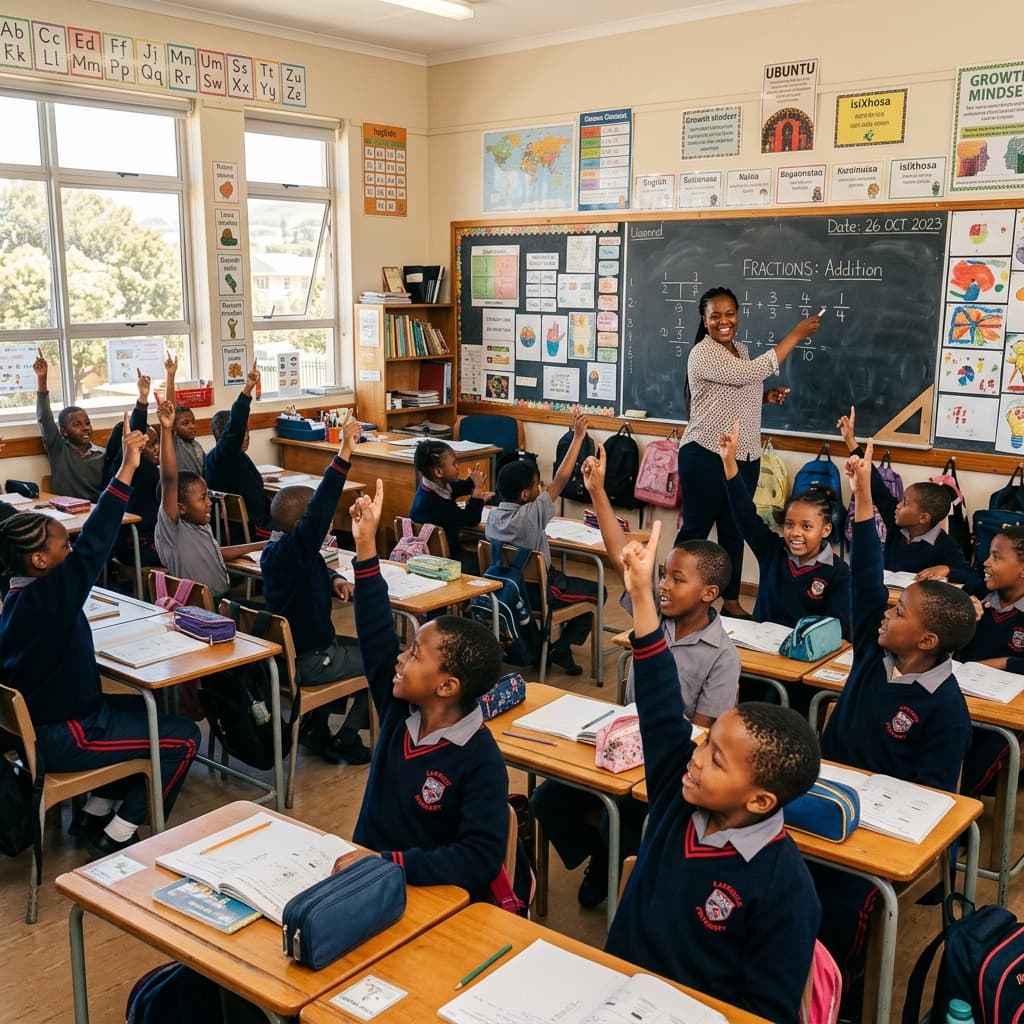
My Grade 11 classroom has forty-seven learners, two broken fans, and exactly enough space between the desks for me to walk sideways. On Mondays after break, those forty-seven teenagers arrive with a week's worth of energy, weekend stories, and varying degrees of readiness to engage with trigonometry. Managing that room — not just keeping order but actually facilitating deep learning — is the most demanding professional skill I have ever developed.
Being a teacher in South Africa means being a classroom management expert by necessity. Unlike in many other countries, we rarely have the luxury of small, easily managed class sizes or abundant support systems. We manage what we have, with what we have, and we do it remarkably well. This article is a deep-dive into what actually works — not theoretical frameworks from overseas textbooks, but lived, tested strategies from South African classrooms.
Understanding the Context: Why Our Classrooms Are Overcrowded
Before we talk solutions, let us name the problem honestly. South Africa has approximately 13 million learners in the public schooling system and a critical shortage of qualified teachers. The Department of Basic Education sets a learner-to-teacher ratio target of 40:1 in primary schools and 35:1 in secondary schools, but in many schools — particularly in Quintile 1 to 3 categories — the reality is closer to 50:1 or beyond.
The reasons are structural. Under-investment in school infrastructure over decades means that many schools simply do not have enough classrooms. Population growth in certain areas outpaces school construction. Teacher vacancies — particularly in priority subjects like Mathematics, Physical Sciences, and Accounting — leave departments understaffed. And the reality of South Africa's post-apartheid geography means that many township and rural schools serve vastly larger learner populations than their facilities were designed to accommodate.
Understanding this context is not about making excuses — it is about approaching classroom management with clear-eyed realism. The strategies that work for 47 learners in a hot, cramped room are different from those designed for 25 learners in a climate-controlled classroom in Finland. Effective classroom management as a teacher in South Africa requires specifically South African solutions.
The Foundation: Establishing Routines That Create Order
Every experienced South African educator I know has built their classroom management approach on a bedrock of consistent, predictable routines. Routines are the invisible architecture of a well-managed classroom. When learners know exactly what is expected of them when they walk through the door, you eliminate the uncertainty and negotiation that is the primary source of behavioural disruption.
Here are the non-negotiable routines I have built over eleven years:
The Entry Routine. As learners enter the classroom, there is an activity on the board. Not an option — an activity. It may be five Mathematics warm-up problems, three vocabulary questions, a quick comprehension paragraph, or a review of yesterday's key concepts. The rule is simple and consistently enforced: you sit down, you open your book, you start the activity. This transition from corridor noise to classroom focus happens in under three minutes when the routine is established. In the first weeks of school, I stand at the door greeting every learner by name and pointing to the board activity. By Week 3, they do it automatically.
Material Distribution. In a class of 47, distributing worksheets or materials can consume five to seven minutes and generate significant noise and movement. My solution: four designated "material monitors" rotate weekly. They collect and distribute everything — papers, worksheets, equipment, marked books. This eliminates the chaos of everyone reaching for materials simultaneously and gives specific learners a responsibility that builds investment in classroom order.
The Attention Signal. I do not raise my voice to get attention. I have trained my classes over many years to respond to a single signal: I raise my hand. The first learner who notices raises their hand, stops talking, and looks at me. This spreads across the room like a wave. Within twenty to thirty seconds, the class is silent and attentive. This technique works in classrooms of any size. It works because I am consistent — the hand goes up and stays up until there is silence. I never speak over noise.
The Transition Routine. Moving between activities in a large class generates noise and loss of momentum. I use countdowns. "In thirty seconds, close your books and face the front. 30... 20... 10... 5..." The countdown gives learners time to finish their sentence, put their pencil down, and reorient — rather than the jarring abruptness of "stop right now." This sounds small, but it reduces transition time by half.
The Exit Routine. The way a class ends shapes how the next one begins. I never dismiss learners because the bell rings. The bell tells me it is time to begin my dismissal routine, not the learners. We close books, I ask two or three review questions from the lesson, the class answers, and then I dismiss row by row. This takes ninety seconds and means the next teacher receives a class that has left an organised, calm room — a professional courtesy that builds collegial goodwill.
Seating Arrangements for Large, Crowded Spaces
Seating in an overcrowded classroom is simultaneously a management tool and a learning tool. There is no single perfect configuration — each works better for different pedagogical purposes.
Traditional rows maximise floor space and are most appropriate for direct instruction and formal assessment tasks. In a room with forty-seven learners and limited floor space, rows may be the only physical possibility. Within this constraint, strategic seat placement remains powerful. Learners who struggle with focus should be seated near the front, where proximity management is easiest. Learners who tend to be social distractors should be separated — not punished, but strategically placed where their social energy does not cascade outward to four neighbouring learners.
Clusters of four work well for collaborative learning and group activities. The challenge in an overcrowded classroom is that clusters take up significantly more floor space than rows. My solution is a "flexible row" arrangement — rows that are close enough for collaborative pair work but can be pushed together quickly for group work when the lesson requires it. This hybrid approach makes the best of the space available.
The most important seating principle is this: know every learner's name and know where they sit by the end of Week 2. When you know names and positions, you can manage with precision — a quiet word, a look, a brief pause in front of a desk — rather than general class reprimands that disrupt everyone to address the behaviour of one learner.
Group Work in Large Classrooms: Structured Collaboration
One of the most persistent myths about overcrowded South African classrooms is that group work is impractical. I want to challenge this directly. Group work in large classes is not impossible — it requires more structure, more deliberate role assignment, and clearer expectations. Done well, it is one of the most powerful pedagogical tools a teacher in South Africa has, because it allows peer learning to multiply your instructional reach.
Here is my group work protocol for large classes:
Assign roles explicitly. Every group of four has four roles: Facilitator (keeps the group on track and manages time), Scribe (records the group's ideas), Reporter (presents the group's conclusions to the class), and Quality Controller (checks that the work meets the task requirements before submission). When roles are explicitly assigned and rotated between tasks, every learner has a specific function and cannot opt out.
Set non-negotiable noise levels. I use a "15-centimetre voice" rule: in group work, your voice should only carry 15 centimetres — meaning the person next to you can hear you, but I cannot hear your specific words from the front of the room. This is practised explicitly in the first few weeks. When the noise level exceeds this, I give one warning. If the warning is not heeded, the class works in silence. Consistently enforcing this boundary means I rarely need to enforce it.
Use time pressure. Group work in large classes goes off-task most often when there is insufficient time pressure. Give groups a specific, tight deadline — five minutes for a discussion task, ten minutes for a short writing task. A visible countdown on the board (or a simple timer on a mobile phone) creates a productive urgency that keeps groups focused.
Monitor strategically. In a large classroom, you cannot visit every group every minute. Prioritise groups with learners who have a history of going off-task. Use strategic positioning — stand near the groups most likely to derail, while scanning the rest of the room. Your physical presence near a group is the most powerful management tool you have.
Positive Behaviour Reinforcement: Building a Culture of Accountability
South African schools operate under the SA Schools Act and the Code of Conduct, which explicitly prohibit corporal punishment. Yet many schools still struggle to articulate a coherent positive discipline framework. As a teacher in South Africa, building a classroom culture grounded in positive reinforcement rather than punitive control is both more ethical and more effective.
Positive reinforcement is not about giving learners prizes for breathing. It is about making the expectations of good behaviour explicit, recognising when those expectations are met, and creating a classroom culture where the social norm is engagement and respect.
The Class Contract. In the first week of school, I spend twenty minutes co-creating a class contract with every class. We discuss what behaviours help us learn, what behaviours prevent learning, and what the consequences of repeated disruption should be. Learners are far more likely to honour agreements they helped create than rules imposed from above. The contract is signed by every learner and displayed in the classroom.
Verbal recognition. Naming specific positive behaviour publicly is powerful. "Thabo, I appreciate how you listened to Amahle's idea before responding — that is exactly the kind of respectful discussion we are building." This takes five seconds and communicates to the whole class what valued behaviour looks like, without embarrassing the named learner.
The Private Conversation. For persistent behavioural challenges, I never address them publicly. Public confrontation in front of peers almost always escalates. Instead, I ask the learner to step out after class. Private conversations — where I can express concern rather than anger, ask about what is driving the behaviour, and collaboratively problem-solve — are far more effective than public reprimands.
Gradual consequence escalation. My consequence system is clear, graduated, and fair: proximity (standing near the disruptive learner without speaking), private verbal warning, seat change, parent contact, referral to HOD. I do not jump to the HOD for a first offence — it undermines the HOD's authority and signals that I cannot manage my own classroom. I handle what I can handle, and refer what genuinely requires escalation.
Tracking Individual Progress in Large Classes
One of the hardest challenges for a teacher in South Africa managing large classes is maintaining an accurate picture of where every individual learner is — not just who is disruptive, but who is silently struggling, who has mastered the content and needs extension, and who has been absent during critical lessons.
Exit tickets are one of my most powerful assessment tools. At the end of every lesson, learners spend three minutes answering a single focused question on a small slip of paper. The question targets the lesson's core objective. I collect the slips as learners leave, sort them into three piles (understood, partially understood, not understood) in about ten minutes that evening, and use the results to plan the next lesson's opening activity. This takes no marking time — I am reading for patterns, not scoring for records.
Quick check-in strategies. I use simple whole-class response systems: thumbs up/down/middle for confidence checks, slates or small whiteboards for quick written responses held up simultaneously, colour cards (green for "I'm fine," yellow for "I need help," red for "I'm lost") that learners keep on their desks. These give me immediate classroom-wide data without requiring me to speak to each individual learner.
The Learner Support Register. I maintain a simple spreadsheet of learners who have been flagged as needing additional support — those who failed their SBA task, those whose class performance suggests learning gaps, and those who have disclosed personal difficulties affecting their learning. I review this register at the beginning of each term and make deliberate plans to check in with these learners at least twice a week. In a class of 47, this means five minutes of intentional attention per targeted learner per week — manageable, but only if it is planned.
The Human Cost of Overcrowding — and Why Connection Still Matters
I do not want to end this article without acknowledging what overcrowded classrooms cost us emotionally. When you teach forty-seven learners in a space designed for thirty, you are inevitably less responsive to individuals than you would like to be. You miss things. You do not always notice the learner at the back who has gone quiet for three days because something difficult is happening at home. You cannot always give the extended explanation that the struggling learner in the middle row needs, because twenty other hands are raised and the clock is moving.
This reality is not a personal failure — it is a systemic one. And yet, within it, experienced teachers in South Africa find ways to remain human and responsive. We learn names. We notice changes. We greet learners at the door. We write a quiet note of encouragement on a returned script. We spend the extra five minutes after class with the learner who needs to talk. We build connection in micro-moments, because that is what we have.
The learners who remember us years later rarely remember our lesson content. They remember that we saw them — that in a crowded room, they felt noticed and cared for. That is what makes classroom management in South African schools more than a set of techniques. It is, ultimately, a deeply human practice.
Sipho Khumalo has spent eleven years teaching in South African public schools and is passionate about practical classroom management strategies that work in the real context of South African education.
Sipho Khumalo
Dedicated to empowering South African teachers through modern AI strategies, research-backed pedagogy, and policy insights.