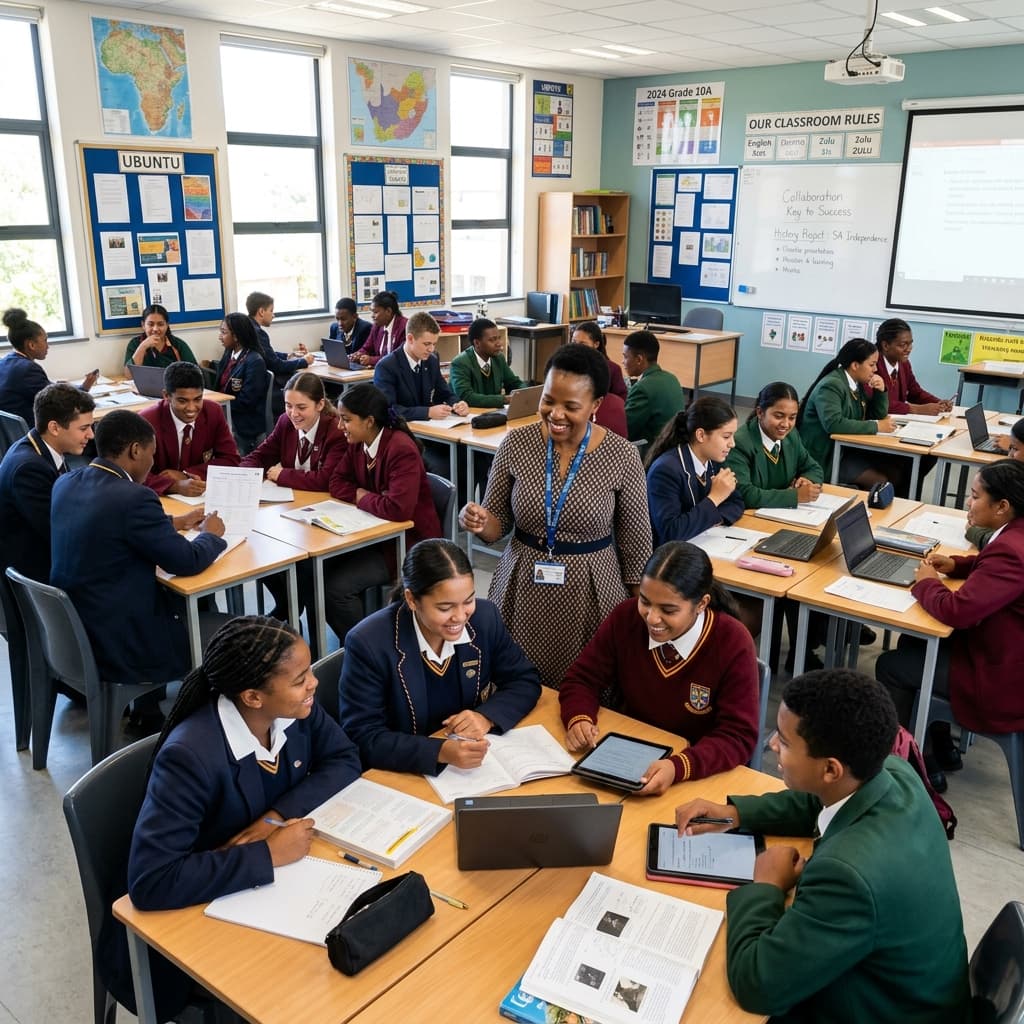
The Power of Purposeful Seating: Transforming Learning in Your South African Classroom
As South African educators, we're continually seeking innovative yet practical ways to elevate learning in our diverse classrooms. We navigate the dynamic landscape of the CAPS curriculum, striving to create environments where every learner can thrive, participate, and reach their full potential. Often, our focus is on curriculum delivery, lesson planning, and assessment. But what if one of the most impactful, yet often overlooked, tools for improving learning is right under our noses – literally?
We're talking about classroom seating arrangements. Far from being a mere logistical exercise, the way you arrange your desks and chairs can profoundly influence student engagement, classroom management, collaboration, and ultimately, learning outcomes. A thoughtful seating plan can be a game-changer, fostering an atmosphere that aligns perfectly with the active, learner-centred approach advocated by CAPS.
Why Seating Matters More Than You Think
Consider the core tenets of the CAPS curriculum: promoting active learning, encouraging critical thinking, fostering collaboration, and differentiating instruction to meet individual needs. How can these be effectively achieved if the physical setup of your classroom inadvertently hinders them?
- Engagement and Participation: A student tucked away in the back corner might feel less inclined to participate than one positioned closer to the front or within a collaborative group.
- Collaboration and Communication: CAPS frequently requires group work, discussions, and peer learning. An arrangement that physically separates students makes these activities difficult, if not impossible.
- Classroom Management: Proximity is power for a teacher. Certain arrangements allow you to move more freely, monitor progress, and address off-task behaviour more discreetly and effectively.
- Differentiation: Some learners thrive in quiet, independent settings, while others benefit from peer support. Your seating plan can be a powerful tool for catering to these diverse learning styles and needs.
- Teacher-Student Connection: The physical layout can impact how easily you connect with individual students, build rapport, and provide personalised feedback.
It's clear that seating isn't just about maintaining order; it's a strategic instructional decision. Let's explore various common seating arrangements, their advantages and challenges, and how they can be effectively implemented within the context of South African schools and the CAPS curriculum.
Exploring Different Seating Arrangements for Optimal Learning
There's no one-size-fits-all "best" arrangement. The most effective setup will depend on your lesson objective, the subject matter, class size, and your learners' specific needs. The key is flexibility and purpose.
1. Traditional Rows
This is the most common arrangement we've all experienced, and it certainly has its place.
- Description: Desks are arranged in straight lines, facing the front of the classroom.
- CAPS Relevance: Ideal for individual work, formal assessments (tests, exams), and direct instruction where students need to focus on the teacher or a presentation. Think Maths problem-solving sessions where individual focus is paramount, or Life Sciences practicals requiring individual observation and recording.
- Advantages:
- Minimises distractions: Students primarily face forward, reducing opportunities for chatting with neighbours.
- Clear sightlines: Most students have a direct view of the board and the teacher.
- Easy classroom management: Allows for clear pathways for the teacher to monitor work and move around.
- Good for independent work: Fosters an environment of individual focus and responsibility.
- Space-efficient: Can accommodate a larger number of students in a given space, which is often a reality in South African classrooms.
- Disadvantages:
- Limits collaboration: Makes group work and peer-to-peer discussion challenging.
- Reduces student-teacher interaction: Can create a sense of distance, especially for students at the back.
- Passive learning: Can promote a more passive learning style, where students are primarily receivers of information.
- Difficulty with differentiation: Harder to provide targeted support to specific individuals without disrupting others.
- Best Use Cases:
- Individual reading or writing tasks.
- Formal tests and examinations (e.g., CAPS assessments).
- Direct instruction or lectures (e.g., explaining new concepts in Natural Sciences).
- Viewing presentations or videos.
- Practical Tips for SA Teachers:
- Break up monotony: Even in rows, incorporate short "turn-and-talk" activities to encourage brief discussions.
- Strategic seating: Place students who require more supervision closer to the front or near your usual walking paths.
- Movement is key: Don't stay fixed at the front. Walk the aisles, interact with learners, and check their understanding regularly.
- Consider modified rows: Instead of rigid straight lines, try slightly staggered rows to improve sightlines and reduce the feeling of absolute separation.
2. Group Pods/Tables
This arrangement is a favourite for fostering collaboration and is particularly well-suited to the group work emphasis in CAPS.
- Description: Desks are pushed together to form small islands or pods, typically seating 2-6 students.
- CAPS Relevance: Directly supports collaborative learning, problem-solving in groups (e.g., EMS case studies, creative writing in Home Language), peer teaching, and project-based learning. Allows for "think-pair-share" and small group discussions integral to many CAPS subjects like Social Sciences and Life Orientation.
- Advantages:
- Promotes collaboration: Encourages students to interact, share ideas, and work together.
- Facilitates peer learning: Students can learn from each other and explain concepts in their own words.
- Enhances engagement: Active participation is often higher in small groups.
- Easier differentiation: Allows you to target specific groups for support or extension activities.
- Develops social skills: Teaches teamwork, negotiation, and communication.
- Disadvantages:
- Can be noisy: Managing noise levels can be a significant challenge, especially with larger classes.
- Distractions are common: Students are more prone to off-task conversations.
- Difficulty for individual focus: Some students may find it hard to concentrate amidst group activity.
- Space constraints: Can consume more floor space, making it challenging in smaller classrooms or with very large classes.
- Uneven participation: Some students might dominate, while others become disengaged or "free-ride."
- Best Use Cases:
- Group projects and assignments.
- Brainstorming sessions.
- Debates and discussions (e.g., ethical dilemmas in Life Orientation).
- Collaborative problem-solving tasks (e.g., Maths word problems, Natural Sciences experiments).
- Peer tutoring and review.
- Practical Tips for SA Teachers:
- Strategic grouping: Don't just let students pick. Group strategically based on ability, personality, or learning style to ensure balanced participation and peer support. Rotate groups regularly.
- Clear expectations: Establish clear rules for group work, including noise levels, roles within the group, and expected outcomes.
- Active monitoring: Circulate constantly, listen to discussions, and intervene where necessary to keep groups on track.
- Vary group size: Try groups of 2, 3, or 4 rather than always 5 or 6, especially for larger classes. Smaller groups are often more productive.
- Accountability: Ensure individual accountability within group tasks (e.g., each student has a specific role, or they complete an individual reflection after group work).
3. Horseshoe or U-Shape
This versatile arrangement combines some benefits of traditional rows with increased opportunities for interaction.
- Description: Desks are arranged in a large U or horseshoe shape, with the open end facing the front of the classroom.
- CAPS Relevance: Excellent for whole-class discussions, presentations, and interactive lessons. It facilitates eye contact between students and with the teacher, promoting dialogue and a sense of community, crucial for subjects like Creative Arts discussions or Life Skills debates.
- Advantages:
- Improved visibility: All students can see the teacher and the board, as well as each other.
- Fosters discussion: Encourages whole-class and small-group interaction.
- Teacher mobility: Allows the teacher to easily move around the inside and outside of the U, getting close to every student.
- Sense of community: Creates a more inclusive atmosphere where everyone feels part of the conversation.
- Suitable for presentations: Students can easily present to the class from the open end.
- Disadvantages:
- Space-intensive: Requires a good amount of floor space, which can be a limitation in many South African classrooms.
- Can be distracting: Students facing each other might get distracted more easily.
- Limited for individual work: Not ideal for extended periods of silent, individual work.
- Best Use Cases:
- Whole-class discussions and debates.
- Student presentations.
- Demonstrations (e.g., Science experiments).
- Interactive read-alouds or storytelling.
- Brainstorming sessions.
- Role-playing scenarios in Life Orientation.
- Practical Tips for SA Teachers:
- Define the "open" space: Use the open end for projector screens, whiteboards, or as a designated presentation area.
- Keep it dynamic: Use this arrangement for specific activities, then transition back to other setups if needed.
- Manage discussions: Establish clear protocols for speaking and listening to maintain respectful and productive dialogue.
- Consider a double U: If your class is very large, two concentric U-shapes can work, but this requires even more space.
4. The Circle
The most intimate and egalitarian of arrangements, fostering strong community bonds.
- Description: Desks and/or chairs are arranged in a single, unbroken circle.
- CAPS Relevance: Primarily for fostering deep discussion, community building, and active listening. Perfect for sensitive discussions in Life Orientation, reflections in Home Language, or sharing perspectives in Social Sciences.
- Advantages:
- Maximum interaction: Every student can see every other student, promoting active listening and participation.
- Equality: Eliminates "front" and "back," making everyone feel equally important.
- Community building: Fosters a strong sense of belonging and trust.
- Ideal for dialogue: Excellent for Socratic seminars, debates, and sharing personal reflections.
- Disadvantages:
- Highly space-intensive: Very difficult to implement in crowded classrooms with many desks. Often works best with chairs only, or if desks are pushed far back.
- Difficult to project: Requires flexibility in where you project or write on the board.
- Can be challenging for individual work: Not practical if students need to write or use textbooks frequently.
- High potential for distraction: Constant eye contact can lead to increased off-task behaviour if not managed carefully.
- Best Use Cases:
- Class meetings or check-ins.
- Debates and philosophical discussions.
- Storytelling or poetry readings.
- Reflective activities.
- Building classroom rapport and addressing social-emotional learning topics.
- Practical Tips for SA Teachers:
- Use it sparingly: Given space constraints, save this for particularly impactful discussions or specific community-building activities.
- Consider a "discussion circle" in front of the main desks: If moving all desks is impossible, gather students on carpets or cushions in a circle at the front for brief, focused discussions.
- Establish ground rules: Emphasise active listening, respect for different viewpoints, and taking turns speaking.
5. Stations or Centres
This arrangement is all about movement, differentiation, and catering to multiple learning activities simultaneously.
- Description: The classroom is divided into several designated areas or "stations," each focused on a different activity or learning task. Students rotate through these stations individually or in small groups.
- CAPS Relevance: Directly supports differentiated instruction and active learning across various CAPS subjects. For example, in a isiXhosa lesson, one station might be for reading comprehension, another for vocabulary practice, and a third for oral conversation practice. In Maths, stations could focus on different problem types or skills.
- Advantages:
- Highly differentiated: Caters to diverse learning styles, paces, and needs.
- Increased engagement: Variety keeps students interested and moving.
- Promotes independence: Students learn to manage their time and tasks.
- Maximises resources: Allows for the use of different learning materials at each station.
- Teacher as facilitator: Frees up the teacher to provide targeted support to small groups or individuals.
- Disadvantages:
- Requires significant planning: Preparing multiple activities and materials for different stations is time-consuming.
- Classroom management: Managing student movement and noise levels can be challenging.
- Space requirements: Can be difficult to set up distinct stations in a small, crowded classroom.
- Pacing issues: Some students might rush through stations, while others struggle to complete them.
- Best Use Cases:
- Reviewing concepts.
- Practising specific skills (e.g., grammar, calculations, scientific observation).
- Project-based learning components.
- Exploration of different topics within a unit.
- Independent reading or research.
- Practical Tips for SA Teachers:
- Start small: Begin with 2-3 stations instead of 5-6, and gradually build up as you and your students get comfortable.
- Clear instructions: Each station must have clear, concise, and self-explanatory instructions. Visual aids are crucial.
- Rotation strategy: Have a clear system for how students rotate (e.g., timed rotations, complete-and-move, choice-based).
- Preparation is key: Organise all materials for each station well in advance.
- The "teacher station": Designate one station where you work directly with a small group for targeted intervention or enrichment.
- Consider a "home base": Students return to their main desk for instructions or wrap-up, reducing chaos.
Key Factors to Consider When Designing Your Seating Plan
Beyond the specific arrangement types, several critical factors must guide your decisions, especially within the South African educational context.
1. Your Lesson Objectives and CAPS Requirements
This is paramount. What do you want students to do and learn in this particular lesson?
- Individual assessment? Rows are often best.
- Collaborative problem-solving? Group pods.
- Whole-class discussion or debate? Horseshoe or circle.
- Differentiated practice for different skill levels? Stations.
Align your seating to the instructional strategy required by the CAPS specific aims and content for that subject and grade.
2. Class Size and Classroom Space
We all know the realities of class sizes in South Africa. This is often the biggest constraint.
- Large classes: Rows are often the default for space efficiency. However, even with large numbers, strategic grouping (e.g., pods of 3 instead of 6) or temporary U-shapes can be achieved by moving only some desks.
- Limited space: Be creative. Can you push desks to the perimeter for a large central circle? Can you create "floor space" for group work by having students sit on mats or bring their chairs to a central spot?
- Movement paths: Always ensure clear, safe pathways for students and the teacher, regardless of the arrangement.
3. Student Needs and Dynamics
Your learners are unique. Tailor your plan to support them.
- Differentiation: Place students needing extra support near you. Group students strategically for peer tutoring (e.g., a strong reader with one who struggles).
- Behaviour management: Separate students who are easily distracted by each other. Place students with behavioural challenges near high-traffic areas where you can provide quick, discreet interventions.
- Special needs: Ensure students with visual or hearing impairments are close to the board or teacher. Provide ample space for learners with physical disabilities.
- Personality types: Mix quiet students with more vocal ones in group settings to encourage participation.
- Visual and auditory learners: Ensure good sightlines to visual aids and clear sound for verbal instructions.
4. Subject Matter and Activity Type
- Maths or Science practicals: Often require stable surfaces and clear individual space.
- Languages (Home/First Additional): Benefit immensely from discussion-based arrangements (pods, horseshoe) for oral work and debates.
- Arts and Culture/Creative Arts: May require open floor space for movement, performance, or larger projects.
- Technology-rich lessons: Consider access to power outlets if using devices, and ensure good visibility of screens.
5. Teacher Proximity and Accessibility
Your ability to move freely and quickly reach every student is vital for both instruction and management.
- Ensure you can easily circulate to provide individual feedback, check understanding, and address behaviour.
- The "proximity effect" – simply being near a student – can often curb off-task behaviour more effectively than verbal reprimands.
6. Noise Levels
Different arrangements naturally lead to different noise levels.
- Group work: Will be noisier than individual work. Establish clear expectations for "working voices" versus "silent work."
- Horseshoe/Circle: Can be conducive to productive discussion, but manage turn-taking to prevent shouting over each other.
Practical Strategies for Implementing and Managing Seating Arrangements
Changing your classroom layout might seem daunting, but with a few practical strategies, you can make it a smooth and effective process.
1. Start Small and Experiment
Don't feel pressured to overhaul your entire classroom overnight.
- Try one new arrangement for a specific lesson: For instance, just for a debate, push some desks into a U-shape.
- Observe and reflect: Did it work? What were the challenges? Ask your students for their feedback.
- Document: Keep a brief note of what worked well for which type of activity.
2. Involve Your Learners
Empower your students by involving them in the decision-making or execution.
- Explain the "why": Help them understand how different arrangements support different learning goals. This builds buy-in.
- Assign roles: Designate "table movers" or "chair stackers" to help with transitions.
- Student voice: Periodically ask them which arrangements they felt most productive in for particular activities.
3. Master Transitions
Moving desks can be chaotic if not managed well.
- Clear signals: Use a specific verbal cue, hand signal, or even a piece of music to signal a transition.
- Time limits: Give students a clear timeframe (e.g., "You have 2 minutes to move into your group pods").
- Practice: Rehearse transitions a few times at the beginning of the year so students know the routine.
- Pre-plan: If you know you'll need a different arrangement for the afternoon lesson, consider doing it during break time or asking a few responsible students to help.
4. Be Strategic with Grouping
Effective group work is more about the mix of students than just the physical arrangement.
- Teacher-assigned groups: Often more effective than student-selected groups for balancing skills and personalities.
- Rotate groups regularly: Prevents cliques and exposes students to diverse perspectives.
- Flexible grouping: Sometimes group by ability (e.g., for targeted intervention), other times by mixed ability (for peer support). Sometimes by interest.
5. Leverage Limited Resources Creatively
South African schools often have resource constraints, but this doesn't mean you can't be flexible.
- Move what you can: If moving all desks is too much, can you move just the chairs for a circle discussion?
- Use the floor: Carpets, cushions, or even just sitting on the floor can create alternative learning spaces for group work or reading.
- Outdoor classrooms: Don't forget the power of going outside! A natural setting can be perfect for group discussions, observations (Natural Sciences), or creative writing.
6. Reinforce Expectations Consistently
Whenever you change an arrangement, reiterate your classroom management expectations.
- "When we're in groups, remember our working voice rule."
- "When we're in a circle, we listen carefully and respect everyone's turn to speak."
- "For individual rows, we focus quietly on our independent tasks."
7. Consider "Flexible Zones"
Even if your default is rows, designate areas for specific purposes.
- A "reading nook": A small corner with a mat and some cushions for quiet reading.
- A "collaboration corner": Two desks pushed together permanently for small group work when needed.
- A "teacher's desk" area: Where you can work one-on-one with students.
Reflecting on Success: Is Your Seating Working?
Ultimately, the goal is improved learning. How will you know if your seating choices are effective?
- Observe student engagement: Are students actively participating? Are they on task?
- Listen to discussions: Are they rich and meaningful, or are students off-topic?
- Check learning outcomes: Are students achieving the lesson objectives more effectively?
- Gather feedback: Ask students directly. "Did you find it easier to work together today with this setup?" or "Did you feel you could concentrate better?"
- Monitor classroom dynamics: Is there less conflict? Is participation more equitable?
Empowering Your Classroom, One Arrangement at a Time
Designing an effective classroom seating arrangement is an ongoing process of observation, experimentation, and reflection. It's about being responsive to your learners' needs and aligning your physical space with the pedagogical goals of the CAPS curriculum.
By thoughtfully considering how you arrange your classroom, you're not just moving furniture; you're actively shaping the learning experience. You're fostering collaboration, promoting engagement, supporting differentiation, and ultimately, empowering your South African learners to reach new heights. So, take a moment to look at your classroom with fresh eyes – what subtle shifts could unlock a world of improved learning for your students today?
Siyanda. M
Dedicated to empowering South African teachers through modern AI strategies, research-backed pedagogy, and policy insights.