Navigating the Classroom Landscape: Thriving Without Abundant Resources
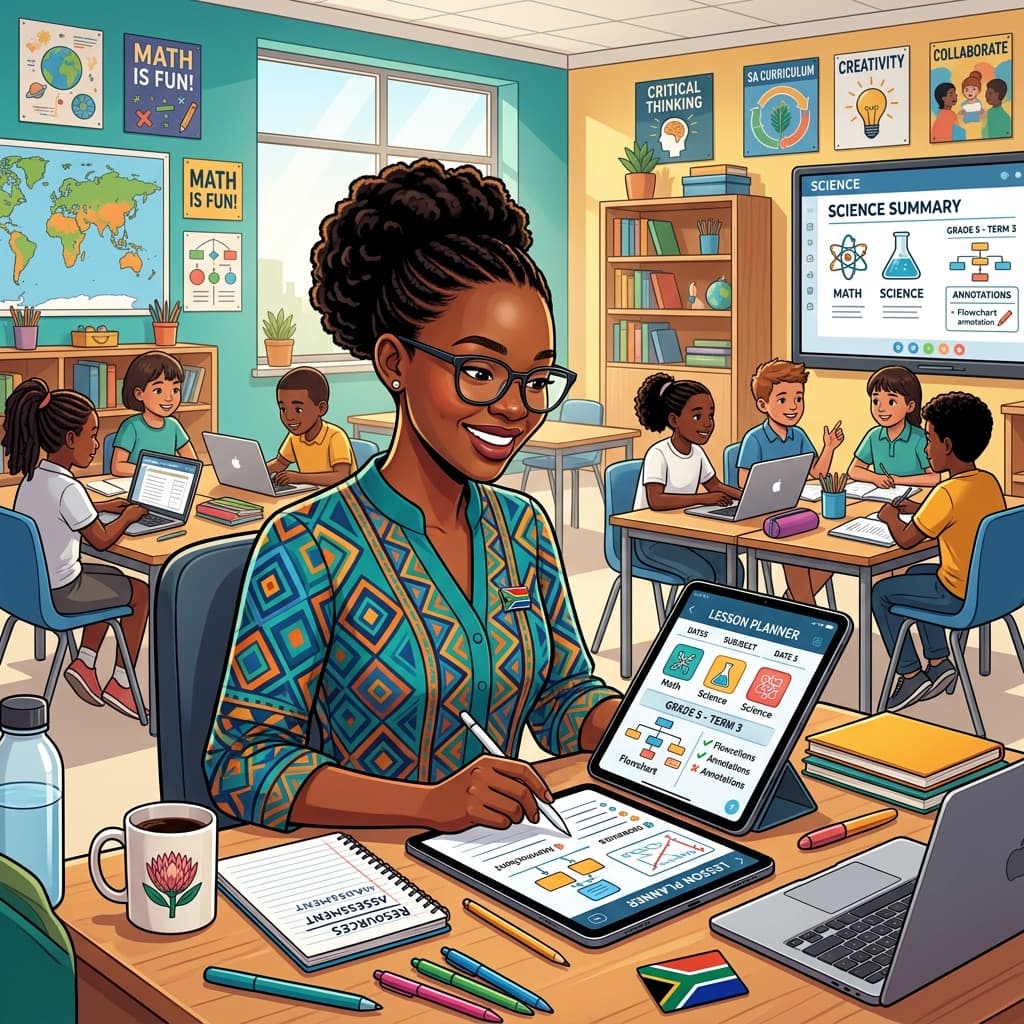
For many dedicated South African teachers, the classroom ideal often clashes with the practical realities of limited resources and insufficient equipment. It's a challenge that can feel isolating and overwhelming. Yet, across our beautiful country, countless educators are not just surviving but thriving, fostering vibrant learning environments with ingenuity, passion, and a profound understanding of what truly matters in education. This post is for you – the resourceful, resilient teacher shaping young minds against the odds. We'll explore practical, CAPS-aligned strategies to empower you to teach successfully, ensuring your learners receive a rich, engaging, and effective education, regardless of what's in the storeroom.
Acknowledging the Challenge, Embracing the Opportunity
Let's be clear: the lack of adequate resources is a significant hurdle. It impacts everything from practical demonstrations in Natural Sciences to visual aids in Language Arts, and even basic stationery for everyday tasks. However, viewing these constraints not as roadblocks but as catalysts for creativity can fundamentally shift your approach. Great teaching isn't defined by the shiny new equipment available, but by the teacher's ability to inspire, adapt, and connect with learners. Your resourcefulness is your greatest asset.
Shifting Your Mindset: The Power of Pedagogical Innovation
Before we dive into tangible tips, let's address the most powerful tool you possess: your mindset. Cultivating a resourceful perspective is the first step towards transforming challenges into triumphs.
Focus on What You *Do* Have
It's easy to lament what's missing. Instead, conduct an audit of your existing assets, no matter how small they seem.
- The Learners Themselves: Each child brings unique experiences, knowledge, and perspectives. Their prior learning and lived realities are invaluable teaching resources.
- Your Own Knowledge and Enthusiasm: Your expertise, passion, and ability to explain complex concepts clearly are unmatched by any piece of equipment.
- The Classroom Space: Even an empty room offers space for movement, group work, and visual displays on walls.
- Everyday Items: Scraps of paper, old newspapers, bottle tops, stones, leaves – the world outside your classroom is a treasure trove of learning materials.
Embrace Creativity and Innovation
Necessity truly is the mother of invention. When traditional resources are unavailable, it forces us to think outside the box, leading to genuinely innovative teaching methods that often prove more engaging and memorable for learners.
- Problem-Solving: Frame resource limitations as a collective problem-solving exercise with your learners. "How can we understand this concept without a diagram/model?" This builds critical thinking skills.
- DIY Spirit: Adopt a "do-it-yourself" approach. Many educational tools can be created cheaply or for free using repurposed materials.
See Constraints as Opportunities for Deeper Learning
Sometimes, the absence of a ready-made solution forces learners to engage more deeply with a concept.
- Active Construction of Knowledge: Instead of passively observing a pre-made model, learners might have to construct one themselves, leading to a much richer understanding.
- Developing Transferable Skills: Resource-limited environments often foster resilience, adaptability, and critical thinking in learners – skills crucial for life beyond school.
Leveraging Existing Resources (Even the Scraps!)
Let's get practical. How can you make the most of what's around you?
The Classroom Itself: Your Primary Canvas
Your physical classroom, no matter how basic, is a dynamic learning space.
- Walls as Whiteboards/Display Boards:
- Cover designated wall sections with large sheets of butcher paper, old newspaper (painted over with watered-down PVA), or cardboard. These become re-usable spaces for brainstorming, mind maps, and daily lesson points.
- Use string and pegs (even paper clips) to create temporary "washing lines" for displaying learner work, flashcards, or key vocabulary.
- Assign sections for different subjects or themes. Learners can contribute to these displays.
- Floor Space for Active Learning:
- Use masking tape or chalk to create grids for maths activities (number lines, coordinate planes).
- Arrange learners in circles or semi-circles for discussions, storytelling, or role-playing.
- Designate zones for group work, quiet reading, or practical activities.
- Furniture for Organisation and Learning:
- Desks can be grouped for collaborative tasks.
- Even a few chairs can become props for drama or storytelling.
- If you have cupboards, label them clearly and involve learners in keeping them organised.
Stationery & Basic Supplies: Maximising Every Item
Every pen, piece of paper, and scrap of cardboard is precious.
- Paper Scraps:
- Keep a box for paper offcuts. These are perfect for small notes, quick calculations, flashcards, or exit tickets.
- Repurpose old calendars or posters by writing on the blank reverse side.
- Cardboard:
- Cereal boxes, shoe boxes, delivery boxes – these are gold! Use them for:
- Flashcards: Cut into uniform sizes for vocabulary, maths facts, or science terms.
- Mini Whiteboards: Cover with clear plastic (contact paper if available) or laminate with packing tape. Learners can write on them with whiteboard markers (or even wax crayons/pencils if laminated) and wipe clean.
- Props & Models: Create simple 3D shapes, diagrams, or historical artifacts.
- Organisational Bins: Cut and fold cardboard to make dividers or storage boxes for smaller items.
- Cereal boxes, shoe boxes, delivery boxes – these are gold! Use them for:
- Chalk and Pens:
- Teach learners to conserve supplies. "Use every centimetre of chalk."
- Implement a system for borrowing and returning pens/pencils to reduce loss.
- Rulers and Measuring Tapes:
- If you lack enough, create simple paper rulers marked with centimetres. Learners can even make their own.
- Use string for measuring lengths, then compare to a standard ruler (if one is available).
Repurposing & Upcycling: Everyday Items as Educational Tools
Look at everyday "waste" through an educator's lens.
- Bottle Tops: Counting, sorting by colour/size, creating patterns, representing fractions (e.g., 4 green tops = 1 red top).
- Plastic Bottles/Containers:
- Cut the top off to make pen holders.
- Use for science experiments (measuring volumes, demonstrating water displacement).
- Create simple musical instruments (shakers with dry beans/rice).
- Toilet Paper/Paper Towel Rolls:
- Building blocks for structures.
- Telescopes for observation games.
- Cut and flattened, they can be used for drawing or writing.
- Newspapers/Magazines:
- Reading practice (vocabulary in context).
- Cut out pictures for collages, categorisation tasks, or creating visual stories.
- Use for science experiments (e.g., insulation).
- Provide a free source of paper for drawing or rough work.
Natural Materials: The Outdoor Classroom
South Africa's diverse natural environment offers an abundance of free learning resources.
- Stones/Pebbles: Counting, sorting, pattern making, representing numbers in maths, creating timelines (small stones for years, large for centuries).
- Leaves/Twigs: Science (identifying different species, life cycles), art, measurement (comparing lengths).
- Sand/Soil: Sensory play, understanding different soil types, building miniature landscapes for Geography.
- Water: Essential for science experiments (density, states of matter), demonstrating concepts of volume and capacity.
Harnessing the Power of Human Resources
Your classroom and school community are rich with untapped human potential.
Learners as Resources: Empowering Peer Learning
Learners are not just recipients of knowledge; they are powerful contributors.
- Peer Teaching:
- Pair learners who have grasped a concept with those who are struggling. This reinforces understanding for the "teacher" and provides accessible support for the "learner."
- Allow learners to explain concepts in their own words to the class.
- Group Work & Collaborative Projects:
- Assign roles within groups (e.g., facilitator, recorder, reporter).
- Projects that require minimal materials but maximal brainpower (e.g., designing a marketing campaign for a local product, creating a play about historical events).
- Active Participation:
- Encourage learners to bring in relevant items from home (with permission) that relate to a topic (e.g., a traditional cooking utensil for a Home Economics lesson, a local plant for Natural Sciences).
Your Fellow Teachers: A Network of Support and Ideas
You are not alone in this journey.
- Collaboration and Sharing:
- Regularly meet with colleagues to share teaching strategies, lesson plans, and even physical resources. "I have two extra protractors; can you share your old geography maps?"
- Team-teach or observe each other's lessons for fresh perspectives.
- Departmental Brainstorming:
- Hold sessions specifically dedicated to "resourceful teaching" within your department. Collect ideas, create a shared bank of DIY resources.
Parents & Community: Bridging School and Home
The local community is an invaluable, often overlooked, resource.
- Donations:
- Send out a respectful, well-worded request for specific items parents might have at home and no longer need: old magazines, plastic bottles, fabric scraps, unused stationery.
- Be clear about how items will be used.
- Guest Speakers:
- Invite parents or community members with specific skills or knowledge to speak to the class (e.g., a local carpenter to explain geometry, a gardener to discuss plant life, an elder to share historical stories).
- Local Businesses:
- Small businesses might be willing to donate materials (e.g., offcuts of fabric, cardboard from deliveries) or even host a small group for an educational visit.
- Community Walks/Field Trips (Local):
- Explore your immediate surroundings. A walk through the neighbourhood can be a rich lesson in Geography, Social Sciences, or even Natural Sciences (observing plants, animals, human impact).
Pedagogical Strategies for Low-Resource Environments (CAPS Aligned)
Effective teaching is not about the equipment; it's about the pedagogy. Here are strategies that align with CAPS principles and thrive in resource-limited settings.
Active Learning & Engagement: Moving Beyond the Textbook
CAPS encourages active learner participation. These methods naturally reduce reliance on external equipment.
- Discussion-Based Learning:
- Think-Pair-Share: Learners ponder a question individually, discuss with a partner, then share with the class. Requires only verbal participation.
- Socratic Seminars: Guided discussions where learners lead the inquiry through thoughtful questions.
- Debates and Role-Playing:
- Excellent for developing critical thinking, communication, and empathy. Use for History, Social Sciences, Life Orientation, or even Language Arts (character analysis).
- Minimal props needed – perhaps a makeshift 'mic' from a toilet roll.
- Storytelling:
- Oral storytelling (by teacher or learners) is a powerful tool for transmitting knowledge, cultural values, and language skills.
- Encourage learners to create their own stories, perhaps illustrated on available paper.
- Educational Games (Simple & DIY):
- Charades/Pictionary: For vocabulary, historical figures, scientific concepts.
- "I Spy": For observation, descriptive language.
- "20 Questions": For critical thinking, deduction.
- Board Games (DIY): Create simple board games on cardboard or large paper using bottle tops as markers and a hand-drawn dice.
Visual Learning (DIY Visual Aids): Crafting Understanding
Visuals are crucial for comprehension, especially for diverse learning styles.
- Charts and Posters (Hand-Drawn):
- Use large sheets of paper (butcher paper, old newsprint, flattened cardboard) for creating clear, colourful charts.
- Involve learners in the design and drawing – this fosters ownership and reinforces learning.
- Examples: mind maps, concept webs, timelines, process diagrams for science experiments, grammar rules, vocabulary lists.
- Flashcards (Repurposed Cardboard):
- Essential for memorisation and quick recall in subjects like Mathematics (tables, formulae), Language Arts (vocabulary, irregular verbs), and Natural Sciences (definitions, diagrams).
- Mind Maps and Concept Maps:
- Excellent for visualising connections between ideas, summarising information, and brainstorming. Can be done individually or as a class activity on a large shared surface.
Kinesthetic Learning: Learning by Doing
Movement and hands-on engagement solidify understanding.
- Practical Demonstrations (Using Learners as Models):
- Instead of a skeleton model, have learners act out the parts of the body.
- Demonstrate concepts like force and motion using learners' bodies or simple objects.
- Act out historical events or scientific processes.
- Movement Breaks:
- Incorporate short, relevant physical activities that relate to the lesson (e.g., "jump for adjectives," "stretch for verbs").
- Local Walks/Outdoor Exploration:
- As mentioned, a walk around the school grounds or neighbourhood can be a rich, hands-on learning experience for almost any subject. Observing patterns, collecting natural items, identifying local features.
Auditory Learning: The Power of Sound and Voice
- Engaging Lectures/Explanations:
- Even without visual aids, a well-structured, enthusiastic, and interactive explanation can be highly effective. Use anecdotes, questions, and varied vocal tones.
- Songs and Rhymes:
- A powerful mnemonic device for memorising facts, formulae, or sequences. Create your own songs or adapt existing tunes.
- Debates and Oral Presentations:
- Develop public speaking and listening skills. Encourage learners to articulate their thoughts clearly.
Practical Classroom Management & Organisation
Limited resources necessitate excellent organisation and a well-managed classroom environment.
Organising the Available Resources
- Designated Spots: Every item, no matter how small, needs a home. Use labelled boxes, containers (repurposed plastic bottles, cardboard boxes).
- Learner Ownership: Involve learners in tidying up and managing resources. Assign "resource managers" for the day or week. This fosters responsibility and care.
- Visibility: Store items where they are visible and accessible to minimise searching time, but also where they can be monitored.
Creating a Stimulating Learning Environment Despite Limitations
A visually rich environment doesn't require expensive posters.
- Learner Work Display: Regularly display high-quality learner work. This is highly motivating and creates a sense of pride.
- Themed Walls: Dedicate sections of walls to current themes or subjects. Change them regularly to keep the environment fresh.
- "Word Walls": Create a constantly evolving wall of key vocabulary words for each subject, with simple definitions or illustrations.
Embracing Technology (Even Basic Forms)
While advanced tech might be scarce, maximise what little you might have.
- The Single Projector/Computer:
- If you have access to one computer or projector, use it strategically. Project key diagrams, short educational videos, or interactive simulations. Plan its use meticulously to avoid time wastage.
- Share resources created on the computer with other teachers.
- Your Cell Phone:
- Use your smartphone (with appropriate permissions and policies) to:
- Take photos of learners' work or natural phenomena.
- Record short explanations or demonstrations.
- Play relevant audio clips or short videos.
- Use your smartphone (with appropriate permissions and policies) to:
- Radio/TV (if available):
- Tune into educational broadcasts if your school has a radio or TV. These can be valuable supplements to lessons, especially for subjects like history, current events, or science.
The Role of Assessment in Resource-Limited Settings
Assessment doesn't always require printed tests and specific equipment. CAPS promotes continuous, varied assessment.
Formative Assessment Strategies
These require minimal resources and provide immediate feedback.
- Observation: Pay close attention to learners during group work, discussions, and practical activities. Note their participation, understanding, and problem-solving approaches.
- Questioning: Use a variety of open-ended and targeted questions to gauge comprehension. Encourage learners to ask questions too.
- Quick Checks:
- Thumb Up/Down/Sideways: Quick visual check for understanding.
- Exit Tickets: Learners write one thing they learned or one question they still have on a small piece of paper (or even slate/mini whiteboard) before leaving.
- "Traffic Light" System: Learners show a red, orange, or green card (made from cardboard) to indicate their level of understanding.
- Peer Assessment: Learners evaluate each other's work based on clear criteria. This helps them understand what quality work looks like.
- Self-Assessment: Encourage learners to reflect on their own learning and identify areas for improvement.
Practical Demonstrations as Assessment
- Observe learners as they perform a task or explain a process orally. This is especially useful in subjects like Technology, Life Skills, or practical components of Natural Sciences.
- Have learners create their own models or diagrams and explain their thinking.
Building a Culture of Creativity and Innovation
Encourage learners to be part of the solution, fostering their own ingenuity.
- "Resource Challenge": Present a learning objective and challenge learners to come up with creative, low-cost ways to achieve it (e.g., "How can we demonstrate the water cycle using only items found in the classroom/schoolyard?").
- "Maker Space" (Simple Version): Designate a corner with collected recycled materials (cardboard, fabric scraps, bottle tops) where learners can freely create and experiment.
- Celebrate Ingenuity: Publicly acknowledge and praise learners who come up with creative solutions or DIY learning aids.
Teacher Wellbeing and Resilience
Teaching in challenging environments can be draining. Your wellbeing is paramount.
- Acknowledge Your Efforts: You are doing incredible, impactful work. Take a moment to recognise your own resilience and creativity.
- Connect with Fellow Teachers: Share your frustrations, successes, and tips. A supportive network is invaluable.
- Focus on Small Wins: Celebrate every moment of engagement, every spark of understanding, every learner who overcomes a challenge. These small victories fuel your spirit.
- Prioritise Self-Care: Even small moments of rest or pursuing a hobby outside of school can recharge you. You cannot pour from an empty cup.
Conclusion: The Heart of South African Education
Teaching successfully without abundant classroom equipment is not merely an act of resilience; it is a testament to the core values of South African education – adaptability, community, and the profound belief in the potential of every child. While the ideal classroom is well-resourced, the truly effective one is led by a teacher who is resourceful, innovative, and deeply committed to their learners.
You, the dedicated South African teacher, are the most powerful resource in your classroom. Your ability to inspire, to adapt, and to create meaningful learning experiences with whatever you have, is what truly transforms lives. Keep innovating, keep adapting, and continue to light up those young minds. Your impact extends far beyond the four walls of your classroom.
Siyanda. M
Dedicated to empowering South African teachers through modern AI strategies, research-backed pedagogy, and policy insights.