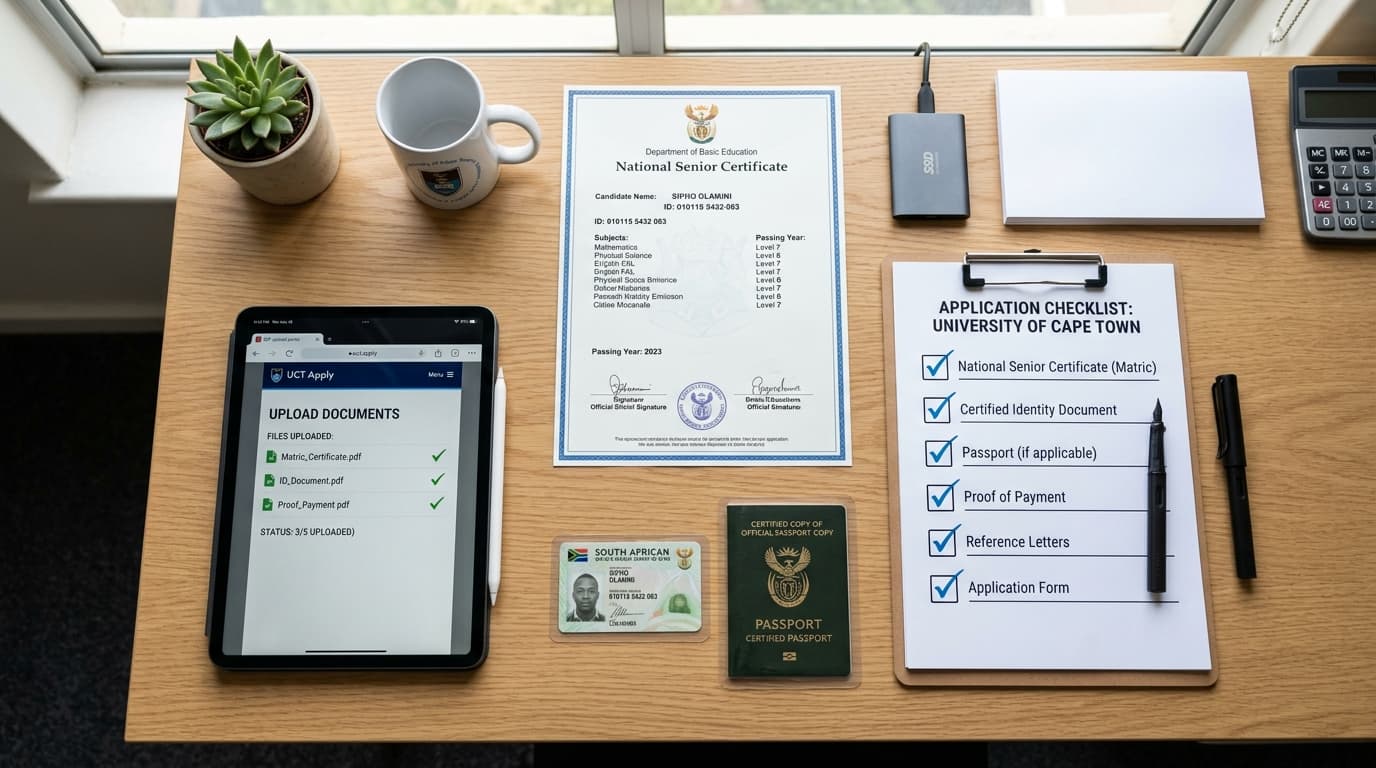
The release of the National Senior Certificate (NSC) examination results every January is a day of profound emotional intensity across South Africa. For thousands of matriculants, tears of joy celebrate the coveted "Bachelor's Degree endorsement" stamped on their statement of symbols. But for tens of thousands of others, the paper brings an overwhelming wave of heartbreak: a Diploma pass, a Higher Certificate pass, or an Admission Point Score (APS) hovering below the competitive cutoffs demanded by residential universities.
If you find yourself in this position, you may feel as though the doors to higher education, professional dignity, and your dream career—such as becoming a qualified, SACE-registered teacher—have slammed shut.
Here is the vital truth that every South African student needs to hear: Your matric results are a snapshot of a single examination period; they do not define your intellectual ceiling or your ultimate career destination.
Through the University of South Africa (UNISA), alternative entry pipelines and accredited bridging frameworks exist specifically to provide second chances. You can strategically apply at UNISA with low APS scores, leverage the Higher Education Qualifications Sub-Framework (HEQSF) ladder, accumulate accredited university credits, and articulate directly into full Bachelor's degree programs. This detailed blueprint unpacks exactly how to construct your academic bridge from matric disappointment to university graduation.
1. Understanding the South African Qualifications Ladder (HEQSF)
To navigate your route around a low matric score, you must understand how academic qualifications interconnect in South Africa. The Higher Education Qualifications Sub-Framework (HEQSF) organizes tertiary education into standardized levels of increasing complexity and cognitive rigor:
graph TD
    A[NQF Level 4: National Senior Certificate / Matric] -->|Low APS / Diploma Pass| B[NQF Level 5: Higher Certificate - 1 Year / 120 Credits]
    B -->|Achieve 50%-60% Average & Credit Exemption| C[NQF Level 7: Bachelor of Education / Bachelor's Degree]
    A -->|Bachelor Pass With High APS| C
    C -->|Graduation| D[NQF Level 7/8: SACE Full Registration & Professional Educator]
    B -->|Alternative Pathway| E[NQF Level 6: National Diploma - 3 Years]
    E -->|Advanced Diploma Articulation| C
- NQF Level 4: National Senior Certificate (NSC) or Senior Certificate (Matric).
- NQF Level 5: Higher Certificate (1 year full-time equivalent / 120 credits). This is the critical academic bridge.
- NQF Level 6: Diploma / Advanced Certificate (240 to 360 credits).
- NQF Level 7: Bachelor's Degree (e.g., Bachelor of Education, Bachelor of Arts, Bachelor of Commerce) or Advanced Diploma (360 to 480 credits).
- NQF Level 8: Honours Degree, Postgraduate Diploma, or BEd Honours.
The foundational principle of the HEQSF is vertical articulation: earning a qualification at one NQF level legally qualifies you to apply for admission to the subsequent NQF level, provided you satisfy the receiving institution's academic performance benchmarks. Therefore, even if your matric certificate did not grant you direct entry into an NQF Level 7 Bachelor's degree, completing an accredited NQF Level 5 qualification unlocks the degree gateway.
2. The UNISA Higher Certificate: Your Premier Academic Springboard
When prospective students ask, "Can I apply at UNISA if I only got a Higher Certificate or Diploma pass in matric?", the definitive answer is yes.
UNISA offers a comprehensive suite of Higher Certificates specifically designed to serve as foundational bridging pathways. Rather than forcing you to spend years repeating high school subjects, a Higher Certificate immerses you directly in tertiary-level coursework, teaching you academic literacy, digital research skills, basic subject theory, and independent study habits.
Key Advantages of the Higher Certificate Route
- Accessible Entry Thresholds: While degrees require an APS of 23 to 30 points with a Bachelor's endorsement, many UNISA Higher Certificates require an APS as accessible as 15 to 18 points, with a standard Senior Certificate or NSC pass.
- Credit Accumulation and Exemption (CAT): When you pass modules in your Higher Certificate, several of those credits (such as Academic Literacy, Computer Literacy, or introductory language modules) can be formally credited toward your subsequent Bachelor's degree, reducing your future degree study load.
- Overcoming Life Orientation Exclusions: While UNISA excludes Life Orientation when computing your APS for degree entry, your foundational subjects are what count toward Higher Certificate placement.
- Demonstrated University Competence: Admissions boards often place greater statistical weight on a candidate who has proven they can pass first-year university examinations than on high school marks achieved years earlier.
3. Top Higher Certificates for Aspiring Teachers and Professionals
If your long-term dream is to apply at UNISA for teaching (such as the Bachelor of Education in Foundation Phase, Intermediate Phase, or Senior and FET Phase), specific Higher Certificates offer the smoothest articulation bridges:
1. Higher Certificate in Education (Qualification Code: 08362)
- NQF Level: 5 (120 Credits)
- Minimum Entrance Criteria: A National Senior Certificate (NSC) with at least 30% in the language of teaching and learning, with an APS of 15 to 18 points.
- Curriculum Focus: Introduces learners to South African schooling contexts, the psychology of childhood learning, basic inclusive education, foundational language teaching strategies, and digital technology in the classroom.
- Articulation Target: Designed specifically for direct articulation into the Bachelor of Education (BEd). Students who complete this certificate with a solid grade average (typically 50% to 60%) can apply directly for BEd admission without needing a matric Bachelor endorsement.
2. Higher Certificate in Adult Basic Education and Training (ABET)
- NQF Level: 5 (120 Credits)
- Minimum Entrance Criteria: NSC with language proficiency.
- Curriculum Focus: Community education, literacy training for adult learners, workplace learning facilitation, and foundational pedagogical communication.
- Articulation Target: Articulates effectively into community development qualifications, educational management streams, and secondary school humanities education tracks.
3. Higher Certificate in Archives and Records Management / Humanities
- NQF Level: 5 (120 Credits)
- Curriculum Focus: Historical record-keeping, societal structures, critical reading, and essay composition.
- Articulation Target: Excellent stepping stone for students aiming to transition into a Bachelor of Arts in Education specializing in History, Social Sciences, or English.
4. Higher Certificate in Economic and Management Sciences
- NQF Level: 5 (120 Credits)
- Curriculum Focus: Basic accounting principles, business economics, and commercial mathematics.
- Articulation Target: The ideal bridge for candidates wanting to enter the BEd Senior/FET Phase specializing in EMS, Business Studies, and Accounting, but whose high school commercial marks were insufficient for direct degree placement.
Study Guide Creator
Transform your notes into structured study guides for learners.
4. The Articulation Formula: How to Transition into a Bachelor's Degree
Enrolling in a Higher Certificate is phase one; successfully articulating into your target Bachelor's degree is phase two. You must be proactive and perform diligently to turn this stepping stone into full degree admission.
+-------------------------------------------------------------------------------+
|  THE 4-STEP HIGHER CERTIFICATE TO DEGREE TRANSITION ROADMAP                   |
+-------------------------------------------------------------------------------+
|  1. ADMISSION:                                                                |
|     Apply at UNISA for the Higher Certificate in Education during the         |
|     annual August - October window. Secure offer & register modules.          |
+-------------------------------------------------------------------------------+
|  2. ACADEMIC EXECUTION:                                                       |
|     Complete all 10 modules (120 credits) within 1 to 2 years. Maintain an    |
|     average mark above 55% - 60% across your coursework.                      |
+-------------------------------------------------------------------------------+
|  3. ADVANCED APPLICATION:                                                     |
|     During the August application window of your final certificate semester,  |
|     apply at UNISA for the Bachelor of Education (BEd).                       |
+-------------------------------------------------------------------------------+
|  4. CREDIT EXEMPTION (CAT):                                                   |
|     Upon BEd admission, apply for formal module exemptions for overlapping    |
|     curriculum credits passed during your Higher Certificate.                 |
+-------------------------------------------------------------------------------+
Institutional Articulation Rules to Remember
- The Minimum Average Rule: While 50% is a pass at university, competitive degrees with high enrollment pressure (such as BEd Foundation Phase) often rank Higher Certificate graduates by academic performance. Aiming for an overall average of 60% or higher across your Higher Certificate modules significantly increases your chances of seamless degree admission.
- Subject-Specific Bottlenecks: A Higher Certificate bridges the general Bachelor's degree endorsement gap, but it does not magically waive specific technical prerequisite requirements for certain subjects. For example, if you wish to teach FET Physical Sciences, you must still prove competent mathematical and physical science mastery. For languages, humanities, and early childhood phases, the Higher Certificate bridge is almost universally accommodating.
5. Strategic Comparison: Matric Rewrites vs. UNISA Higher Certificate
When facing low matric scores, students often debate: "Should I rewrite my matric subjects through the Second Chance Matric Programme, or should I apply at UNISA for a Higher Certificate?"
Both pathways are valid, but they serve distinct student situations:
| Evaluation Criteria | Route A: Second Chance Matric Rewrite | Route B: UNISA Higher Certificate Bridge |
|---|---|---|
| Academic Level | High school level content (NQF Level 4) | Tertiary university level content (NQF Level 5) |
| Qualifications Earned | An updated Statement of Results / NSC | A formal, accredited tertiary certificate (120 credits) |
| Time Investment | 6 to 12 months studying high school textbooks | 12 months completing university modules |
| Credit Transferability | Zero university credits earned | 2 to 4 modules can often be credited toward your degree |
| Best Suited For | Students with a single failed subject or needing to jump from Maths Lit to Pure Maths | Students with a Diploma pass who want immediate tertiary momentum |
| Financial Cost | Free or low-cost through public centers | Subsidized tertiary tuition fees (NSFAS eligible) |
The Hybrid Strategy
In many cases, the most resilient students combine both strategies: they enroll in an online Higher Certificate while simultaneously registering to rewrite one specific high school subject (such as Mathematics or English Home Language) during the June mid-year matric examination series. This double-barreled approach guarantees that your academic profile strengthens on both the secondary and tertiary fronts simultaneously.
6. Mature Age Exemption and Recognition of Prior Learning (RPL)
If you completed high school years ago and are now a working adult seeking to apply at UNISA to become a teacher or obtain an undergraduate degree, standard matric rules may no longer be the primary barrier holding you back. South African higher education legislation provides statutory pathways for mature learners:
1. Mature Age Exemption (USAf)
Under the joint regulations of Universities South Africa (USAf) and the Matriculation Board, applicants who do not hold a standard Bachelor's endorsement can qualify for statutory exemption based on age and life experience:
- Age 23 and Older: Candidates aged 23 and above who hold a Senior Certificate with passes in three subjects at Higher Grade or four subjects at Standard Grade can apply for conditional age exemption.
- Age 45 and Older: Candidates who have reached 45 years of age can apply for complete mature age exemption to enter degree studies, irrespective of their formal secondary school certificate results, subject to passing foundational institutional placement assessments.
2. Recognition of Prior Learning (RPL)
UNISA maintains an active Recognition of Prior Learning (RPL) policy. If you have spent five, ten, or fifteen years working as an uncertified teacher assistant, early childhood development (ECD) center facilitator, corporate trainer, or administrative officer:
- You can submit a comprehensive Portfolio of Evidence (PoE) documenting your practical knowledge, curriculum delivery experience, and professional training.
- An academic assessment panel reviews your portfolio against the learning outcomes of specific degree modules.
- RPL can grant you direct access to an advanced qualification or award formal module credits, cutting down your required time to graduation.
7. A Step-by-Step Strategic Roadmap for Low-APS Candidates
If you are ready to take action and apply at UNISA, follow this tactical roadmap:
- Calculate Your Realistic APS: Be ruthlessly honest with your numbers. Exclude Life Orientation and determine whether your total falls between 15 and 20 points.
- Identify Your Ultimate Goal and Your Bridge:
- Ultimate Goal: Bachelor of Education in Intermediate Phase Teaching (BEd).
- Stepping Stone Bridge: Higher Certificate in Education (08362).
- Submit Your Application During the Annual Window:
- First Choice: Your dream degree (in case departmental enrollment capacity accommodates you).
- Second Choice: Your chosen Higher Certificate.
- Dedicate Your Year to Academic Excellence:
- Once admitted to the Higher Certificate, treat every assignment, online quiz, and exam with professional rigor.
- Secure distinctions or high passes (65%+) in your academic literacy and foundational education modules.
- Reapply for Your Degree During the Next Cycle:
- In the second semester of your Higher Certificate, apply for your Bachelor's degree for the following academic year, citing your current university student number and academic record.
- Apply for Credit Exemptions:
- Once admitted to your degree, submit a formal Credit Transfer and Exemption application to the registrar, shortening your journey to graduation.
8. Conclusion: The Power of Academic Resilience
In the story of personal and professional success, where you start is vastly less important than how persistently you keep moving forward. Many of South Africa’s most distinguished educators, school principals, curriculum advisors, and academic researchers began their tertiary journeys without a Bachelor's pass. They faced the sting of matric disappointment, chose not to succumb to despair, and utilized the Higher Certificate bridge to build their dreams module by module.
UNISA exists precisely to make that transformation possible. By choosing to apply at UNISA with low APS marks through accredited alternative pathways, you are refusing to let an old examination score dictate your future. Embrace the bridge, dedicate yourself to the process, and take the first decisive step toward your degree today. Your classroom and your future students are waiting for you.
Andile. M
Dedicated to empowering South African teachers through modern AI strategies, research-backed pedagogy, and policy insights.